
Free Commercial Invoice Generator
Create a legally compliant export invoice that clears customs faster. Includes mandatory fields for HS Codes, Incoterms®, and Origin.
Works with DHL, FedEx, UPS & all carriers. Instant PDF.
What is a Commercial Invoice?
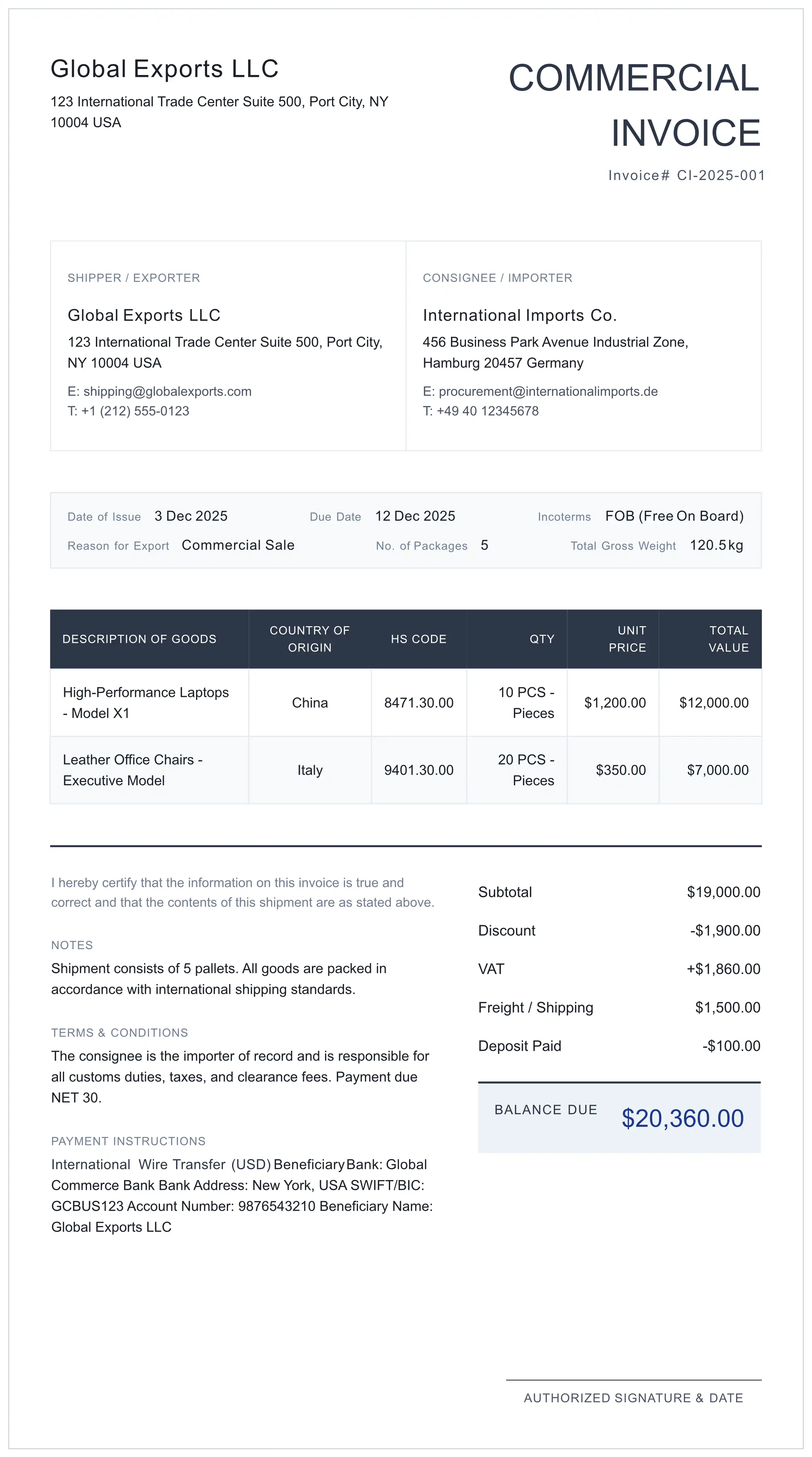
A commercial invoice is the primary customs document required for all international shipments. It declares the goods being exported, their monetary value, and the terms of sale between exporter and importer. Customs authorities use it to calculate import duties, verify declared values, and enforce trade regulations. Unlike a standard sales invoice, a commercial invoice must include HS Codes, Country of Origin, and Incoterms to clear customs.
Use the generator below to create yours in minutes, or read our full guide.
Secure Session: Data is processed for PDF generation and immediately purged.
Why Exporters Trust This Tool in 2026
Customs authorities have tightened regulations. Standard Excel templates often lack the required data fields, causing shipment holds.
HS Code Compliance
Mandatory for all international shipments. We provide a specific column for the Harmonized System codes to prevent misclassification penalties.
Incoterms® Ready
Clarify liability instantly. Define whether you ship FOB, CIF, or DDP to protect your business from unexpected logistics costs.
Clean PDF Formatting
No more broken Excel layouts. Our system generates a professional PDF that prints perfectly on A4 or Letter paper for the shipping pouch.
Commercial Invoice vs. Other Trade Documents
A commercial invoice is legally distinct from other shipping documents. It serves as the official declaration of goods, their value, and the sale terms between the exporter (seller) and importer (buyer) -- making it the foundation of all customs paperwork.
While a proforma invoice is used before shipment for quotes and import permits, the commercial invoice is the binding post-shipment document that customs authorities use to assess duties, verify declared values, and enforce trade compliance.
Need pre-shipment documentation? Use our Proforma Invoice Generator. For a deeper dive, see our Complete Guide to Commercial Invoices.
How to Create a Commercial Invoice
Follow these steps to create a customs-compliant commercial invoice for international shipments.
- 1 Enter Exporter (Shipper) Details
Add your company name, full address, phone, email, and tax/VAT registration number if applicable.
- 2 Add Consignee (Importer) Information
Include the buyer's company name, delivery address, and contact details. This must match the shipping label exactly.
- 3 List Products with HS Codes
Add detailed descriptions, quantities, unit prices, 6-digit HS codes, and country of origin for each item.
- 4 Select Incoterms (Delivery Terms)
Choose the appropriate Incoterms® 2020 rule (FOB, CIF, DAP, DDP) that defines shipping responsibilities.
- 5 Add Shipment Details
Specify the number of packages, total weight, and reason for export (commercial sale, sample, etc.).
- 6 Include Payment Terms
Add payment method details including bank name, SWIFT/BIC code, and account number for wire transfers.
- 7 Download Your PDF
Generate and download your customs-ready commercial invoice. Print 3 copies: one for customs, one for the carrier, one for your records.
3 Reasons Commercial Invoices Get Rejected
A rejected invoice means your goods sit in a bonded warehouse while storage fees pile up. Based on industry experience, here are the top errors to avoid using our tool:
Customs hates "Parts". Use specific terms like "Steel Ball Bearings for Automotive Use".
Even if shipped from the US, if it was made in China, the invoice must say "China". This affects tariffs.
The unit price on the invoice must match the Purchase Order and Packing List exactly.
Verify your data with official sources:
Letter of Credit (L/C) Ready Invoices
When your shipment is backed by a Letter of Credit, every detail must match the bank's requirements exactly.
Critical L/C Fields
- Beneficiary name matching exactly
- Description of goods word-for-word
- Unit prices and totals
- Shipping marks and numbers
Common L/C Rejection Reasons
- Spelling variations in company names
- Missing "on board" notation reference
- Partial shipment not allowed discrepancies
- Late presentation after expiry date
Pro Tip: For L/C shipments, always have your bank's trade finance officer review the commercial invoice before submission. Minor discrepancies can cause payment delays of 30+ days.
Commercial Invoice Requirements by Region
Different customs authorities have specific documentation requirements. Our generator supports them all.
United States (CBP)
U.S. Customs and Border Protection requires HS codes, country of origin, and accurate value declarations for all commercial imports exceeding $2,500. Exporters must file through the Automated Export System (AES) for shipments over $2,500 or requiring a license.
European Union (TAXUD)
EU customs requires EORI numbers for businesses, proper Incoterms classification, and the Single Administrative Document (SAD) for customs declarations. EUR.1 certificates may be required for preferential tariff treatment under trade agreements.
Asia-Pacific (China, Japan, India)
China requires CIQ inspection certificates for certain goods and 10-digit HS codes for customs clearance. Japan mandates detailed product descriptions in both English and Japanese for faster processing. India requires IEC (Importer Exporter Code) on all commercial invoices and specific GST compliance documentation.
Frequently Asked Questions
Is this Commercial Invoice valid for 2026 customs regulations?
Yes. Our template is updated to reflect the latest international trade standards for 2026, including fields for the 6-digit HS Code, Country of Origin, and Incoterms® 2020 rules mandated by most customs authorities globally.
How is my data handled during PDF generation?
Security is our priority. Your invoice data is transmitted via 256-bit TLS encryption to our secure server. The PDF is created instantly using an ephemeral process, and all data is permanently deleted from memory immediately after the download completes. We do not store, archive, or share your trade secrets.
Why is the HS Code (Harmonized System) mandatory?
Customs officers use the HS Code to determine duties and taxes. A missing or incorrect code is the #1 reason for shipment delays in 2026. This tool provides a dedicated field to ensure you don't miss this critical requirement.
Can I use this for Letter of Credit (L/C) shipments?
While this tool generates a standard commercial invoice, Letter of Credit shipments often require very specific wording matching the bank's credit terms exactly. We recommend using this tool for the draft and having it reviewed by your bank's trade finance officer before final submission.
What is the difference between a Commercial Invoice and a Proforma Invoice?
A Commercial Invoice is a legally binding document used for customs clearance and payment after goods are shipped. A Proforma Invoice is a preliminary estimate used for quotes, Letter of Credit applications, and import permits before shipment. Use our Proforma Invoice Generator for pre-shipment documentation.
Do I need a Commercial Invoice for shipping within the EU?
For intra-EU shipments between member states, a Commercial Invoice is not required for customs clearance. However, you still need it for VAT documentation and accounting purposes. For exports outside the EU to third countries, a Commercial Invoice is mandatory for customs.
What are the most common HS Code mistakes that delay shipments?
The top HS Code errors are: (1) Using outdated codes from previous years, (2) Selecting a 4-digit code instead of the required 6-digit minimum, (3) Misclassifying composite goods by dominant material, (4) Ignoring country-specific tariff extensions beyond 6 digits, and (5) Copy-pasting codes without verifying against the current WCO database. Always verify your HS codes with your national customs authority before shipping.
Do I need special documentation for shipping wildlife products internationally?
Yes. If you're exporting products derived from CITES-listed species (certain woods, leather, plants, or animal products), you need a CITES permit in addition to the commercial invoice. Our tool includes a notes field where you can reference your CITES permit number. Always check with your country's wildlife authority before shipping.
Ready to Create Your Commercial Invoice?
100% free. No signup required. Download your customs-ready PDF instantly.
Create Free Commercial Invoice