
Net 0, due on receipt and immediate payment
These three phrases are close but not identical. Read literally:
- Net 0: zero days after the invoice date, so payment is due on the invoice date.
- Due on receipt (or "due upon receipt"): payment is due when the customer receives the invoice, which may be a day or more after the invoice date if it travels by post.
- Immediate payment: payment is expected at once, with no credit period. It says nothing about which day counts, so it is the least precise of the three.
Because the receipt date is not printed on the invoice, write the date itself: "Payment due on receipt, and no later than [date]". That removes any argument about when the invoice arrived.
Wording lines
- "Terms: Net 0. Payment is due on the invoice date, [date]."
- "Terms: Due on receipt. Please pay by [date]."
- "Payment is due immediately. Please pay by [date] to [payment details]."
Net 14 and Net 28
Net 14 means the full amount is due 14 calendar days after the invoice date; Net 28 means 28 days. Both are whole numbers of weeks, so the due date always falls on the same weekday as the invoice date: an invoice dated Thursday, 5 Mar 2026 is due on Thursday, 19 Mar 2026 under Net 14 and on Thursday, 2 Apr 2026 under Net 28.
- Net 14 wording: "Payment is due within 14 days of the invoice date, by [date]." Net 14 calculator and dates
- Net 28 wording: "Payment is due within 28 days of the invoice date, by [date]." Net 28 calculator and dates
What the law says about payment periods
Most payment periods are simply what the buyer and seller agree. The law steps in with a default payment period, or time frame, where nothing was agreed, and in some places with a ceiling on what may be agreed. One point matters when you compare them: the statutory clocks below mostly run from receipt of the invoice, delivery or completion of the work, while "Net N" on an invoice counts from the invoice date. Your contract decides which start date applies to your invoice. If you are new to invoicing, start with our guide on how to create an invoice.
United Kingdom
- When payment is late if no payment date was agreed (business to business)
-
“If you do not agree a payment date, the law says the payment is late 30 days after either: the customer gets the invoice; you deliver the goods or provide the service (if this is later)”
Counts: from receipt of the invoice or delivery of the goods or service, whichever is later, not from the invoice date
GOV.UK, Late commercial payments: charging interest and debt recovery · Source: GOV.UK · verified 25 Sep 2026 - No payment date agreed: the default
-
“Unless you agree a payment date, the customer must pay you within 30 days of getting your invoice or the goods or service.”
GOV.UK, Invoicing and taking payment from customers: Payment obligations · Source: GOV.UK · verified 25 Sep 2026 - Agreed payment periods: 30 days for public authorities, 60 days for business transactions
-
“If you agree a payment date, it must usually be within 30 days for public authorities or 60 days for business transactions. You can agree a longer period than 60 days for business transactions - but it must be fair to both businesses.”
GOV.UK, Late commercial payments: charging interest and debt recovery · Source: GOV.UK · verified 25 Sep 2026 - Statutory interest on late business payments
-
“The interest you can charge if another business is late paying for goods or a service is 'statutory interest' - this is 8% plus the Bank of England base rate for business to business transactions. You cannot claim statutory interest if there's a different rate of interest in a contract.”
GOV.UK, Late commercial payments: charging interest and debt recovery · Source: GOV.UK · verified 25 Sep 2026 - Fixed sum for recovery costs
-
“(a) for a debt less than £1000, the sum of £40; (b) for a debt of £1000 or more, but less than £10,000, the sum of £70; (c) for a debt of £10,000 or more, the sum of £100.”
Late Payment of Commercial Debts (Interest) Act 1998, s.5A(2) · Source: legislation.gov.uk · verified 25 Sep 2026
European Union
- Business to business: when no payment date or period is fixed in the contract
-
“where the date or period for payment is not fixed in the contract, that the creditor is entitled to interest for late payment upon the expiry of any of the following time limits: (i) 30 calendar days following the date of receipt by the debtor of the invoice or an equivalent request for payment;”
Counts: from receipt of the invoice, not from the invoice date
A directive binds EU Member States; businesses apply each country's national law that implements it.
Directive 2011/7/EU, Art. 3(3)(b)(i) · Source: EUR-Lex · verified 25 Sep 2026 - Business to business: agreed payment periods over 60 days
-
“Member States shall ensure that the period for payment fixed in the contract does not exceed 60 calendar days, unless otherwise expressly agreed in the contract and provided it is not grossly unfair to the creditor within the meaning of Article 7.”
Directive 2011/7/EU, Art. 3(5) · Source: EUR-Lex · verified 25 Sep 2026 - Public authorities as the payer: the 30-day period
-
“the period for payment does not exceed any of the following time limits: (i) 30 calendar days following the date of receipt by the debtor of the invoice or an equivalent request for payment;”
Counts: from receipt of the invoice, not from the invoice date
Directive 2011/7/EU, Art. 4(3)(a)(i) · Source: EUR-Lex · verified 25 Sep 2026 - Public authorities as the payer: longer agreed periods
-
“Member States shall ensure that the period for payment fixed in the contract does not exceed the time limits provided for in paragraph 3, unless otherwise expressly agreed in the contract and provided it is objectively justified in the light of the particular nature or features of the contract, and that it in any event does not exceed 60 calendar days.”
Directive 2011/7/EU, Art. 4(6) · Source: EUR-Lex · verified 25 Sep 2026 - Fixed compensation for recovery costs
-
“Member States shall ensure that, where interest for late payment becomes payable in commercial transactions in accordance with Article 3 or 4, the creditor is entitled to obtain from the debtor, as a minimum, a fixed sum of EUR 40.”
Directive 2011/7/EU, Art. 6(1) · Source: EUR-Lex · verified 25 Sep 2026 - How periods in EU legal acts are counted (not a rule for invoice Net terms)
-
“The periods concerned shall include public holidays, Sundays and Saturdays, save where these are expressly excepted or where the periods are expressed in working days. 4. Where the last day of a period expressed otherwise than in hours is a public holiday, Sunday or Saturday, the period shall end with the expiry of the last hour of the following working day.”
Applies to periods in acts of the Council or Commission, not to the due date a contract or invoice sets.
Regulation (EEC, Euratom) No 1182/71, Art. 3(3) and 3(4) · Source: EUR-Lex · verified 25 Sep 2026
United States (federal agencies)
- Federal Prompt Payment rules: when the payment period starts
-
“The period available to an agency to make timely payment of an invoice without incurring an interest penalty shall begin on the date of receipt of a proper invoice”
Counts: from receipt of a proper invoice, not from the invoice date
5 CFR 1315.4(f) · Source: eCFR · verified 25 Sep 2026 - Federal Prompt Payment rules: the 30-day due date when the contract sets none
-
“30 days after the start of the payment period as specified in paragraph (f) of this section, if not specified in the contract, if discounts are not taken, and if accelerated payment methods are not used.”
5 CFR 1315.4(g)(1)(iv) · Source: eCFR · verified 25 Sep 2026 - Federal Prompt Payment rules: due dates on a weekend or federal holiday
-
“Payments falling due on a weekend or federal holiday may be made on the following business day without incurring late payment interest penalties.”
5 CFR 1315.4(h) · Source: eCFR · verified 25 Sep 2026 - Prompt Payment interest rate (changes every six months)
-
“The Prompt Payment interest rate for July 1– December 31, 2026 is 4.75%.”
Bureau of the Fiscal Service, Prompt Payment rates · Source: fiscal.treasury.gov · verified 25 Sep 2026
United States (private sales of goods)
- Sale of goods with no payment terms agreed (UCC § 2-310(a))
-
“Unless otherwise agreed: (a) Payment is due at the time and place at which the buyer is to receive the goods even though the place of shipment is the place of delivery;”
Article 2 of the UCC covers sales of goods; it sets no day count. Outside rules like this, the payment term is what your contract says.
Cal. Com. Code § 2310(a), California's enactment of UCC § 2-310(a) · Source: California Legislative Information · verified 25 Sep 2026
California
- Freelance Worker Protection Act (SB 988): when a freelance worker must be paid
-
“(a) Except as otherwise provided by law, a hiring party shall pay a freelance worker the compensation specified by a contract for professional services: (1) On or before the date compensation is due pursuant to the contract. (2) If the contract does not specify when the hiring party shall pay, no later than 30 days after the completion of the freelance worker’s services under the contract.”
Counts: from completion of the services when the contract sets no date
Cal. Bus. & Prof. Code § 18102(a) · Source: California Legislative Information · verified 25 Sep 2026 - Freelance Worker Protection Act (SB 988): who is covered and from when
-
“This part applies only to contracts entered into or renewed on or after January 1, 2025.”
§ 18101(a) covers a freelance worker hired "to provide professional services in exchange for an amount equal to or greater than two hundred and fifty dollars ($250), either by itself or when aggregated with all contracts for services between the same hiring party and independent contractor during the immediately preceding 120 days."
Cal. Bus. & Prof. Code § 18107 · Source: California Legislative Information · verified 25 Sep 2026
California (state agencies)
- California state agencies: 45 calendar days from receipt of an undisputed invoice
-
“Except as otherwise provided in this chapter, to avoid late payment penalties, the maximum time from state agency receipt of an undisputed invoice to the date of payment is 45 calendar days. If payment is not issued within 45 calendar days from the state agency receipt of an undisputed invoice, late payment penalties shall be paid to the claimant in accordance with Sections 927.6 and 927.7.”
Counts: from the state agency's receipt of an undisputed invoice, not from the invoice date
California state agencies only (Government Code, Chapter 4.5, Prompt Payment of Claims); not private buyers.
Cal. Gov. Code § 927.4 · Source: California Legislative Information · verified 25 Sep 2026
France
- Code de commerce L441-10: maximum agreed payment period
-
“Le délai convenu entre les parties pour régler les sommes dues ne peut dépasser soixante jours après la date d'émission de la facture.”
Translation: The period agreed between the parties to pay the sums due may not exceed sixty days after the date the invoice is issued.
Code de commerce, art. L441-10 (version in force from 26 April 2019 to 1 January 2027; the version from 1 January 2027 keeps this sentence) · Source: Légifrance · verified 25 Sep 2026 - Code de commerce L441-10: 45 days end of month by derogation
-
“Par dérogation, un délai maximal de quarante-cinq jours fin de mois après la date d'émission de la facture peut être convenu entre les parties, sous réserve que ce délai soit expressément stipulé par contrat et qu'il ne constitue pas un abus manifeste à l'égard du créancier.”
Translation: By derogation, a maximum period of forty-five days end of month after the date the invoice is issued may be agreed between the parties, provided that this period is expressly stipulated in the contract and is not a manifest abuse towards the creditor.
Code de commerce, art. L441-10 (version in force from 26 April 2019 to 1 January 2027; the version from 1 January 2027 keeps the same periods) · Source: Légifrance · verified 25 Sep 2026
France (ministerial guidance)
- Two ways to count "45 jours fin de mois"
-
“Le mode de computation du délai de 45 jours fin de mois n'est pas imposé par la loi. Les opérateurs ont ainsi la liberté de le calculer de deux manières : soit en ajoutant 45 jours à la fin du mois d'émission de la facture, soit en ajoutant 45 jours à la date d'émission puis en allant jusqu'à la fin du mois. Le mode de calcul retenu doit toutefois être convenu au préalable entre les partenaires commerciaux afin d'éviter toute ambiguïté.”
Translation: The law does not impose a way of counting the 45 days end of month period. Businesses are therefore free to calculate it in two ways: either by adding 45 days to the end of the month in which the invoice is issued, or by adding 45 days to the date of issue and then going to the end of that month. The method chosen must, however, be agreed in advance between the trading partners to avoid any ambiguity.
A ministerial answer, not a statute, and it covers only 45 days end of month under French law.
Assemblée nationale, written answer to question no. 63277 (14th legislature), JO 6 October 2015, p. 7590 · Source: Assemblée nationale · verified 25 Sep 2026
What you may charge once a payment is late: the late fee calculator has a page for each US state with the statute quoted, and the maximum late fee by state compares the caps.
Not legal advice. The quotes above are the rules as published on the official sources linked; they do not cover every exception. Check the full text, or ask a lawyer, for your own contract.
Payment terms wording examples (copy-paste)
One line per term. Replace the brackets and always print the date next to the term. Each term's page has more wording and a table of dates.
| Term | Wording |
|---|---|
| Net 0 | "Payment is due on the invoice date, [date]." |
| Due on receipt | "Payment is due on receipt of this invoice, and no later than [date]." |
| Net 10 | "Payment is due within 10 days of the invoice date, by [date]." |
| Net 15 | "Payment is due within 15 days of the invoice date, by [date]." |
| Net 30 | "Payment is due within 30 days of the invoice date, by [date]." Full Net 30 wording: Net 30 page. |
| Net 45 | "Payment is due within 45 days of the invoice date, by [date]." |
| Net 60 | "Payment is due within 60 days of the invoice date, by [date]." |
| 30 days EOM | "Payment is due 30 days after the end of the month in which this invoice is dated, by [date]." |
| Net 10 EOM / 10th prox | "Payment is due on the 10th of the month following the invoice date, [date]." |
| 2/10 Net 30 | "2% discount if paid within 10 days of the invoice date (by [date]); otherwise the full amount is due within 30 days (by [date])." |
| PIA | "Payment in full is required before work begins / before the goods are shipped." |
| COD | "Payment is due on delivery." |
A four-line invoice payment policy
Drafting text to adapt; put it in your terms and conditions and at the foot of the invoice.
- Payment methods: "We accept [bank transfer / card / other methods]. Bank details: [details]."
- Due date: "Each invoice states its due date. Payment in full is due by that date."
- Late payment: "[Your late payment clause: see the examples below.]"
- Billing questions: "Please raise any question about an invoice with [name / email] within [number] days of the invoice date, quoting the invoice number."
Late payment terms: clause examples for invoices
Copy-ready clauses with placeholders only: fill in a rate or amount that your contract supports and that the law governing it allows. The maximum late fee by state and the state pages of the late fee calculator quote each US statute.
- Annual interest: "Amounts not paid by the due date bear interest at [rate]% per year from the due date until paid."
- Monthly rate with a cap: "Overdue balances are charged [x]% per month, not above the maximum allowed in [state]."
- Flat fee: "A late fee of [amount] applies to any invoice not paid by the due date."
- One-time percentage: "A one-time late charge of [x]% of the overdue amount applies to payments received after the due date."
- Grace period: "If payment is not received within [number] days after the due date, a late fee of [amount / x% of the overdue amount] will be added."
UK and EU invoices: the law already gives business creditors statutory interest and fixed compensation on late payments, and a contract rate can replace statutory interest. A plain reference is enough, for example "Late payments may attract statutory interest and compensation under the Late Payment of Commercial Debts (Interest) Act 1998" (UK) or "Late payments attract interest and compensation as provided by the law applicable to this contract" (EU). The rates and amounts are quoted in what the law says about payment periods.
Where payment terms go on the invoice
Put the term and the explicit due date where the customer's accounts payable team looks first: next to the invoice number and invoice date at the top, and again next to the total. Put the full clauses (late payment, discount, payment methods) in the terms area at the foot of the invoice.
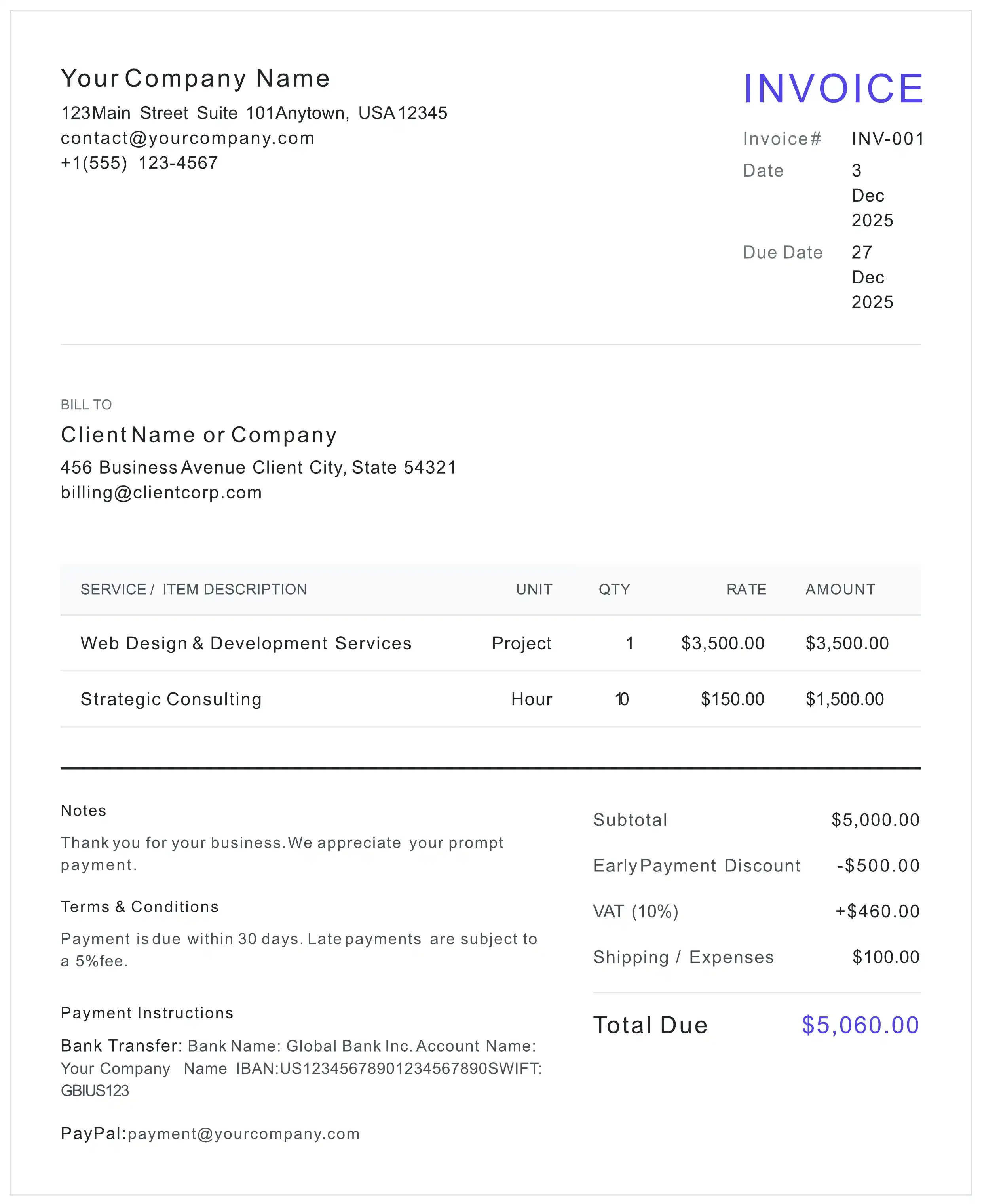
The Master Glossary: Domestic & Commercial Codes
Short codes set expectations for Accounts Payable (AP) departments at a glance. More invoicing terms, such as net amount, amount due, maturity and E&OE, are defined in the invoice glossary.
Net 7 / 10 / 15 / 30 / 45 / 60
Definition: Payment is due the specified number of calendar days (not business days) after the invoice date.
Dates: invoice due date calculator
Due Upon Receipt
Definition: Payment is due when the customer receives the invoice. Print a date as well, because the receipt date is not on the invoice.
More: Net 0 vs due on receipt
PIA / CIA (Payment or Cash in Advance)
Definition: The full amount is paid before the work starts or the goods are shipped.
Often used for: first-time clients and custom work.
COD (Cash on Delivery)
Definition: Payment is due when the goods are delivered.
EOM (End of Month)
Definition: With a number (for example 30 days EOM), the days are counted from the end of the invoice month. On its own, read literally, "EOM" means payment by the last day of the invoice month, but not every source reads it that way: the Cambridge Business English Dictionary defines EOM dating as payment "30 days after the last day of the month that follows". Print the due date.
More: EOM payment terms explained · 30 days EOM: meaning and due dates
21 MFI (Month Following Invoice)
Definition: Payment is due on the 21st of the month following the invoice date.
Often used for: recurring and subscription billing.
Prox
Definition: "10th prox" means the 10th of the month after the invoice month. The Cambridge Business English Dictionary lists "net 10 prox" as another name for "net 10 eom".
Dates: prox mode in the due date calculator
Payment terms for commercial and international invoices
Cross-border sales add a second question on top of the due date: how the money moves and who carries the risk until it arrives. The U.S. International Trade Administration's Trade Finance Guide lists five methods of payment:
- Cash-in-advance: "an exporter can avoid credit risk because payment is received before the ownership of the goods is transferred."
- Letters of credit: "An LC is a commitment by a bank on behalf of the buyer that payment will be made to the exporter, provided that the terms and conditions stated in the LC have been met".
- Documentary collections: "the exporter entrusts the collection of the payment for a sale to its bank (remitting bank), which sends the documents that its buyer needs to the importer's bank".
- Open account: "a sale where the goods are shipped and delivered before payment is due, which in international sales is typically in 30, 60 or 90 days."
- Consignment: "payment is sent to the exporter only after the goods have been sold by the foreign distributor to the end customer."
Source: trade.gov, Methods of Payment · verified 25 Sep 2026
- Bank details: give the details your bank quotes for incoming international transfers, such as the IBAN and the SWIFT/BIC code.
- Currency clause: state the currency and who pays bank charges, e.g. "Payment to be received in USD, net of all bank transfer fees."
- Date: print the due date itself ("Due by 30 March 2026") rather than only "Net 30".
The shipping document itself is covered in the commercial invoice guide, and you can fill one in with the commercial invoice generator. For wider cross-border rules, see our guide to international invoicing.
Financial Strategy: The "2/10 Net 30" Discount
The term "2/10 Net 30" is a trade credit discount used in B2B invoicing.
Calculation: Is it worth it?
- The Deal: Client deducts 2% if paid in 10 days. Otherwise, full amount in 30.
- The effective annual rate: giving up 2% to be paid 20 days early works out at (2 ÷ 98) × (365 ÷ 20) × 100 = 37.24% a year on a 365-day basis. Try other terms with the early payment discount calculator.
Offer it when earlier cash is worth more to you than that rate.
Calculating Net 30 Late Fees & Interest (Legally)
Charging interest on overdue Net 30 invoices must be mathematically correct and disclosed in your terms. Keep in mind that late fee limits vary by state, so always verify your rate against the statute that applies before charging it.
Which day is the first late day? Count the term from the invoice date, then take the next day: an invoice dated Saturday, 31 Jan 2026 on Net 30 is due on Monday, 2 Mar 2026, and payment is late from Tuesday, 3 Mar 2026. The EU Late Payment Directive uses the same logic for agreed terms: interest runs "from the day following the date or the end of the period for payment fixed in the contract" (Directive 2011/7/EU, Art. 3(3)(a)). Where a statute sets a later start day, the state page says so; the methods and the Texas and Virginia start rules are covered in how to calculate late fees. To see how many days past due each of your open invoices is, use the invoice aging calculator.
Simple Interest Formula (Non-Compounding)
Fee = (Invoice Total × Annual Rate) ÷ 365 × Days Late Scenario:
Total: $10,000 | Annual Rate: 18% (0.18) | Late: 15 Days
Math: ($10,000 × 0.18) ÷ 365 × 15 = $73.97
Other methods (monthly rates, flat fees, compounding): how to calculate late fees.
⚠️ Compliance Warning: Do not guess your interest rate. Usury laws in California, New York, Texas, Florida, and other states differ significantly. The consequences of charging above a cap are set by each state's usury statute — see the cited statute. See our state-by-state late fee guide below for details, and always verify with the statutory rate defined by your local government.
Invoice Late Fee Calculator
Formula: (Invoice Amount x Annual Rate) / 365 x Days Overdue
State presets and statute-linked rates: the late fee calculator and its page for each state, e.g. California or New York.
Late Fee Limits by State
What you can charge on an overdue Net 30 invoice depends on state law twice over: a default statutory rate applies when your contract never mentions interest, and a separate written-contract ceiling (or none at all) applies when it does. Five states as a preview, pulled straight from our statute-linked reference table (all states side by side: maximum late fee by state):
| State | Default rate (contract silent) | Written-contract cap (B2B) |
|---|---|---|
| California | 10% | higher of 10% or FRBSF rate +5 pts (if a 'loan or forbearance') |
| New York | 9% | 25% criminal (effective) |
| Texas | 6% | 18% for Oct 5–11, 2026 (28% statutory max) |
| Florida | Variable | 18% |
| Georgia | 7% | 16% (principal $3,000 or less) |
Every state name links to its own page — statute citation, official source link and the exact conditions — and all of them are in our late payment interest table covering all 50 states + DC. The rates come from the cited statutes, not estimates: see how we verify this data. Put your late-fee terms in the written agreement as well as on the invoice, and check the cited statute for the state whose law applies to the contract.
Important Disclaimer: This information is educational, not legal advice. Late-fee rules change and vary by industry, contract type, and transaction amount — confirm against the cited statute or a licensed attorney in your jurisdiction.
Professional Collection Scripts (Copy-Paste)
Escalation should be firm but preserve the relationship. We have expanded these scripts to cover the entire lifecycle.
📧 1. The Pre-Deadline "Nudge" (3 Days Before)
Subject: Coming up: Invoice #12345 due on [Date]
Hi [Name],
Hope you're having a great week. This is just a friendly courtesy reminder that Invoice #12345 for [Amount] is scheduled for payment this [Day of Week].
Let me know if you need another copy of the invoice.
Best regards,
📧 2. The Standard Reminder (1 Day Overdue)
Subject: Invoice #12345 is now overdue
Hi [Name],
Our records indicate we haven't received payment for Invoice #12345 yet. It was due yesterday, [Date].
If this has already been sent, please disregard. Otherwise, please remit payment today via [Link].
Thank you,
📧 3. The "Is Everything Okay?" (7 Days Overdue)
Subject: Action Required: Invoice #12345 Outstanding
Hi [Name],
We are now a week past the due date. I wanted to check if there is an issue with the invoice or the banking details provided?
Please let us know immediately so we can resolve any administrative blockers.
Regards,
📧 4. The Payment Plan Offer (15 Days - Empathy Route)
Subject: Regarding outstanding balance for Invoice #12345
Hi [Name],
We value our relationship and understand that cash flow can sometimes be tight. Since this invoice is now significantly overdue, we need to settle the balance to keep your account in good standing.
If paying the full [Amount] today is not possible, please reply to this email so we can agree on a structured payment plan.
Sincerely,
📧 5. The "Final Notice" (30+ Days - Legal Route)
Subject: FINAL NOTICE: Invoice #12345 sent to collections
Hi [Name],
This invoice is now 30 days past due. Despite multiple reminders, we have not received payment or communication.
As per our contract terms, a late fee of [Amount] has been applied. The total due is now [New Total]. If payment is not received by [Date + 3 days], we will be forced to escalate this to [Debt Collection Agency/Legal Counsel].
This is your final notice.
Sincerely,
Frequently Asked Questions (Payment Terms & Law)
How long does a customer have to pay an invoice?
As long as the payment term agreed on the invoice or in the contract allows, for example 30 days after the invoice date on Net 30. Where no term was agreed, statutory defaults apply in some places, such as the UK and the EU; they are quoted with their sources in the section on what the law says about payment periods.
Is there a time limit to send an invoice?
It depends on the tax and legal rules that apply. UK VAT-registered businesses must "normally issue a VAT invoice within 30 days of the tax point arising" (HMRC VAT Notice 700, para 16.2.3). In the EU, Article 222 of the VAT Directive 2006/112/EC requires an invoice "no later than on the fifteenth day of the month following that in which the chargeable event occurs" for intra-EU supplies of goods under Article 138 and for services where the customer pays the VAT under Article 196; for other supplies, each Member State may set its own time limit. Separately, in England and Wales "An action founded on simple contract shall not be brought after the expiration of six years from the date on which the cause of action accrued" (Limitation Act 1980, s.5), which limits how long you can sue for an unpaid debt. In the US, rules differ by state, so check your state's statute.
HMRC VAT Notice 700 · VAT Directive (EUR-Lex) · Limitation Act 1980, s.5 · Legal payment periods
Is 'Net 30' legally binding without a contract?
An invoice records the terms; whether they bind the customer depends on what the two of you agreed. Put the payment term in the contract, quote or order confirmation the customer accepts before the work starts, and repeat it on the invoice together with the explicit due date.
What is the maximum late fee I can legally charge?
It depends on your state and on whether the rate was agreed in writing. Some states cap written B2B contract rates, many impose no cap at all on written business contracts, and a separate default statutory rate applies when the contract is silent. In the UK, statutory interest is 8% plus the Bank of England base rate. Check your state's row in our statute-linked 50-state table before setting a rate.
What limits apply to an invoice?
"Limits" can mean several things, each covered on its own page: how long the customer has to pay (legal payment periods), how much you can charge when it is late (late-fee caps by state), how long you have to send the invoice (see the FAQ above), and what free invoice generators allow. Our generator is free and unmetered for normal use; an anti-abuse cap of 20 PDFs per device per day (200 per IP) applies, well above ordinary use.
Legal payment periods · Maximum late fee by state · Invoice generator limits compared
How do I denote international payment terms?
For cross-border invoices, use ISO currency codes (USD, EUR, GBP) and give the bank details your bank quotes for incoming international transfers (such as IBAN and SWIFT/BIC). Avoid 'Net 30' ambiguity by stating a specific date: 'Due by 30 March 2026'.
What does a 'Time is of the Essence' clause mean?
It is a contract clause stating that the dates in the contract, such as the payment date, are essential terms. What follows if such a date is missed depends on the rest of the contract and on the law that governs it, so have the clause drafted for your jurisdiction.
What are California's standard payment terms and late fee caps for Net 30 invoices?
For payment timing, the terms you agree apply. For freelance professional services of $250 or more, the Freelance Worker Protection Act (Bus. & Prof. Code § 18102) requires payment on the date in the contract or, if the contract sets none, no later than 30 days after the work is completed. A late-fee clause in a business contract is judged under Civil Code § 1671(b): it "is valid unless the party seeking to invalidate the provision establishes that the provision was unreasonable under the circumstances existing at the time the contract was made" (consumer contracts fall under the stricter § 1671(d)). For the interest rate side, including the constitutional limit on a 'loan or forbearance', see California's page, with the statute citation, current figures and official source link.
Do late fee limits vary by state in the United States?
Yes — significantly. In our statute-verified table of all 51 US jurisdictions, 26 impose no cap on written B2B contract rates, 12 apply conditional caps, and 13 enforce hard caps; a separate default statutory rate applies whenever the contract says nothing about interest. Look up your state's row for the exact rate, citation and official source.