
1. What a Commercial Invoice Is
The commercial invoice is the document customs authorities read to see what is arriving, who sold it to whom, and what it is worth.
Unlike an ordinary accounting invoice, it is filed with the customs entry, so its contents become part of a declaration to the importing country. In the US, 19 CFR 141.86 sets out what it must contain, and 19 CFR 141.83(c)(1) says it "shall be prepared in the manner customary in the trade".
2. Commercial vs Proforma and Other Documents
Each document has its own stage in the shipment.
| Document Class | Legal Status | Execution Time | Customs Validity |
|---|---|---|---|
| Commercial Invoice | Final Bill of Sale | At time of Export | Filed with the customs entry |
| Proforma Invoice | Preliminary Quote | Pre-shipment (Negotiation) | Not a substitute for clearance* |
| Consular Invoice | Govt. Certified | Post-production | Only where the importing country asks for one |
*In US customs rules a "pro forma invoice" means something narrower: the importer's own statement of value, which may be filed with a bond when the commercial invoice is not available at entry, the commercial invoice then being produced later (19 CFR 141.85 and 141.91). To correct a commercial invoice after the fact, see section 7.
A commercial invoice is also not the same thing as a VAT or tax invoice, although one export invoice can carry both sets of details. The differences are laid out in commercial invoice vs tax invoice.
3. Commercial Invoice Requirements
Destinations word their rules differently, but the same core data turns up again and again. The references below are the item numbers in the US list, 19 CFR 141.86(a), which is quoted in full on our US requirements page.
| Core field | What it covers | US reference |
|---|---|---|
| Seller and buyer | Who sold the goods to whom, when and where; if there was no sale, who shipped them to whom | 141.86(a)(2) |
| Port of entry | Where the goods are destined | 141.86(a)(1) |
| Description | Name each item is known by, grade or quality, marks and numbers of the packages | 141.86(a)(3) |
| Quantity | In the weights and measures of the shipping country or the US | 141.86(a)(4) |
| Price or value | Purchase price of each item in the currency of the purchase; a value even when nothing was sold | 141.86(a)(5)-(6) |
| Charges | Freight, insurance, commission, containers and packing, itemized by name and amount | 141.86(a)(8) |
| Rebates and assists | Rebates, drawbacks and bounties; tools, dies or engineering supplied for production and not in the price | 141.86(a)(9), (11) |
| Country of origin | Where the goods were made | 141.86(a)(10) |
| Contact person | A responsible employee of the exporter who knows the transaction | 141.86(j) |
HS codes
The Harmonized System (HS) code classifies each item. For a US entry it is required: the invoice or the other documents filed with the entry must carry the eight-digit HTSUS subheading (19 CFR 142.6(a)(4)), and the importer or customs broker notes the subheading and rate of duty on or with the invoice (19 CFR 141.90(b)). Elsewhere it depends on the destination and on your carrier. How many digits to use and where the code goes: HS code on a commercial invoice.
Precise goods description
Vague descriptions invite questions.
Too vague: "Machine Parts".
Specific: "Hydraulic Seal Kit for Excavator, made of vulcanized rubber".
Country of origin
Origin is where the goods were made, not where they were shipped from. US rules define it as "the country of manufacture, production, or growth of any article of foreign origin entering the United States" (19 CFR 134.1(b)). It also decides whether preferential trade agreements can apply (e.g., USMCA, EU-UK TCA).
4. Requirements by Destination
The data in section 3 is the common core. Some destinations add their own documents or wording:
- United States: the full list of invoice contents, the HTSUS subheading rule and the English-language rule (19 CFR 141.86(d)) are on our US commercial invoice requirements page.
CARICOM (example: Jamaica)
For goods moving between CARICOM members, origin is certified on a CARICOM invoice. The Jamaica Customs Agency says goods imported from CARICOM countries and certified to be of CARICOM origin "do not generally attract these import duties", and that "A CARICOM Invoice ( C23 ) certifying the country of origin of the goods is to be produced to the Customs Department". It adds: "The Invoices must be certified by the Certifying Authorities in the CARICOM country of origin of the goods." Other member states publish their own form numbers and certifying authorities, so check with the customs authority of the country you ship to.
Source: Jamaica Customs Agency, "Caricom" (jca.gov.jm), read 25 September 2026.
Shipping within CARICOM? See CARICOM invoice: the official form and how to fill it in.
5. Penalties for Errors
In the United States, 19 U.S.C. 1592 sets the maximum civil penalties for entering goods by means of a material false statement, document or omission:
| Level of culpability | Maximum civil penalty (19 U.S.C. 1592(c)) |
|---|---|
| Negligence | The lesser of the domestic value of the goods or two times the lost duties, taxes and fees (20% of dutiable value if duties were not affected) |
| Gross negligence | The lesser of the domestic value of the goods or four times the lost duties, taxes and fees (40% of dutiable value if duties were not affected) |
| Fraud | Up to the domestic value of the goods |
The same section says clerical errors or mistakes of fact are not violations unless they are part of a pattern of negligent conduct (1592(a)(2)). A prior disclosure made before a formal investigation lowers the maximum (1592(c)(4)); see section 7.
Declaring a value lower than the transaction price is a false statement on the entry, not a saving.
Using the wrong term (e.g., DDP vs. DAP) can force the seller to pay unexpected import VAT and duties, erasing profit margins. Use our VAT invoice generator to ensure correct tax calculations when DDP terms apply.
In extreme cases of misdeclaration (especially regarding dual-use goods), shipments can be seized and destroyed.
6. Step-by-Step Procedure
Follow these five steps to prepare the document.
- Step 1: Entity Identification (EOR/IOR)
Clearly distinguish between the Sold To (Buyer) and Ship To (Consignee) parties. Include Tax IDs (VAT/EORI/EIN) for both entities to facilitate tax assessment.
- Step 2: Define Terms of Trade
State the Incoterms® rule, the named place and the edition, for example "CIP Heathrow Airport Incoterms® 2020". This defines the point where risk transfers. Clearly specify the payment terms (e.g., T/T in advance, L/C at sight) alongside the Incoterm; see payment terms for commercial and international invoices.
- Step 3: Line Item Classification
For every item: Description, HS Code, Quantity, Unit of Measure, Unit Value, and Total Value. Warning: Ensure the currency (USD, EUR, CNY) is explicitly stated.
- Step 4: Origin & Weight Logic
State the country of origin of each item (where it was made) and its price in the currency of the sale. Check that the net weight plus the packaging weight equals the gross weight, and that weights and values match the packing list and the transport document.
- Step 5: Certification
Add a statement such as "I hereby certify that the information on this invoice is true and correct...". Whether you must also sign depends on who receives it: for US imports, CBP ruling H328583 found no signature requirement for a commercial invoice (only for a pro forma invoice), within the limits of a ruling letter (19 CFR 177.9(b)(1)). The rule on ink colour, 19 CFR 141.90(d), covers notations the importer or customs broker makes on the invoice, not the seller's signature.
7. Revising or Correcting a Commercial Invoice
Before the goods ship, correct the invoice and replace every copy you have already sent (carrier, broker, buyer). Once the goods have been entered, a corrected invoice alone does not change the customs record; the correction runs through customs. In the United States the routes are:
- Post Summary Correction (PSC). CBP says: "Submission of a PSC is the sole method for trade to electronically correct entry summaries prior to liquidation." PSCs can be filed "within 300 days from the date of entry and up to 15 days of the scheduled liquidation date, whichever date is earlier". CBP adds that "The trade is responsible for submitting a PSC", filed through ACE for the importer of record.
- After liquidation. CBP's PSC page says that once an entry is liquidated, the options to correct it are "to file a prior disclosure or a protest".
- Prior disclosure (19 CFR 162.74). Disclosing the circumstances of a violation of 19 U.S.C. 1592 to CBP before, or without knowledge of, a formal investigation, and tendering the lost duties, taxes and fees. Under 19 U.S.C. 1592(c)(4) this lowers the maximum penalty; for negligence or gross negligence it is limited to interest on the unpaid duties, provided those duties are tendered.
Carriers have their own procedures for replacing an invoice already attached to a shipment; ask your carrier or broker. If the correction changes what the buyer owes, issue a credit or debit note for the difference as well.
Sources: CBP, "Post Summary Corrections" (cbp.gov), read 25 September 2026; 19 CFR 162.74 (eCFR, up to date as of 23 September 2026); 19 U.S.C. 1592 (United States Code, 2024 edition, govinfo.gov).
8. Digital Customs (ICS2, ACE, & ETD)
Customs regimes increasingly work from data sent ahead of the goods.
- EU ICS2: Requires detailed line-item data sent digitally prior to loading.
- US ACE: Automated Commercial Environment requires electronic data transmission.
- Electronic trade documents: Some carriers let you send the commercial invoice electronically instead of on paper; check your carrier's options.
9. Annotated Document Specimen
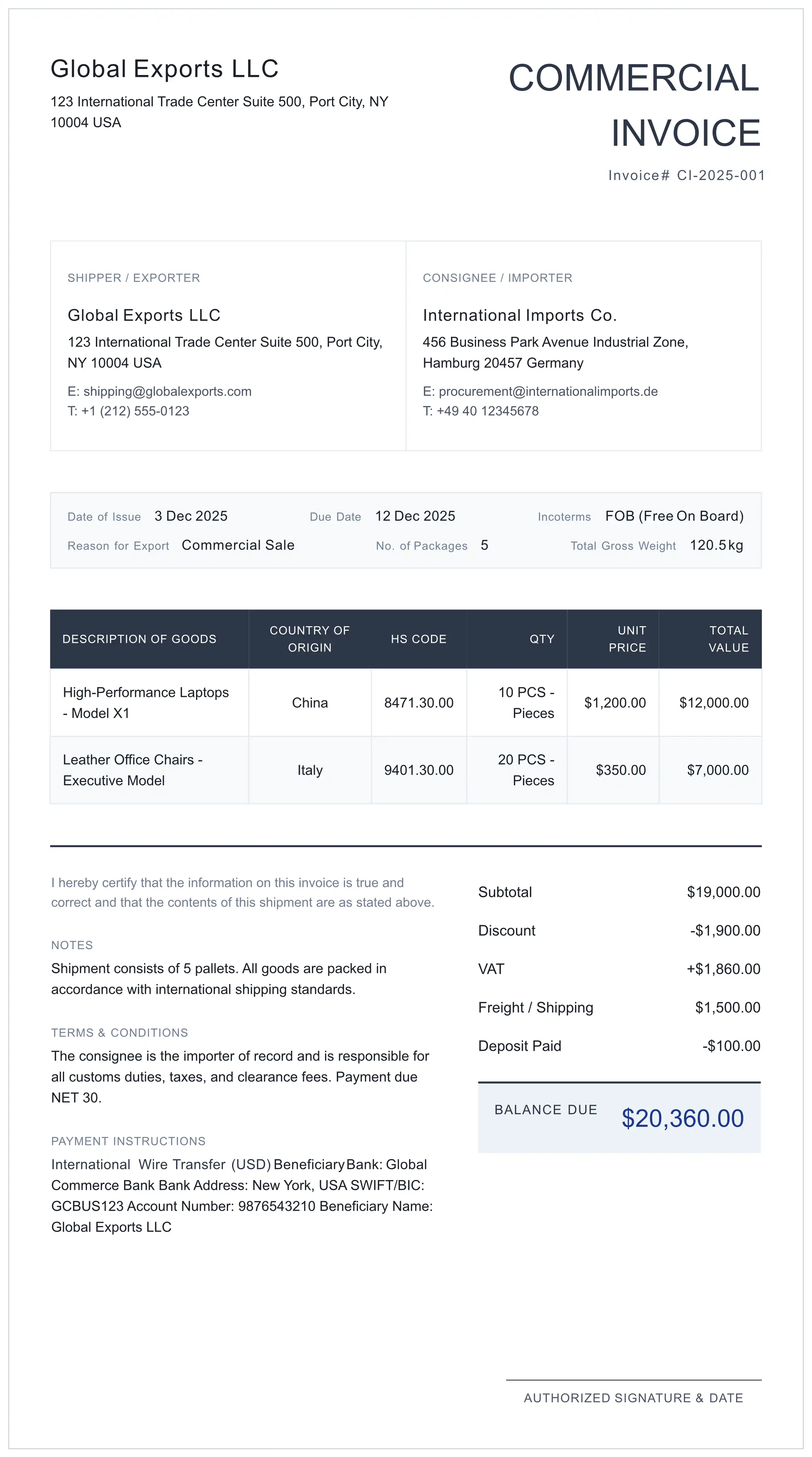
The visual guide below highlights the data zones customs officers look at.
10. Commercial Invoice Example: What a Completed Form Looks Like
A completed commercial invoice has several distinct data blocks. At the top, the shipper (exporter) section lists the seller's full legal name, address and, where needed, a tax identification number (EORI, EIN or VAT number). Opposite, the consignee (importer) block gives the same details for the buyer. Below the parties, the invoice states the Incoterms rule (such as DAP, CIF or EXW) with its named place and edition, which together define who bears the cost and risk at each stage of transit.
The line-item table is the core of the document. Each row includes a precise goods description (never generic terms like "samples" or "parts"), the HS code at the level the destination expects, quantity, unit of measure, unit price and extended total in the stated currency (ISO 4217 code). The country of origin, where the goods were made rather than where they shipped from, is given per line when lines differ. At the bottom come the total value, the charges such as freight and insurance, weights, the number of packages, and a certification that the information is true and correct, with a signature where one is asked for. To fill one in quickly, our free commercial invoice generator has these fields ready; it adds up the lines but does not check codes or values against customs rules, and its sample commercial invoice shows a completed example.
Before the sale is finalized, many exporters issue a proforma invoice as a preliminary quotation. Once both parties agree on terms, the proforma is replaced by the final commercial invoice. For step-by-step instructions on building any invoice from scratch, refer to our complete guide to creating an invoice.
11. FAQ
What does CI stand for on a commercial invoice?
CI is short for commercial invoice, and some exporters also use it as an invoice-number prefix ("CI-"). It is the seller's invoice for goods sent to another country, and it is the invoice customs uses to clear the goods, which is why it is also called a customs invoice.
Does a Commercial Invoice serve as a proof of ownership?
No. The Commercial Invoice is a bill of sale that documents the transaction and declares the value of goods—but it does not transfer legal title (ownership). In international trade, the Bill of Lading is the primary document of title. The Commercial Invoice serves as proof of the sale, is used for customs clearance and duty calculation, and supports payment processing (e.g., Letters of Credit), but ownership transfer is governed by the sales contract and accompanying title documents.
Can a commercial invoice show zero value for samples or gifts?
For goods entering the United States, the invoice must give a value even when nothing was sold. 19 CFR 141.86(a)(5) asks for the purchase price of each item when there is a purchase; 141.86(a)(6) says that for goods shipped otherwise than under a purchase, the invoice gives the value for each item in the usual currency or, failing that, the price the seller or owner would have received in the ordinary course of trade. Other destinations have their own rules. See our guide to no-commercial-value invoices.
What is the penalty for an incorrect HS code or value?
In the United States, a material false statement or omission on entry documents can lead to a civil penalty under 19 U.S.C. 1592. For negligence the maximum is the lesser of the domestic value of the goods or two times the lost duties, taxes and fees; for gross negligence four times; for fraud up to the domestic value of the goods. Clerical errors and mistakes of fact are not violations unless they are part of a pattern of negligent conduct. A prior disclosure made before a formal investigation lowers the maximum.
Can I use a handwritten Commercial Invoice?
For US imports the rules ask for content, not a typed layout: 19 CFR 141.83(c)(1) says the commercial invoice "shall be prepared in the manner customary in the trade" and must contain the information required by 19 CFR 141.86-141.89. Other destinations and carriers set their own rules, and a carrier that takes invoices electronically needs a file. A typed invoice is easier to read and to upload, so use a typed PDF where you can.
What is the difference between a Commercial Invoice and a Proforma Invoice?
A commercial invoice records the actual sale and is the invoice customs uses to clear the goods. A proforma invoice is issued before the sale is final, for quotes, prepayment and permits. In US customs rules, a pro forma invoice is the importer's own statement of value, filed only when the commercial invoice is not available (19 CFR 141.85 and 141.91).
Is a commercial invoice the same as a tax invoice?
No. A tax (VAT) invoice is the document a VAT-registered seller issues to meet tax rules, while a commercial invoice is the document customs reads for goods crossing a border. One export invoice can sometimes serve both purposes if it carries both sets of details. See commercial invoice vs tax invoice.
Do I need a Commercial Invoice for shipping with DHL, FedEx, or UPS?
For most international shipments of goods you will need one, and each carrier decides when it asks for it, whether it accepts your own invoice file or creates one from your shipment data, and whether it wants the invoice uploaded or printed. Check the instructions in your carrier's shipping tool before you ship.
Does a commercial invoice need a signature?
For US imports, CBP ruling H328583 (14 December 2023) says there is no signature requirement in 19 CFR 141.86(j) for a commercial invoice and that a signature is only required for a pro forma invoice. A ruling letter applies to the transaction it describes and is subject to verification of the facts (19 CFR 177.9(b)(1)). Carriers and other countries may still ask for a signed invoice, so check before you ship.
Legal Disclaimer & Liability Limitation
Informational Purposes Only: The contents of this guide are intended for general educational and reference purposes only. International trade regulations, including HS Codes, duty rates, and customs procedures, are subject to frequent changes by government entities (WCO, CBP, European Commission, HMRC). Information presented here may not reflect the most current legal developments or regulations applicable to your specific situation.
No Professional Advice: This document does not constitute legal, tax, customs brokerage, or any other professional advice. MyInvoiceTemplate is not a licensed customs broker, attorney, or tax professional. We expressly disclaim any and all liability for penalties, seizure of goods, delays, fines, or financial losses resulting from reliance on this guide or associated tools.
User Responsibility: Users are solely responsible for verifying the accuracy of information before acting upon it. You should always consult with a licensed Customs Broker, Trade Attorney, or qualified professional for advice specific to your shipments and compliance obligations. By using this resource, you acknowledge that any decisions made based on this information are made at your own risk.