
Quote vs. Estimate vs. Invoice: The Strategic Differences
In the digital economy, precision in terminology is vital for both legal protection and accurate accounting.
| Document Type | Legal Binding Status | Accounting Impact (GL) | Flexibility |
|---|---|---|---|
| Quote | High (Fixed Price) | None (No Entry) | Zero. Price is locked. |
| Estimate | Low (Approx.) | None (No Entry) | High (Can vary 10-20%). |
| Invoice | Legal Demand | Dr. Accounts Receivable Cr. Sales/Revenue | Zero. Final demand. |
The Legal Framework: Offer, Acceptance & E-Signatures
A Quote acts as an "Offer" in contract law. Once accepted, it forms a binding agreement. In 2026, the method of acceptance has shifted entirely to digital.
Wet ink is obsolete. Platforms like DocuSign, Dropbox Sign, or our PDF Generator create a cryptographic hash that timestamps the acceptance. This "Digital Audit Trail" is often more legally defensible than a scanned paper document.
- Mutual Assent: Both parties clearly understand the terms (no ambiguity).
- Consideration: An exchange of value (Services for Money).
- Capacity: Both parties are legally authorized to sign.
Visual Anatomy of a Professional Quote
A quote isn't just a list of prices; it's a trust signal. Below is the standard architecture expected by corporate finance departments.
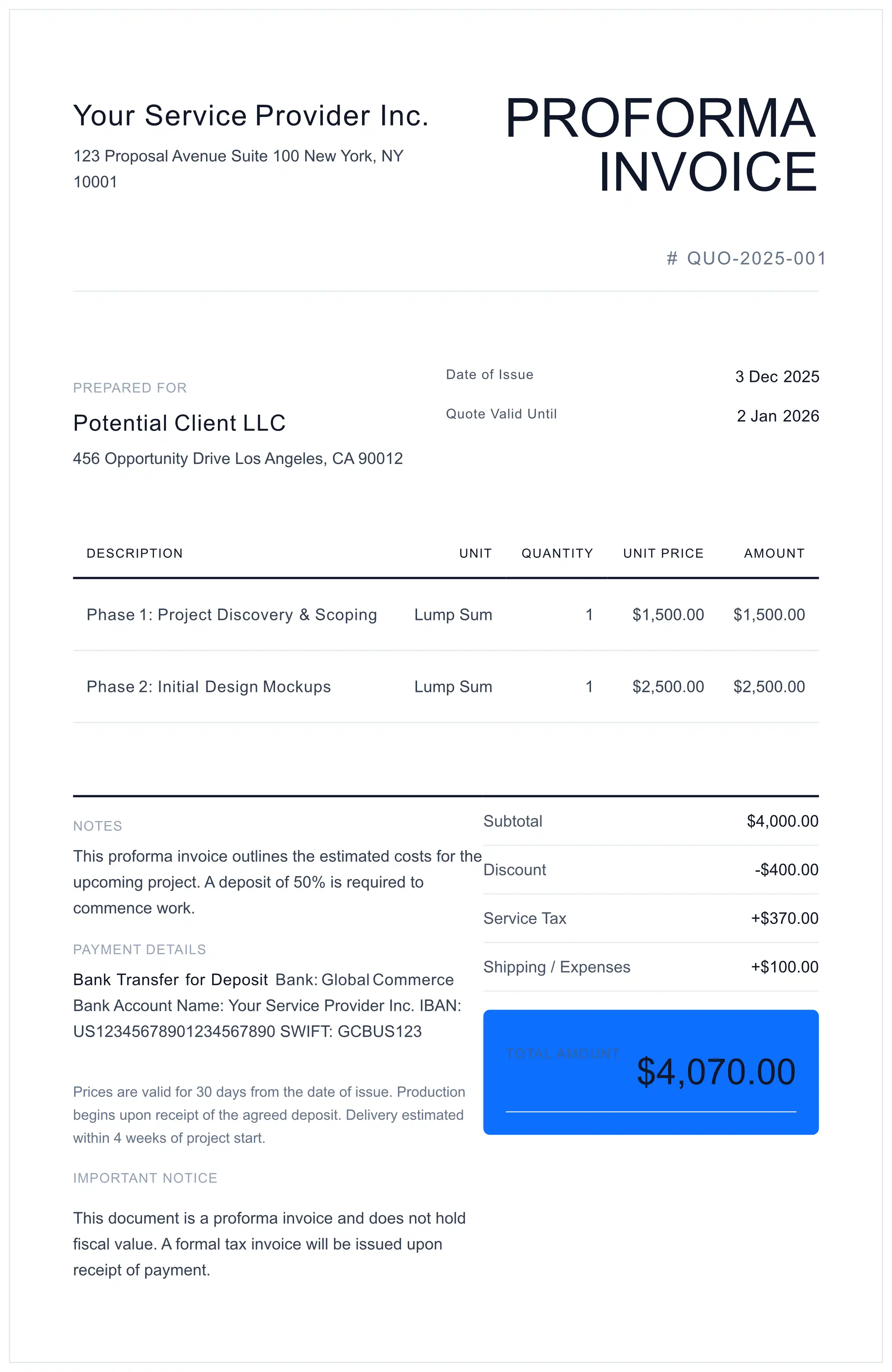
(1) Reference ID: Ensures the quote can be tracked in the accounting system.
(2) Validity Date: Mitigates risk by setting an expiration for the pricing.
(3) Disclaimer Area: Defines the legal boundaries of the 'Offer'.
Strategy: The Psychology of Pricing in Quotes
Top-performing sales teams don't just send a number; they engineer the quote for approval. Here are two proven psychological levers:
The "Good-Better-Best" Option
Never send a single price. Provide three tiers. This shifts the client's mindset from "Should I buy?" to "Which one should I buy?". Usually, the middle option is the target.
Anchor Pricing
Place your premium package first. This "anchors" a high value, making the standard package (your actual target) seem like a bargain in comparison.
Step-by-Step Creation Guide
Follow this 8-step protocol to ensure your document is commercially robust and error-free.
- 01
Standardize Your Header & Branding
Your logo and full legal business name must be prominent. Pro Tip: Ensure your tax ID (VAT/GST/EIN) is visible in the header to prevent accounting delays.
- 02
Generate a Traceable Reference Number
Use a sequential system (e.g.,
Q-2026-104). Never use "1". A higher number suggests experience and stability. - 03
Detail the "Bill To" & "Ship To"
For B2B transactions, verify the exact legal entity name of your client. Billing the wrong subsidiary can void the quote's enforceability.
- 04
Line Items: Be Specific to Avoid Disputes
Vague descriptions are the enemy. Instead of "Website Design", use "5-Page Responsive Website Design, Homepage, Contact, About, Services, Blog".
💡 Scope Creep Protection: Always include a line stating what is excluded (e.g., "Hosting fees and domain registration are excluded"). - 05
The Critical "Validity Period"
Supply chains are volatile. A quote without an expiry date is a blank check for future liability. Standard validity is 14-30 days.
- 06
Payment Schedule & Terms
Don't just say "Due on Receipt". Specify: "50% Deposit to commence work, 50% upon completion." This secures your cash flow.
- 07
The Totals (Subtotal, Taxes, Grand Total)
Ensure your tax calculations are compliant with the client's location rules (e.g., Reverse Charge Mechanism for EU B2B).
- 08
The "Call to Action" & Digital Acceptance
Remove friction. Clearly state: "To accept, please click the 'Approve' button below or sign digitally." Modern quotes should support 1-click acceptance to reduce drop-off rates.
Generate a professional quote with built-in digital acceptance using our free tool.
Industry-Specific Requirements
Different sectors require different safeguards. Customize your quote based on your vertical:
Construction & Trade
You must include an "Escalation Clause". This protects you if raw material costs (lumber, steel) spike between the quote date and the start date. For more details, see our Contractor Invoice Guide.
Creative Agencies & Freelancers
Focus on "Revision Limits". Specify that the quote includes "Up to 2 rounds of revisions." Any work beyond that is billed hourly. Related: Freelance Invoicing Guide.
Retail & Wholesale (Goods)
Define "Incoterms" (Shipping Terms). Who pays for insurance? Who pays for customs duties? Use terms like FOB or DAP clearly.
Professional Communication Scripts
The email delivering the quote is as important as the document itself. Use these templates to project professionalism.
1. The "Corporate Formal" (High Value Projects)
Subject: Proposal: [Project Name] - Quote Ref #Q-2026-001
Dear [Client Name],
Following our discussion regarding [Topic], please find attached our formal quotation outlining the scope, timeline, and investment required.
Please note this offer is valid until [Date]. To proceed, kindly digitally sign the attached PDF or reply with a Purchase Order number.
We are ready to deploy resources starting [Start Date] pending your approval.
Sincerely,
[Your Name]
2. The "Agency / Consultant" (Relationship Focused)
Subject: Quote for [Project Name] 🚀
Hi [Name],
Great connecting earlier. Based on our chat, I've put together a detailed breakdown for [Project Name] to get us to [Goal].
I've included two options in the quote: the Standard Package and the Accelerated Package we discussed.
If everything looks correct, just hit reply with "Approved" and I'll send over the deposit invoice.
Best,
[Your Name]
Risk Management & Critical Disclaimers
In 2026, business liabilities are complex. Your quote must serve as a shield. Ensure these clauses are present in your footer or terms page.
🛡️ The "Force Majeure" Clause
Essential for post-2020 global trade. It excuses you from performance if unforeseen events (pandemics, natural disasters) occur.
🛡️ The "Price Variation" Clause
Expert FAQ: Common Quotation Issues
Is a digital signature (DocuSign/PDF) legally binding on a quote?
Yes. Under acts like the **ESIGN Act (USA)** and **eIDAS 2.0 (EU)**, an electronic signature has the same legal standing as a wet-ink signature. In 2026, digital timestamps are actually preferred for audit trails over scanned paper documents.
Does sending a quote create an accounting entry?
No. A quote is a non-financial posting document. It does not debit 'Accounts Receivable' or credit 'Sales'. It only becomes a financial transaction when converted to an **Invoice**.
Can I withdraw a quote after sending it?
Generally, yes—unless the client has already accepted it. This is why the 'Validity Period' is critical. Without an expiration date, a quote could theoretically be accepted months later when your costs have increased.
What is the difference between a quote and an estimate?
A quote provides a fixed, binding price that cannot change once accepted by the customer. An estimate is an approximate price that can vary by 10-20% depending on actual work required. Use quotes when the scope is clearly defined; use estimates when variables are uncertain.
How long should a quote be valid?
The standard validity period for a business quote is 14-30 days. For volatile markets (construction, commodities), shorter periods (7-14 days) are recommended. Always include an expiration date to protect against cost increases.
What must be included in a professional business quote?
A professional quote must include: (1) Your business name, logo, and contact info, (2) Client details, (3) Unique quote number, (4) Itemized list of products/services with prices, (5) Validity period/expiration date, (6) Payment terms, (7) Terms and conditions, (8) Acceptance method (signature line or digital acceptance).
About the Financial Compliance Board
This guide is maintained by the MyInvoiceTemplate.com Editorial Review Board, ensuring all content meets the 2026 commercial and auditing standards.
Disclaimer: The information provided in this guide is for educational purposes regarding business processes and does not constitute legal or financial advice. Laws regarding contracts and digital signatures vary by jurisdiction. Please consult a qualified attorney for your specific agreements.