
Lien Law & Compliance Basics
Before discussing "how" to invoice, it helps to know "why" the details matter. In construction, your invoice is not just a payment request: if you are not paid, your invoices and the documents behind them are part of the record for a Mechanic's Lien claim, and lien rights run on strict state deadlines.
State-by-State Mechanic's Lien Deadlines
Lien laws vary by state. The rows below summarise the notice and filing deadlines in six large construction markets; each row names the statute it comes from and the date we read it. The statutes contain conditions and exceptions this summary leaves out, so read the section itself before relying on a date.
| State | Notice before a lien | Lien filing deadline | Statute (checked) |
|---|---|---|---|
| California | Preliminary notice "not later than 20 days after the claimant has first furnished work"; a late notice covers only work from 20 days before it was served. Laborers need not give it, and a claimant contracting directly with the owner gives it only to the construction lender, if any (§ 8200(e)). | Direct contractor: after completing the contract and before the earlier of 90 days after completion of the work of improvement or 60 days after the owner records a notice of completion or cessation. Other claimants: the earlier of 90 days after completion or 30 days after that notice. | Civ. Code § 8204(a), § 8200(e), § 8412, § 8414 (2026-09-25) |
| Texas | Claimants other than the original contractor send a notice of claim by the 15th day of the 3rd month after the month the labor or materials were provided (2nd month on residential projects). | Original contractor: affidavit by the 15th day of the 4th month after the month the work was completed, terminated or abandoned (3rd month on residential projects). Other claimants: generally the 15th day of the 4th month after the month they last provided labor or materials (3rd month on residential projects). | Prop. Code §§ 53.052, 53.056, as amended by H.B. 2237, eff. Jan. 1, 2022 (2026-09-25) |
| Florida | Lienors not in privity with the owner (except laborers) serve a notice to owner "before commencing, or not later than 45 days after commencing" to furnish labor, services or materials. | Claim of lien recorded "not later than 90 days after the final furnishing of the labor or services or materials by the lienor". | Fla. Stat. § 713.06(2)(a), § 713.08(5) (2026 Statutes, 2026-09-25) |
| New York | No pre-lien notice in § 10. After filing, serve a copy on the owner within 5 days before or 30 days after filing, and file proof of service within 35 days, or the lien terminates (§ 11). | During the work or within 8 months after completion of the contract or the final work or materials; within 4 months where the property is a single family dwelling. | Lien Law § 10(1), § 11 (2026-09-25) |
| Illinois | Subcontractors and suppliers give the owner written notice within 90 days after completing their work (or after extra work or final delivery). | Contractor: bring suit or record a claim for lien within 4 months after completion to hold the lien against other creditors, encumbrancers or purchasers; against the owner, within 2 years after completion. | 770 ILCS 60/7(a), 60/24(a) (2026-09-25, read on an archived copy of ilga.gov because the site did not respond) |
| Ohio | Where a notice of commencement is recorded, subcontractors and material suppliers serve a notice of furnishing within 21 days after first performing work or furnishing materials. Original contractors do not. | Affidavit within 60 days after the claimant's last labor or materials for a one- or two-family dwelling or a residential condominium unit; 75 days for most other improvements. | R.C. 1311.05(A), 1311.06(B) (2026-09-25, read on archived copies of codes.ohio.gov because the site did not respond) |
Note: This is a summary, not the statute. Deadlines depend on who you are on the job (direct contractor, subcontractor, supplier), the type of property and notices recorded by the owner. Consult a local construction attorney for your situation.
Why Standard Invoices Fail Contractors
Using a generic "service invoice" (like those for graphic designers or consultants) is dangerous for tradespeople. If you are a general business looking for standard invoicing guidance, see our B2B invoicing guide. Construction billing requires specific data points to track Project Continuity.
- Risk of Audit: Failure to separate capital improvements (often exempt) from repair labor (taxable) can trigger sales tax audits.
- Scope Creep Liability: Without explicit "Change Order" line items, extra work is often legally interpreted as "included in the original contract."
- Retainage Gaps: Standard invoices do not have fields for "Stored Materials" or "Retainage Held," causing accounting errors.
Anatomy of a Contractor Invoice
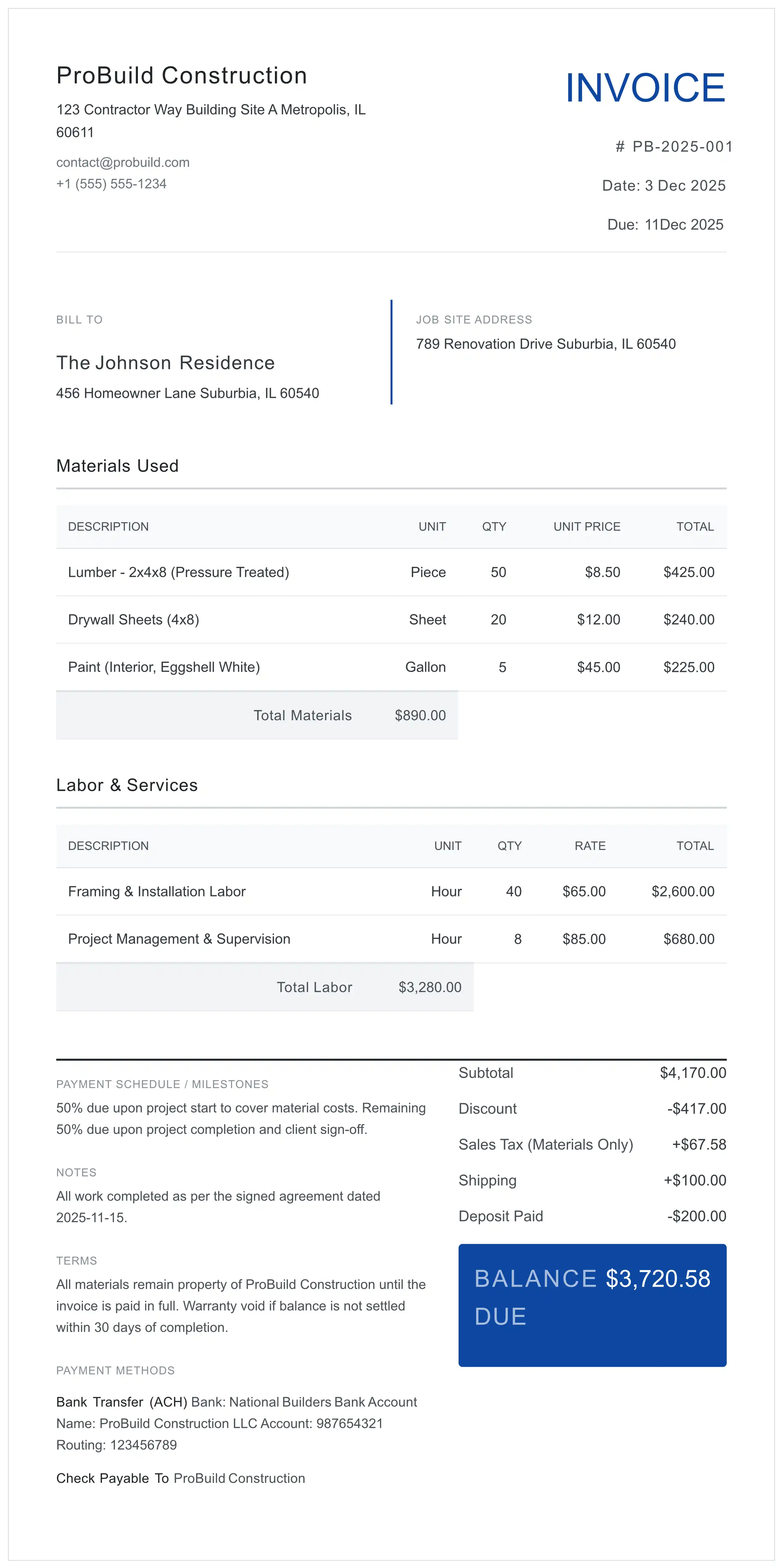
To get through a payment application process (especially with General Contractors or Commercial Clients), build the document around the following structure.
✅ Fields to Include
- Job Site Address: The property as named in the contract, even if the client's billing address is different.
- Contractor License Number: Where your state or licensing board expects it. California, for example, requires the license number in "all construction contracts", "subcontracts and calls for bid" and "all forms of advertising" (Bus. & Prof. Code § 7030.5); repeating it on the invoice lets the client match the two.
- Period of Performance: The specific dates work was performed (lien deadlines run from dates such as the last day you furnished work; see the table above).
- Detailed Scope Breakdown: "For bathroom renovation" is insufficient. Breakdown by "Demolition," "Rough-in," "Finish."
- Payment Application #: Sequential numbering tied to the master contract (e.g., Pay App #003).
Tax Rules: Labor vs Materials
Sales tax rules for construction work differ from state to state, and the taxability of a project often hinges on the separation of costs, so check your state tax agency's guidance for contractors. For contractors working with international clients, understanding VAT and GST invoicing rules is equally important.
Industry Best Practice: Always segregate items.
| Cost Category | Tax Treatment (General Standard) | Invoicing Protocol |
|---|---|---|
| Tangible Personal Property (Materials) | Generally Taxable | List cost + applicable sales tax. |
| Capital Improvement Labor | Often Tax Exempt (New Construction/Value Add) | List separately. Do NOT apply tax if exempt cert is on file. |
| Repair/Maintenance Labor | Often Taxable | Check local jurisdiction. Often taxed like materials. |
The 2026 Digital Standard (E-Invoicing)
Handwritten carbon-copy receipts are increasingly outdated in professional construction management. In 2026, Digital Traceability is the industry-preferred standard for documentation and compliance. Use our free contractor invoice generator to create compliant digital invoices instantly.
Why should you consider moving to digital PDFs?
- Timestamp Verification: Emailing a secure PDF establishes a legal "Received Date," which starts the clock for your "Net 30" payment terms.
- Immutability: A PDF generated by a tool like ours cannot be easily altered by the client, preventing fraud.
- Integration: Digital invoices can be directly imported into accounting software, reducing friction for your client's AP department.
Handling Change Orders & Scope Creep
"Scope Creep" destroys profitability. Before starting a project, consider providing a formal written quote to define the scope clearly. The golden rule of construction management is: No ticket, no payment. Never bill for work that hasn't been documented.
Script: How to Formalize a Verbal Request
If a client verbally asks for extra work on-site, do not just do it. Send this email template immediately to create a paper trail:
Subject: Change Order Confirmation - [Project Address]
Hi [Client Name],
Per our discussion on site today, you have requested we [Description of new task, e.g., install dimmer switches instead of standard toggles].
This falls outside the original contract scope. The additional cost will be $[Amount] for materials and labor. This will be billed as Change Order #01 on the next invoice.
Please reply "Approved" so we can proceed without delay.
On the invoice, this must appear as a distinct line item: "Change Order #01 - Approved via email on [Date]".
Retainage & Cash Flow Management
Retainage is the part of each payment the owner or GC holds back until the job is finished, at the percentage in your contract (some states cap it by statute; on California public works, for example, retention "shall not exceed 5 percent of the payment" under Public Contract Code § 7201(b)(1)). Track the running total withheld on every invoice so you can bill its release at the end.
🧮 Retainage Accounting Formula (illustrative figures)
Releasing Retainage
At the end of the job, you must issue a final invoice specifically for the "Release of Retainage." Do not combine this with new work. It should be a clean invoice billing solely for the accumulated withheld amount ($1,000 in the example above), attached to the "Certificate of Substantial Completion."
The Documentation Packet
Professional contractors do not send a single page. They send a Packet. To ensure your invoice is processed without "Request for Information" (RFI) delays, include:
- The Invoice: The cover sheet with totals.
- Schedule of Values (G703 style): A breakdown of percentage complete per line item.
- Conditional Lien Waiver: A document stating, "Upon receipt of $X, I waive lien rights for this amount." Use the form your state or contract requires; in California the statutory forms are in Civil Code sections 8132 to 8138.
- Site Photos: Proof of work completed (especially for work that gets covered up, like plumbing or wiring).
Troubleshooting: What if the Invoice is Rejected?
Invoices are rarely rejected because of the price; they are rejected because of Format or Compliance. If a General Contractor kicks back your invoice:
- Check the Math: Is the 'Previous Billed' amount matching exactly what they paid last month? Rounding errors of even $0.01 can cause rejection in software systems.
- Verify the Waiver: Did you sign the lien waiver on the form your state or contract requires, and is it the conditional or unconditional version they asked for?
- Review the Period: Are you billing for work done after the billing cutoff date (e.g., the 25th of the month)? Remove it and bill it next cycle.
Frequently Asked Questions
Is separating labor and materials legally required?
There is no single rule: whether labor, materials or both are taxable, and how they must be shown, depends on the state (or country) and on the kind of job. Check your state tax agency's guidance for contractors. Keeping them on separate lines is what lets you tax only the lines that are taxable and lets the client check each cost.
How do I legalize a verbal change order?
Stop work immediately until a written confirmation is received. Even a text message or email reply stating 'I approve the additional $500 for the lighting' creates a paper trail. Attach this proof to your invoice as a supporting document.
When should I send the Lien Waiver?
A conditional waiver can go out with the invoice, because it takes effect only when you are actually paid. California's statutory form, for example, says the conditional waiver on a progress payment is 'EFFECTIVE ON RECEIPT OF PAYMENT' (Civil Code section 8132), while the unconditional form warns 'THIS DOCUMENT IS ENFORCEABLE AGAINST YOU IF YOU SIGN IT, EVEN IF YOU HAVE NOT BEEN PAID' (section 8134). Send an unconditional waiver only after the payment has cleared, and use the form your state or contract requires.
How should I send a contractor invoice?
However your contract says: by email, through the client's portal or on paper. Keep a record of when and how you sent it, because payment terms such as Net 30 run from the date your contract names, such as the invoice date or the date the client received it.
Can I charge interest on late payments?
Put the late-payment term in your contract and repeat it on the invoice, for example: 'Overdue balances accrue interest at [rate] per [month/year] from the due date, as agreed in contract [number].' State law can limit the rate you may charge; the late fee calculator lists each state's rule with the statute it comes from.
What should a roofing company's billing SOP include?
A written estimate or contract; a deposit invoice only as the contract and state law allow; material-delivery and progress invoices; signed change orders; a final invoice with the warranty terms; and a lien waiver exchanged for each payment. Insurance-funded jobs are billed to the scope the adjuster approved, and commercial jobs carry the buyer's PO number. In California, a home-improvement downpayment may not exceed $1,000 or 10 percent of the contract amount, whichever is less (Business and Professions Code section 7159.5(a)(3)).