
Why Payment Terms Are a Legal Necessity
Invoice Payment Terms are not merely polite suggestions; they form the contractual backbone of the B2B exchange. In the absence of signed terms, you are subject to default common laws which often favor the buyer's delay.
Establishing clear terms (e.g., "Net 30") legally defines the Default Date. Without a defined default date, you cannot legally enforce late fees or initiate debt recovery protocols effectively.
🏛️ The "Prompt Payment" Legal Framework
Establishing terms aligns your business with government protections:
- USA: The Prompt Payment Act requires federal agencies to pay interest on overdue invoices.
- UK: The Late Payment of Commercial Debts Act allows you to charge statutory interest + compensation.
- EU: The Late Payment Directive establishes a standard 30-day limit for public authorities.
Strategic Anatomy: Placement for Maximum Visibility
Legal enforceability often hinges on "conspicuousness". Terms hidden in 6pt font may be deemed unenforceable in small claims court.
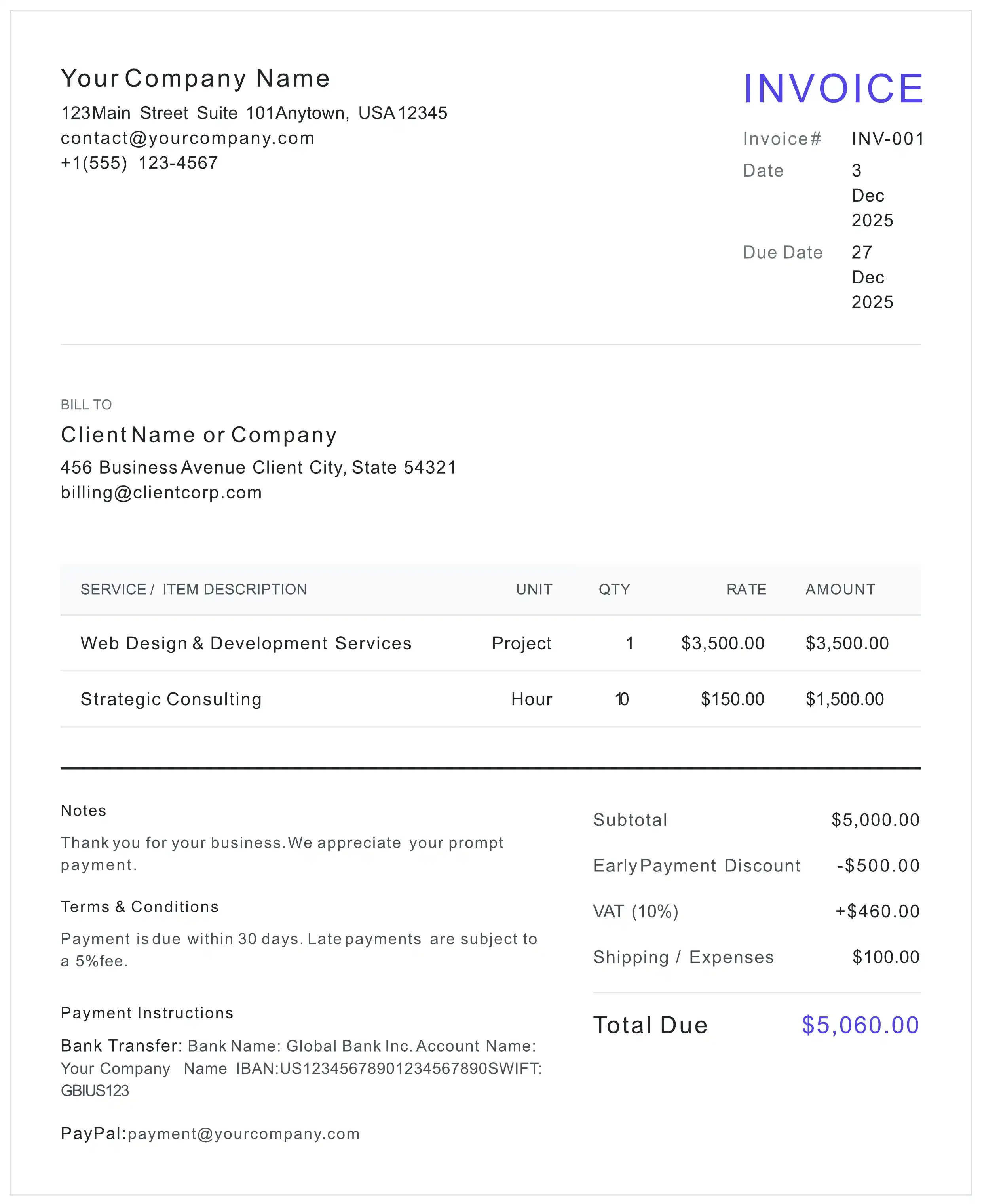
The Master Glossary: Domestic & Commercial Codes
Industry-standard codes reduce friction by setting immediate expectations for Accounts Payable (AP) departments.
Net 7 / 15 / 30 / 60
Definition: Payment is due the specified number of calendar days (not business days) after the invoice date.
Standard: Net 30 is the global B2B standard. Net 60 is common in Logistics and Manufacturing.
Due Upon Receipt
Definition: The debt is active immediately. Technically, the payment is late the next day.
Best For: Medical services, home repairs, and immediate digital downloads.
PIA (Payment in Advance)
Definition: 100% funds required before work commencement. Essential for solvency protection.
Best For: First-time clients with no credit history or custom fabrication.
EOM (End of Month)
Definition: Payment due date accumulates to the end of the current month.
Best For: Agencies with Retainers to streamline admin work into one monthly transaction.
21 MFI (Month Following Invoice)
Definition: Payment is due on the 21st of the month following the invoice date.
Best For: Recurring subscription models and SaaS billing cycles.
Global Standards: Dealing with International Clients
When invoicing across borders in 2026, "Net 30" is insufficient due to banking delays. You must include banking routing codes.
- IBAN (International Bank Account Number): Mandatory for all invoices sent to Europe.
- SWIFT / BIC Code: Required for wire transfers outside the SEPA zone.
- Currency Clause: Explicitly state "Payment to be received in USD, net of all bank transfer fees."
Benchmark: Common Terms by Industry (2026 Data)
Setting terms that deviate too far from industry norms can friction. Use this benchmark table to align your expectations.
Financial Strategy: The "2/10 Net 30" Discount
Cash flow is often more valuable than profit margin. The term "2/10 Net 30" is a classic trade credit agreement.
Calculation: Is it worth it?
- The Deal: Client deducts 2% if paid in 10 days. Otherwise, full amount in 30.
- The Effective APR: By giving up 2% to get money 20 days early, you are effectively paying an APR of ~36%.
Strategy: Use this only when you need immediate liquidity for operations or inventory restocking.
The Psychology of Payment: "Odd Days" Strategy
Data from financial platforms suggests that using standard boilerplate terms causes "Banner Blindness" in AP departments. To get paid faster, break the pattern.
- The "Net 21" Trick: Using an odd number like 13 or 21 days signals that the date is calculated specifically for this project, creating a subconscious urgency.
- Politeness Matters: Invoices containing "Please pay by..." and "Thank you for your business" are paid, on average, 5% faster than those without courtesy phrases.
Calculating Net 30 Late Fees & Interest (Legally)
Charging interest on overdue Net 30 invoices is a powerful deterrent, but it must be mathematically correct and legally disclosed. A commonly accepted commercial rate is 1.5% per month. Keep in mind that late fee limits vary by state, so always verify your rate against local usury laws before applying charges.
Simple Interest Formula (Non-Compounding)
Fee = (Invoice Total × Annual Rate) ÷ 365 × Days Late Scenario:
Total: $10,000 | Annual Rate: 18% (0.18) | Late: 15 Days
Math: ($10,000 × 0.18) ÷ 365 × 15 = $73.97
⚠️ Compliance Warning: Do not guess your interest rate. Usury laws in California, New York, Texas, Florida, and other states differ significantly. Charging above the legal cap can void your entire invoice. See our state-by-state late fee guide below for details, and always verify with the statutory rate defined by your local government.
Invoice Late Fee Calculator
Formula: (Invoice Amount x Annual Rate) / 365 x Days Overdue
Late Fee Limits by State: Net 30 Invoice Compliance Guide
When using standard payment terms such as Net 30, the late fees you can legally charge depend heavily on your state's usury laws and commercial code. Below is an overview of how key states regulate late fees on invoices. Use this alongside our payment terms calculator above to ensure your Net 30 invoices remain compliant.
California Late Fee Caps
California regulates late fees under its Civil Code and usury provisions. For typical Net 30 payment terms, California law requires that late fees represent a reasonable estimate of actual damages caused by the late payment, rather than serving as a penalty. California's usury laws place general caps on interest rates for non-exempt transactions. Businesses issuing Net 30 invoices in California should also be aware of the state's Prompt Payment Act for public contracts, which imposes specific timelines and interest requirements on government-related payments.
California's regulations apply differently to consumer vs. commercial transactions. B2B contracts may have more flexibility, but late fee clauses must still pass the "reasonable estimate" test.
New York Late Fee Regulations
New York enforces its own usury limits under General Obligations Law and Banking Law. For standard Net 30 invoices, New York distinguishes between civil usury caps applicable to most transactions and criminal usury thresholds. Commercial transactions above certain dollar amounts may be exempt from the general civil cap. Businesses using Net 30 or Net 60 terms should ensure their late fee provisions are clearly disclosed in the original agreement.
New York courts closely scrutinize late fee clauses in contracts. Ambiguous terms may be interpreted against the party that drafted them.
Texas Late Fee Rules
Texas regulates late charges under its Finance Code. For B2B invoices with Net 30 payment terms, Texas law permits reasonable late fees as long as they are agreed upon in writing before the transaction. Texas also has specific provisions for the construction industry and government contracts, each with their own payment timelines and penalty structures.
Texas has separate prompt payment statutes for public and private construction projects that override general late fee provisions.
Florida Late Fee Provisions
Florida's approach to late fees on Net 30 invoices is governed by its usury statute and general contract law. Florida recognizes a distinction between simple interest caps and rates allowed under specific commercial agreements. For standard payment terms, businesses must disclose any late fee policy in advance. Florida's Prompt Payment Act also provides specific protections for contractors and subcontractors.
Florida law may void the entire interest charge, not just the excess, if a court determines the rate is usurious.
Other States & General Guidance
Every U.S. state has its own combination of usury statutes, commercial codes, and prompt payment acts. States such as Illinois, Pennsylvania, Ohio, and Georgia each set their own caps and disclosure requirements for late fees on Net 30, Net 60, and other standard payment terms. Some states differentiate between consumer and commercial transactions, while others apply uniform limits.
When invoicing clients in multiple states, apply the most restrictive applicable law to avoid compliance issues.
Best Practices for Setting Late Fees on Net 30 Invoices by State
- Research your state: Look up your state's usury laws and any industry-specific prompt payment statutes before setting late fee rates.
- Disclose in writing: Always include your late fee policy in the original contract or agreement, not just on the invoice itself.
- Keep fees reasonable: Courts across all states are more likely to enforce late fees that reflect a genuine pre-estimate of damages rather than a punitive charge.
- Use our calculator: The late fee calculator above can help you model different scenarios, but always verify the resulting rate against your state's legal limits.
- Update annually: State laws change. Review your late fee policies at least once per year to ensure ongoing compliance.
Important Disclaimer: The state-by-state information above is provided for general educational purposes only. Late fee laws are subject to change and may vary based on your specific industry, contract type, and transaction amount. Always consult a licensed attorney in your jurisdiction before implementing late fee policies on your invoices.
Professional Collection Scripts (Copy-Paste)
Escalation should be firm but preserve the relationship. We have expanded these scripts to cover the entire lifecycle.
📧 1. The Pre-Deadline "Nudge" (3 Days Before)
Subject: Coming up: Invoice #12345 due on [Date]
Hi [Name],
Hope you're having a great week. This is just a friendly courtesy reminder that Invoice #12345 for [Amount] is scheduled for payment this [Day of Week].
Let me know if you need another copy of the invoice.
Best regards,
📧 2. The Standard Reminder (1 Day Overdue)
Subject: Invoice #12345 is now overdue
Hi [Name],
Our records indicate we haven't received payment for Invoice #12345 yet. It was due yesterday, [Date].
If this has already been sent, please disregard. Otherwise, please remit payment today via [Link].
Thank you,
📧 3. The "Is Everything Okay?" (7 Days Overdue)
Subject: Action Required: Invoice #12345 Outstanding
Hi [Name],
We are now a week past the due date. I wanted to check if there is an issue with the invoice or the banking details provided?
Please let us know immediately so we can resolve any administrative blockers.
Regards,
📧 4. The Payment Plan Offer (15 Days - Empathy Route)
Subject: Regarding outstanding balance for Invoice #12345
Hi [Name],
We value our relationship and understand that cash flow can sometimes be tight. Since this invoice is now significantly overdue, we need to settle the balance to keep your account in good standing.
If paying the full [Amount] today is not possible, please reply to this email so we can agree on a structured payment plan.
Sincerely,
📧 5. The "Final Notice" (30+ Days - Legal Route)
Subject: FINAL NOTICE: Invoice #12345 sent to collections
Hi [Name],
This invoice is now 30 days past due. Despite multiple reminders, we have not received payment or communication.
As per our contract terms, a late fee of [Amount] has been applied. The total due is now [New Total]. If payment is not received by [Date + 3 days], we will be forced to escalate this to [Debt Collection Agency/Legal Counsel].
This is your final notice.
Sincerely,
Frequently Asked Questions (Compliance & Law)
Is 'Net 30' legally binding without a contract?
Generally, invoice terms are enforceable if the client accepts the goods/services knowing these terms apply. However, best practice (and YMYL compliance) dictates explicitly stating these terms in a signed contract or SOW (Statement of Work) before billing.
What is the maximum late fee I can legally charge?
This depends entirely on your jurisdiction's 'Usury Laws'. In many US states, caps exist around 10-18% APR. In the UK, statutory interest is 8% plus the Bank of England base rate. Always consult local statutes.
How do I denote international payment terms?
For cross-border invoices, strictly use ISO currency codes (USD, EUR, GBP) and provide IBAN/SWIFT/BIC codes. Avoid 'Net 30' ambiguity by stating a specific date: 'Due by 30 March 2026'.
What implies 'Time is of the Essence'?
This is a legal clause often added to contracts indicating that late performance (payment) is a material breach of contract, allowing you to terminate services immediately.
What are California's standard payment terms and late fee caps for Net 30 invoices?
California regulates late fees through its usury laws, which generally cap interest on non-exempt loans. For typical Net 30 B2B invoices, California businesses must ensure their late fee policies comply with the state's Civil Code provisions on penalties and liquidated damages. Late fees must be a reasonable estimate of actual damages caused by the delay, not a penalty. Consult a California-licensed attorney for your specific situation.
Do late fee limits vary by state in the United States?
Yes, late fee regulations vary significantly by state. States like California, New York, Texas, and Florida each have their own usury laws, penalty caps, and disclosure requirements. Some states impose strict caps on interest rates, while others allow more flexibility in commercial contracts. Always verify the specific laws in your state before setting late fee policies on your invoices.