
Hourly, Retainer, Project and Value-Based Billing
The billing methodology selected impacts not only profitability but also how the client budgets for you. Some consultants start a relationship on "Time & Materials" and later move long-running clients to retainers or fixed-fee projects. If you frequently bill other businesses, our B2B invoicing guide covers PO matching and AP processes in detail.
Hourly Billing
Time & Materials. The baseline model for initial engagement. It offers transparency but caps revenue at maximum billable hours. Similar to freelance invoicing, hourly billing works best for undefined scope projects.
15 billable hrs/week × 44 working weeks = 660 hrs; 80,000 target ÷ 660 hrs ≈ 121/hr
Retainer Model
Fixed Recurring Fee. Ensures availability and stabilizes cash flow. Well suited to long-term advisory roles.
"Advisory retainer, [month]" — Qty 1 × the monthly fee.
Project (Fixed Fee)
Deliverable Oriented. One agreed price for a defined scope, often split into milestones and invoiced as each one is accepted.
"Phase 1: current-state assessment" — Qty 1 × the milestone fee.
Value-Based
Outcome Oriented. Pricing is anchored to the value of the result for the client rather than time input.
Decouples income from time.
Define a clear rollover policy in the Master Service Agreement (MSA): whether unused retainer hours roll over to the next period, for how long, or lapse at the end of each period. Whichever you choose, each retainer invoice should show the period it covers and any unused balance carried forward, so both sides can reconcile it.
Asking for the retainer up front? A retainer or deposit invoice is an invoice, while a proforma only asks for payment; see proforma vs retainer or deposit invoice for the difference and the tax point rules.
Retainer and fixed-fee invoices use a single "flat fee" line (Qty 1). Create one in the consulting invoice generator.
Model Comparison Matrix
Selecting the appropriate model depends on the project phase and client relationship maturity.
| Model | Primary Metric | Financial Advantage | Ideal Usage Case |
|---|---|---|---|
| Hourly | Time Input | Low Risk / Full Compensation | Short-term, undefined scope projects. |
| Retainer | Availability | Cash Flow Stability | Maintenance, advisory, and ongoing support. |
| Project (fixed fee) | Deliverables | Known price for both sides | Well-defined scope with clear milestones. |
| Value-Based | Client Outcome | Income not tied to hours | High-impact strategic work with a measurable result. |
Consulting invoice example: hourly, retainer and expenses
Here is how one consulting invoice combines the three most common line types: hours × rate, a monthly retainer, and a reimbursable expense passed through at cost. The fields match the consulting invoice generator, including its Project Code field for the client's PO or project reference.
INVOICE SAMPLE
From: [Your name or firm], [address], [email]
Bill To: [Client legal entity], Attn: Accounts Payable, [address]
| Description | Unit | Hours/Qty | Rate | Amount |
|---|---|---|---|---|
| Strategy workshops and analysis, [period] | Hour | 12 | 150.00 | 1,800.00 |
| Advisory retainer, [month] | Month | 1 | 2,000.00 | 2,000.00 |
| Reimbursable expense: rail travel to client site, at cost (receipt attached) | Trip | 1 | 85.00 | 85.00 |
| Subtotal | 3,885.00 | |||
| Tax ([your tax label], at the rate that applies to you; 0 here) | 0.00 | |||
| Total Amount | 3,885.00 | |||
Terms: Net 30 — payment due [due date]. Please quote CONS-0012 and the Project Code with your payment.
Payment Details: [bank name, account name, account number or IBAN]
What each part does
- Project Code: the client's PO number or project reference, so the invoice can be matched to an approved budget.
- Hourly line: describe the work and the period, and keep the timesheet that backs the hours.
- Retainer line: one line per period (Qty 1); name the month so there is no doubt what it covers, and note any unused balance carried forward if your contract allows rollovers.
- Expense line: at cost, labelled as reimbursable, with the receipt sent alongside the invoice. In the generator you can also enter a single total in the Expenses field under Totals.
- Due date: an exact date, not just "Net 30"; the payment due date calculator works it out.
What Corporate Clients Check on a Consulting Invoice
For consultants engaging with corporate entities, the invoice has to pass the client's Accounts Payable (AP) process before anyone pays it.
The PO or project reference
If the client works with Purchase Orders (POs), ask for the PO number before you send the first invoice and show it on every invoice: AP teams use it to match your invoice to an approved order. Clients without POs may use an internal project code or cost-centre reference instead.
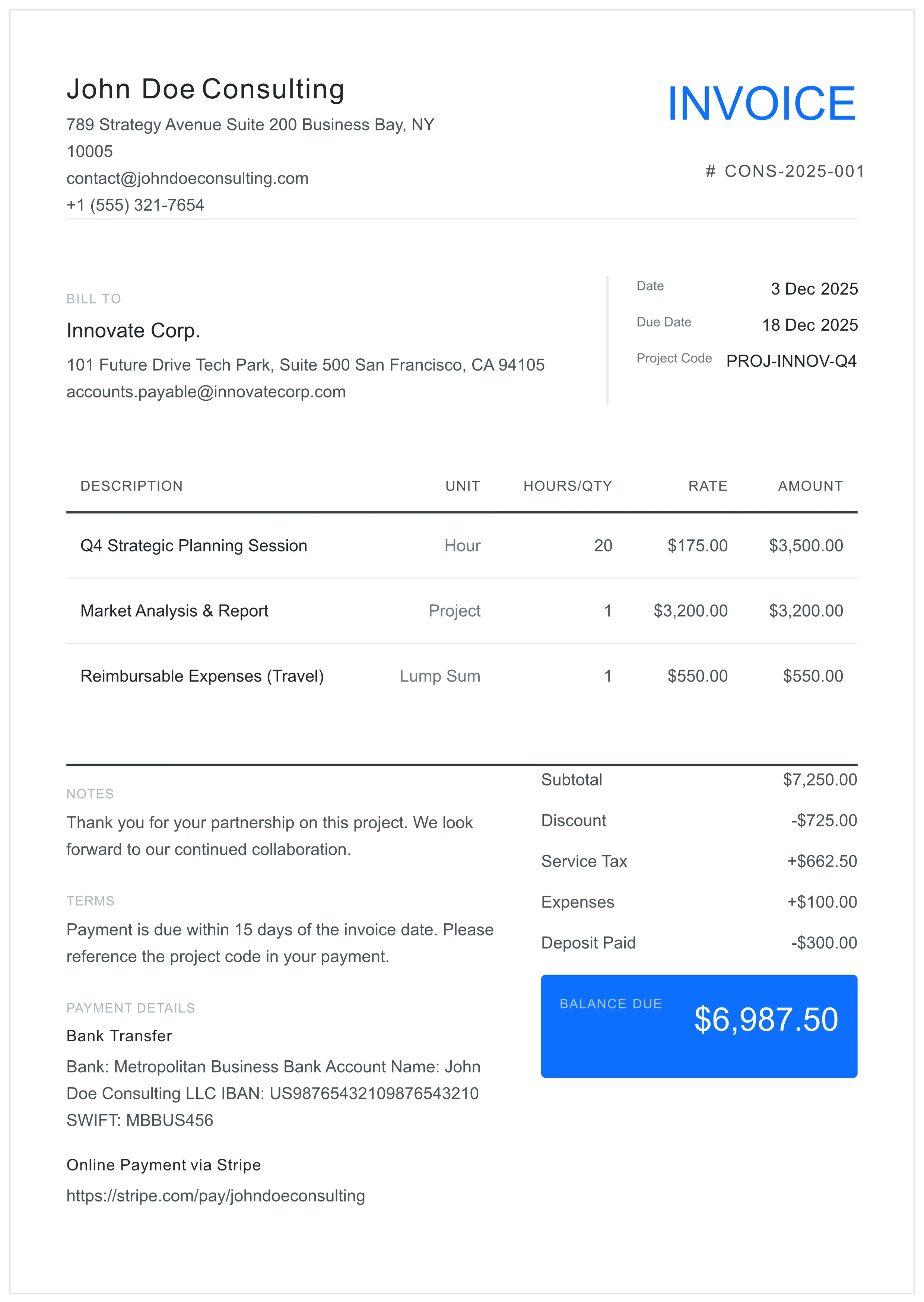
Details that speed up approval:
- Service Itemization: Avoid generic terms like "Consulting Services". Be specific (e.g., "Q4 Financial Analysis - 15 Hours @ 150/hr").
- Payment Terms: State the terms (e.g., Net 15, Net 30) and the exact due date they produce, so there is no doubt when payment is late.
- Tax Identification: Include a tax registration number where one applies to you, for example your VAT number if you are VAT-registered.
Cross-Border Consulting & E-Invoicing
With the rise of remote consulting, cross-border billing has become common, and it adds tax and format rules of its own. For a comprehensive overview of cross-border requirements, see our guide to international invoicing.
- E-Invoicing: Some countries now require structured electronic invoices between businesses instead of a PDF. In Belgium, structured e-invoicing between VAT-registered businesses established there applies from January 1, 2026. In Germany, domestic businesses must be able to receive e-invoices from January 1, 2025, and the general obligation to issue them starts January 1, 2027, with transitional relief for some issuers. In France, all companies must be able to receive e-invoices from September 1, 2026, and small and medium-sized businesses and micro-enterprises must issue them from September 1, 2027. Where such an obligation covers your invoice, a plain PDF does not meet it. Scope, exemptions and sources for each country are in our e-invoicing mandates tracker.
- VAT/GST Reverse Charge: Billing a business client in another EU country can fall under the reverse-charge mechanism, where the client accounts for the VAT instead of you. The conditions and the invoice wording are in our VAT & GST invoicing guide. Note: The USA does not use VAT; different sales tax rules apply.
- Currency Specifications: Always specify the currency code (USD, EUR, GBP) explicitly to avoid forex discrepancies in payment. Use our multi-currency invoice generator for international clients.
Handling Reimbursable Expenses
Reimbursable expenses must be treated with high transparency to pass audit. According to IRS tax guidelines, commingling expenses with service fees can complicate tax deductions.
- Segregation: Expenses should be listed as distinct line items, separate from labor fees.
- Pass-Through Policy: Pass costs through at face value unless the contract says otherwise. If you add any administrative markup, stipulate it in the contract before invoicing.
- Digital Proof: Attach a consolidated PDF of receipts for any single expense exceeding $75 (or the local currency equivalent). Note: The IRS requires receipts for lodging expenses regardless of amount.
Billing accuracy and the metrics to track
Before you send, reconcile the invoice against everything the client already holds: timesheets, the rate card, the statement of work and the PO.
✅ Pre-send reconciliation checklist
- Timesheets vs invoice: Do the billed hours equal the approved timesheet hours for the same period, person by person?
- Rate card: Is every line billed at the rate the contract sets for that role or service?
- SOW caps: Does the running total stay within any not-to-exceed amount in the SOW, and is anything beyond it backed by a signed change order?
- Expense receipts: Is there a receipt for each reimbursable line, billed at cost unless the contract allows a markup?
- PO / Project Code: Is the client's reference on the invoice and still open for this amount?
- Entity Verification: Is the "Bill To" the client's legal entity name, not just the trading brand?
- Banking Integrity: Are SWIFT/IBAN or routing numbers accurate for the payment method?
Metrics worth tracking
Compare these with your own history and your own payment terms; this guide publishes no industry benchmarks, because averages blend firms with very different clients and terms.
- Utilization
- Billable hours ÷ available working hours in the period. It shows how much of your time turns into billable work.
- Realization
- Amount billed ÷ (hours worked × your standard rates). It shows how much of the work you did actually reaches an invoice at full rate; some firms measure it on cash collected instead of amount billed.
- Days Sales Outstanding (DSO)
- (Accounts receivable ÷ credit sales) × days in the period. It shows how long, on average, invoices take to be paid. Work it out with the DSO calculator.
- Aging of open invoices
- Unpaid invoices grouped by how far past due they are. Sort yours with the invoice aging calculator.
Billing for healthcare consulting
Healthcare clients bill work to budgets like any other organisation, but their data carries extra rules. Two habits keep a healthcare consulting invoice clean wherever you work:
- Bill against the client's reference. Put the client's PO or cost-centre reference in the Project Code field and describe the work by deliverable (for example "Clinic scheduling review, phase 1"), not by patient.
- Keep patient-identifiable details off the invoice unless your contract specifically requires them. An invoice is read by finance and AP staff who do not need clinical information.
United States (HIPAA): Under 45 CFR 160.103, a "business associate" includes a person who provides "legal, actuarial, accounting, consulting, data aggregation … management, administrative, accreditation, or financial services" to a covered entity "where the provision of the service involves the disclosure of protected health information". Under 45 CFR 164.502(b), a covered entity or business associate "must make reasonable efforts to limit protected health information to the minimum necessary to accomplish the intended purpose of the use, disclosure, or request". Sources: 45 CFR 160.103 and 45 CFR 164.502 (eCFR).
Outside the US, other health-data rules apply; check with the client's information-governance team what may appear on an invoice.
Contractual Protections: Scope & Late Fees
The invoice applies the contract; it cannot add terms the contract lacks. Put scope, rates, payment terms and late fees in the contract, then repeat them on each invoice.
Managing Scope Creep
Scope creep erodes consulting margins. Don't start additional work without a written estimate or Change Order. The invoice should explicitly reference "Change Order #X" for any out-of-scope billing.
Late Fee Clause (fill in for your Terms section):
"Payment terms are Net [30] days from the invoice date. Amounts unpaid after the due date accrue [a late fee of ___ / interest at ___% per ___], or the maximum allowed by law, whichever is less."
Choose the figure yourself and check it against the law that governs your contract. For US states, the late fee calculator shows the statutory figures and caps state by state and works out the amount on an overdue invoice.
Consultant Billing FAQs
How do I invoice as a consultant?
Agree the billing model (hourly, retainer, project or value-based) and the payment terms before the work starts. Then issue one invoice per billing period or milestone that shows: a unique invoice number, the invoice date and an exact due date, your details and the client's legal entity, the client's PO or project reference, one line per service (hours × rate, the retainer for the period, or the fixed fee), reimbursable expenses as separate lines at cost, any tax that applies, the total due and how to pay. Send it as a PDF to the accounts-payable address the client gave you and keep a copy.
Which pricing model minimizes risk for new consultancies?
The Hourly Billing model minimizes initial risk by ensuring all time spent is compensated. However, transitioning to a Retainer model can improve cash flow predictability by providing agreed monthly revenue.
Is there a standard formula for consulting billable rates?
No single standard exists. The simplest method divides your target annual revenue (pay, business costs, taxes and profit) by the hours you can realistically bill. One heuristic among others, the 'rule of thirds', splits each fee into a third for your pay, a third for overhead and a third for profit. Whichever you use, test the result against what clients in your specialty actually pay.
How should scope creep be documented?
Agree the extra work in writing before you start it, for example with a change order or an amended statement of work (SOW). Then bill it as its own line item that cites the change-order number, so the client can match the charge to the approval.
Can I charge late fees to corporate clients?
That depends on your contract and on the law that governs it. Agree the late fee or interest in the contract, repeat it on every invoice, and keep it within any legal maximum. For US states, our Late Fee Calculator shows the statutory figures and caps state by state.
Do I need consulting billing software?
Not to send professional invoices. Our free consulting invoice generator fills a consulting layout with a Project Code field, hourly and retainer lines, expenses and tax, and the consulting template page offers blank PDF and Word files; a free Excel consultant invoice tracker logs what you have sent and what is still open. The generator is free and unmetered for normal use; an anti-abuse cap of 20 PDFs per device per day (200 per IP) applies, well above ordinary use, and blank template file downloads are not metered. A one-line "Created free with myinvoicetemplate.com" credit is switched on by default and one free checkbox in the settings turns it off. Your draft is stored in your own browser on this device, so download and keep the PDF you need. Dedicated billing software makes sense when you need time tracking, recurring invoices or an invoice history, which our generator does not keep.