
What is a Photography Invoice?
A Photography Invoice requests payment for photography services and usually also restates the licence terms for the delivered images: who may use them, for what, and for how long. If you are new to invoicing, start with our guide on how to create an invoice for the fundamentals.
Photography Invoice vs Standard Invoice
Unlike invoices that simply request payment for goods or services, a photography invoice usually carries the usage licence agreed in your contract. Freelance photographers can also benefit from the general billing strategies in our freelance invoice generator. It specifies:
- Usage Rights: Personal, Commercial, Editorial, or Exclusive licensing
- Duration & Territory: How long and where the client can use images
- Copyright: who owns it; the statutory position differs by country (see the copyright notes below)
- Conditions: for example, that the licence starts when the invoice is paid in full, if your contract says so
Who Needs a Photography Invoice?
Wedding Photographers
Retainer agreements, multi-day coverage, print releases
Event Photographers
Corporate events, conferences, hourly billing
Portrait Photographers
Session fees, print packages, digital delivery
Commercial Photographers
Usage licensing, buyouts, agency billing
Photography Invoice by Type of Shoot
Different photography specializations bill differently. Each type below has its own generator page with matching line items and an FAQ.
Wedding Photography Invoice
A wedding invoice can list coverage, a second shooter, an engagement session and album or print orders, and deducts the retainer already paid to show the balance due. The Wedding Photography Invoice Generator starts with those lines and also covers invoicing wedding videography.
Event & Corporate Photography Invoice
Corporate and event photography is usually billed by the hour or by half and full day, with the number of edited images, the delivery turnaround and any rush fee as separate lines. The Event Photography Invoice Generator sets those lines up and has room for the client's PO number.
Portrait & Headshot Invoice
Portrait sessions typically combine session fees with print/digital package options. Before confirming a session, many photographers send a formal quote outlining package options and pricing.
Essential Line Items:
- Session Fee: Time/location based
- Digital Delivery: Number of edited images
- Print Package: Sizes and quantities
- Retouching: Basic vs advanced
- Personal Use License: Standard inclusion
Product, Food & Commercial Photography Invoice
Product and commercial work can be priced per final image or per shoot, with a separate usage-licence line and production costs such as props or stylists passed through at cost. The Product & Commercial Photography Invoice Generator covers product, food and commercial shoots.
Real Estate Photography Invoice
Real estate photography can be billed per property, with photos, twilight shots, drone images and virtual-tour hosting as separate package lines and the agent or brokerage as the client. The Real Estate Photography Invoice Generator starts with those lines.
1. Event Logistics & Scope of Work
For event and wedding photography, the invoice should repeat the logistics your contract fixes, so both sides are billing against the same booking.
Put these on the invoice:
- Event Date & Time: the date and the start and end times of coverage.
- Venue Location: where you are working (useful when travel costs are billed).
- Scope of Work: e.g., "8 Hours of Continuous Coverage" vs. "All Day".
Why it matters: with the start and end times written down, any extra hours are easy to identify and bill at the overtime rate your contract sets.
2. Licensing & Usage Rights
This is the most important difference in photography billing: besides your time, you are licensing the use of images. Keep the Creative Fee (time and labour) and the Licensing Fee (usage) on separate lines.
B2B: Commercial & Editorial Licensing
For corporate clients, spell out the licence terms so the permitted use is clear. The invoice terms should define:
- Duration: (e.g., 1 Year, 5 Years, Perpetuity).
- Territory: (e.g., North America, EU, Worldwide).
- Media: (e.g., Social Media Only, Print Advertising, Above-the-Line).
"Grant of License: Client is granted a Non-Exclusive, Non-Transferable license for [MEDIA TYPE] use in [TERRITORY] for a period of [DURATION]. Photographer retains all Copyright and Moral Rights." B2C: Personal Use Licensing
For weddings and portraits, state that the licence is for personal use only.
"License strictly limited to Personal Use (Archive, Personal Web, Print). Commercial resale, third-party vendor distribution, or alteration of images is prohibited." Copyright: what the statutes say, by country
- United States: "Copyright in a work protected under this title vests initially in the author or authors of the work" (17 U.S.C. §201(a)). "A transfer of copyright ownership, other than by operation of law, is not valid unless an instrument of conveyance, or a note or memorandum of the transfer, is in writing and signed by the owner of the rights conveyed or such owner's duly authorized agent" (§204(a)).
- United Kingdom: "An assignment of copyright is not effective unless it is in writing signed by or on behalf of the assignor" (Copyright, Designs and Patents Act 1988, s.90(3)).
- Elsewhere: the rules differ by country.
An invoice does not replace the contract: have your contract and licence wording reviewed for your jurisdiction.
3. Retainers vs. Deposits
Photographers use both words for money paid upfront to secure a date. What decides whether that money is refundable if the client cancels is your contract, read under the law where you work, not the label on the invoice.
- In the contract: say how much is paid upfront, what it covers (for example reserving the date) and whether any of it is refunded on cancellation.
- On the invoice: use the same word as the contract, show the amount already paid in Deposit Paid, and let the invoice show the Balance Due.
Wording tip: label the line exactly as the contract does, for example "Booking retainer (non-refundable per clause [X] of our agreement)", so the invoice and the contract say the same thing. Have the refund clause reviewed for your jurisdiction.
4. Licence on Full Payment
One way to link payment to usage is to make the licence, and the delivery of final files, conditional on full payment. The condition belongs in your contract; the invoice repeats it.
"The usage licence described on this invoice starts when this invoice is paid in full. Until then, no licence to use the images is granted." What you can do if a client uses the images without paying depends on your contract and on copyright law where you work (see copyright by country). Have the clause reviewed for your jurisdiction.
5. Expenses, Re-billing & Tax
Keep reimbursable expenses and taxable items on their own lines so each can be treated correctly.
Travel & Per Diem
When re-billing travel expenses (flights, hotels), decide whether you bill them "at cost" or with a markup, and say so in the contract. Whether re-billed expenses are taxable, and whether a markup changes that, depends on your tax rules; ask your accountant. In the generator, travel costs can go in the Travel / Expenses total or on separate lines.
Digital Files, Prints and Services
Sales tax, GST or VAT treatment of digital files, prints and services differs by state and country. List them as separate lines so the right treatment can be applied, and check the rules with your tax authority.
What should be on a photography invoice: an annotated example
The image below is the generator's Photography Pro layout with sample data. The numbered list underneath walks through each part of it, from top to bottom.
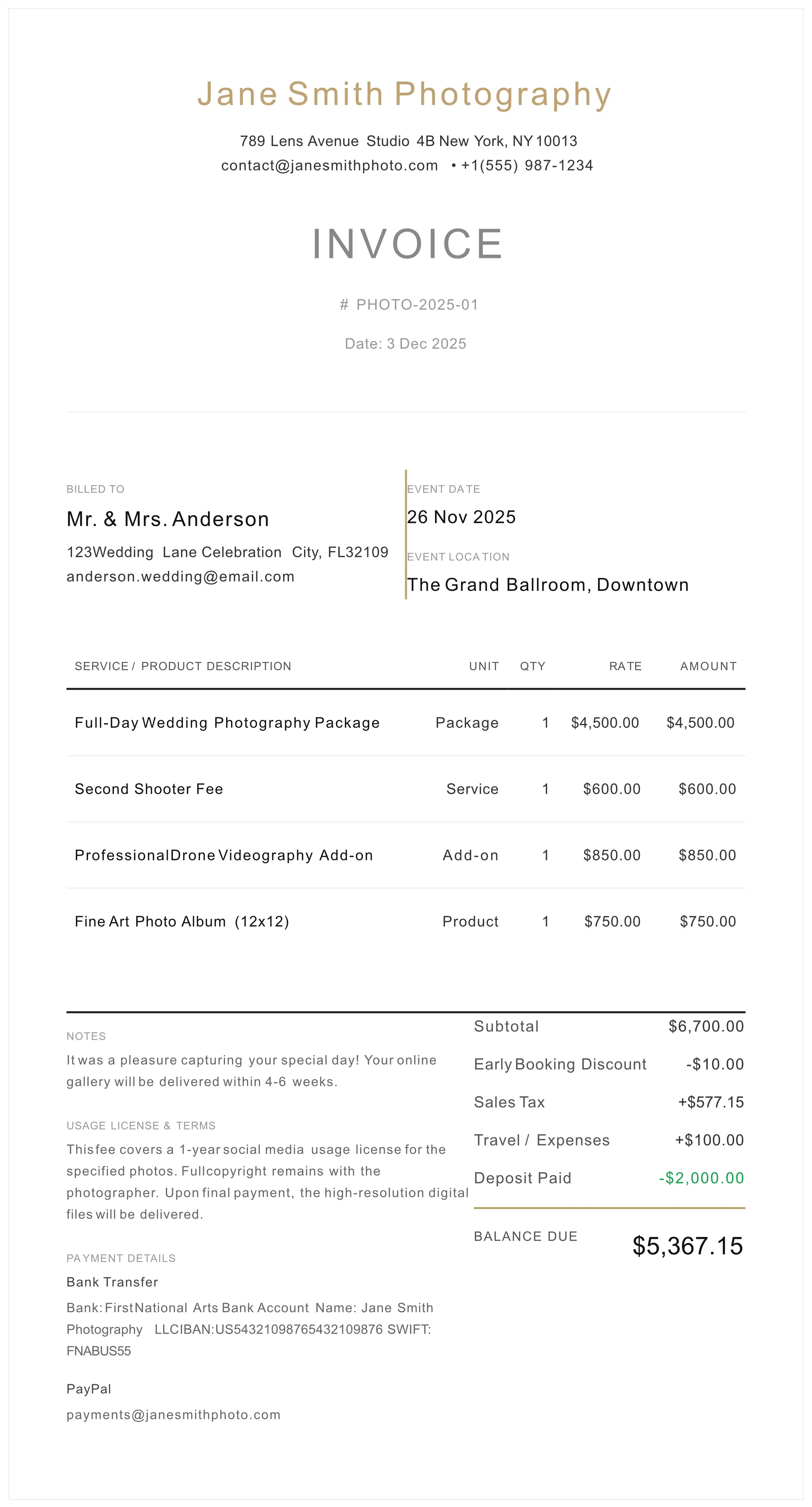
- Your business block: logo, business name, address, email and phone at the top.
- Document title, number and date: INVOICE (editable), a unique invoice number and the invoice date.
- Billed To: the client's name, address and email.
- Event Date and Event Location: printed only when you fill them in.
- Service / Product Description table: one line per service with Unit, Qty, Rate and Amount: coverage, second shooter, add-ons, album or prints.
- Notes: delivery details, such as when the online gallery will be ready.
- Usage License & Terms: the licence scope and the key terms from your contract.
- Payment Details: bank transfer details or a payment link.
- Totals: subtotal, any discount, the tax line with your label, Travel / Expenses, Deposit Paid, and the Balance Due (shown as Total Amount when no deposit was paid).
For a complete filled-in photography invoice with the arithmetic shown, see the example on the Photography Invoice Generator page.
Photography invoice terms and conditions (editable clauses)
Short clauses to adapt for the Usage License & Terms box. Each one is a starting point, not legal advice: the full terms belong in your contract, and whether a clause can be enforced depends on the contract and the law where you work.
"Licence: [personal / commercial / editorial] use of the delivered images for [media] in [territory] for [duration]. All other rights reserved by the photographer." "Payment schedule as set in our agreement dated [date]: [amount] paid on booking (shown as Deposit Paid); balance of [amount] due by [date]." "Amounts unpaid after the due date are subject to [the late fee / interest set in our agreement], or the maximum allowed by law, whichever is less." Check the rate you plan to charge with the late fee calculator, which shows statutory figures and caps for each US state.
"Edited images delivered by [date / number of weeks after the event] via [online gallery / download link]. Final files are released when the balance is paid." "Cancellations and rescheduling are governed by clause [X] of our agreement dated [date]." Real Estate & Drone Line Items
Real estate and aerial work can be priced per property or per deliverable rather than per hour; the Real Estate Photography Invoice Generator lists photos, twilight shots, drone images and virtual-tour hosting as separate lines. If you fly a drone for paid work in the US, 14 CFR 107.12 says no person may act as remote pilot in command unless that person has "a remote pilot certificate with a small UAS rating" (eCFR); outside the US, check your national aviation authority's rules.
How to write a photography invoice, step by step
These steps follow the fields of the Photography Invoice Generator in order; the same items apply if you use a blank template.
- Add your business details and logo In the Invoice Configuration panel, upload your logo (PNG, JPG or WEBP) and pick the currency under Monetary Unit: one of 8 presets or a custom symbol. Under From (Sender), enter your business name, address, email and phone.
- Enter the client Under To (Client), enter the client's name or company, address, email and phone. On the invoice this block prints as Billed To.
- Add the Event Date and Event Location Fill in Event Date and Event Location for a wedding, event or on-location shoot. Each prints only when filled, so leave them empty for studio or product work.
- Number and date the invoice In Invoice Details, give the invoice a unique number and the invoice date. The Document Title (INVOICE by default) can be edited. This layout does not print the Due Date field, so state the exact due date in your terms (next steps).
- List the services as line items One line per item: a description, a unit (hour, session, image, album), the quantity and the rate. Keep the creative fee and the usage licence on separate lines.
- Check the totals, deposit and balance Set the tax label (sales tax, GST or VAT) and the rate that applies to you, or leave it at 0. Add travel costs in Travel / Expenses. Enter any retainer or deposit already paid in Deposit Paid; the invoice then shows the Balance Due.
- Write the notes and the Usage License & Terms Use Notes for delivery details such as the gallery date. The Terms & Conditions box prints as Usage License & Terms: put the licence scope, the payment schedule with the exact due date, and the cancellation reference there.
- Add payment details Under Payment Methods, list how the client can pay (for example bank transfer details or a payment link). They print as Payment Details.
- Preview, download and send Click Preview & Download, check the preview, then Confirm & Download PDF. Email the PDF to the client and keep a copy.
Sending the invoice and following up
- Email the PDF to the person who pays, with the invoice number and the due date in the subject line, and keep a copy of every invoice you send.
- Check the due date matches your terms; the payment due date calculator works out the exact date from Net terms.
- Before the due date, a short friendly reminder with the invoice attached again.
- On the due date, a reminder that payment is due today, with your payment details.
- After the due date, a firmer reminder stating the amount overdue and any late fee your contract provides; the late fee calculator works out the figure.
- If it stays unpaid, a final written notice before any further step, and keep a record of every message.
Free Photography Invoice Template & Generator
Fill in a photography invoice online with the generator, or download a blank photography invoice template (PDF or Word) to fill in yourself.
In the generator:
- Event Date and Event Location fields
- Line items with Unit, Qty and Rate
- An editable tax label and rate
- Travel / Expenses and Deposit Paid, with Balance Due
- A Usage License & Terms box and Notes
- Your logo and currency
No signup required. Or download the blank photography invoice template.
Photography Invoice FAQ
What terms and conditions should a photography invoice include?
Repeat the terms your contract sets, in short form: the usage licence (who may use the images, for what, where and for how long), the payment schedule and due date, what happens if payment is late, the delivery timeline, and a reference to the cancellation terms. Keep the full wording in the contract and summarise it on the invoice. Treat any clause wording you find, including ours, as a starting point and have it reviewed for your jurisdiction.
Is an invoice legally binding without a separate contract?
An invoice is a request for payment. The terms that bind you and the client are the ones you both agreed, normally in a signed contract or an accepted quote before the shoot; terms that appear for the first time on an invoice sent afterwards may not bind the client. Put the licence, payment schedule and cancellation terms in the contract and repeat them on the invoice. The rules differ by country, so have your contract reviewed for your jurisdiction.
Can I withhold photos if the invoice is not paid?
What you may do is set by your contract, so put the condition there, for example that final files are delivered and the licence starts only when the invoice is paid in full, and repeat it on the invoice. Copyright law also differs by country: in the US, copyright 'vests initially in the author' (17 U.S.C. §201(a)) and a transfer of ownership must be in writing and signed (17 U.S.C. §204(a)); in the UK, an assignment of copyright 'is not effective unless it is in writing signed by or on behalf of the assignor' (CDPA 1988 s.90(3)). Have your contract reviewed for your jurisdiction.
How should I bill for 'Digital Delivery' tax?
Whether digital files, prints and photography services are taxed, and at what rate, depends on your state or country. List them as separate lines so the right treatment can be applied to each, set the tax label and rate that apply to you, and check with your tax authority or accountant.
What is the difference between a Photography Invoice and a Contract?
A Photography Contract is signed before services begin and outlines the full terms of engagement. A Photography Invoice is issued after (or during) services to request payment. A well-structured photography invoice repeats the key contract terms, particularly the usage licence, so the client sees them again when paying; it does not replace the contract.
Should I use 'Deposit' or 'Retainer' on my photography invoice?
Use the word your contract uses, and make sure the contract says whether the payment is refundable if the client cancels. Whether a non-refundable booking fee holds up depends on the contract wording and the law where you work, so have it reviewed locally. On the invoice, show the amount already paid in Deposit Paid so the Balance Due is clear.