
What makes an invoice valid?
It depends first on whether you are registered for VAT or GST:
- VAT- or GST-registered seller: the invoice must show every detail the tax authority lists for that kind of invoice. The checklist below sets out the UK, EU and Australian lists.
- Not VAT-registered (UK): GOV.UK: “Only VAT-registered businesses can issue VAT invoices.” and “You cannot include VAT on your invoices until you get your VAT registration number” (Charge, reclaim and record VAT; Register for VAT). Your invoice still needs “a unique identification number”, your name, address and contact details, the customer's name and address, “a clear description of what you're charging for”, the supply date, the date of the invoice, the amounts charged and “the total amount owed”. A sole trader must also show “your name and any business name being used” and “an address where any legal documents can be delivered to you if you are using a business name” (GOV.UK, Invoices: what they must include).
- Not GST-registered (Australia): business.gov.au says to use “the word ‘invoice’ – you must not use ‘tax invoice’” (How to invoice).
- United States: there is no federal VAT. IRS Publication 583 lists invoices among the supporting documents to keep: “Supporting documents include sales slips, paid bills, invoices, receipts, deposit slips, and canceled checks. These documents contain information you need to record in your books.” (IRS Publication 583). This guide does not cover US state sales tax; check with the tax agency of the state where you sell.
Valid VAT invoice checklist (UK, EU, Australia)
HMRC lists the details a full VAT invoice must show in VAT Notice 700/21, section 4.1. Only VAT-registered businesses can issue VAT invoices. Article 226 of the VAT Directive (2006/112/EC) lists the only details Member States may require for VAT purposes on a full invoice. Which Member State's invoicing rules apply is set by Article 219a. The ATO lists 7 details a tax invoice for a taxable sale under $1,000 must let the buyer clearly determine; from $1,000 the invoice must also show the buyer's identity or ABN. Each cell follows the source's own list (EU items numbered as in Article 226); “Not on this list” means that list does not ask for it.
| Detail | UK full VAT invoice VAT Notice 700/21 s. 4.1 | EU full invoice Directive 2006/112/EC Art. 226 | EU simplified invoice Art. 220a / 226b | Australia tax invoice ATO, Tax invoices |
|---|---|---|---|---|
| Invoice number | A sequential number based on one or more series which uniquely identifies the document | (2) a sequential number, based on one or more series, which uniquely identifies the invoice | Not in the Art. 226b minimum | Not on this list |
| Date of issue | The date of issue of the document (where different to the time of supply) | (1) the date of issue | (a) the date of issue | Date the invoice was issued |
| Date of supply (tax point) | The time of the supply | (7) the date of supply (or of a payment on account), where it can be determined and differs from the date of issue | Not in the Art. 226b minimum | Not on this list |
| Seller's name and address | The name, address and VAT registration number of the supplier | (5) the full name and address of the taxable person and of the customer | (b) identification of the taxable person supplying the goods or services | Seller's identity |
| Seller's VAT / GST number | Part of: “The name, address and VAT registration number of the…” | (3) the supplier's VAT identification number | (b) identification of the taxable person supplying the goods or services | Seller's Australian business number (ABN) |
| Customer's name and address | The name and address of the person to whom the goods or services are supplied | Part of: “(5) the full name and address of the taxable…” | Not in the Art. 226b minimum | Buyer's identity or ABN (Sales of $1,000 or more) |
| Customer's VAT number | Not on this list | (4) the customer's VAT identification number, where the customer is liable for the VAT or receives an intra-Community supply of goods (Art. 138) (Reverse charge or intra-EU supply of goods) | Not in the Art. 226b minimum | Part of: “Buyer's identity or ABN” |
| Description of the goods or services | A description sufficient to identify the goods or services supplied | (6) the quantity and nature of the goods supplied or the extent and nature of the services rendered | (c) identification of the type of goods or services supplied | Brief description of the items sold, including the quantity (if applicable) and the price |
| Quantity, unit price and net amount | For each description, the quantity of the goods or the extent of the services, and the rate of VAT and the amount payable, excluding VAT, expressed in any currencyThe unit price | (8) the taxable amount per rate or exemption, the unit price exclusive of VAT and any discounts or rebates if they are not included in the unit price | Not in the Art. 226b minimum | Part of: “Brief description of the items sold, including the quantity…” |
| VAT rate | Part of: “For each description, the quantity of the goods or…” | (9) the VAT rate applied | Not in the Art. 226b minimum | Extent to which each sale on the invoice is a taxable sale |
| Total excluding VAT | The gross total amount payable, excluding VAT, expressed in any currency | Part of: “(8) the taxable amount per rate or exemption, the…” | Not in the Art. 226b minimum | Not on this list |
| VAT / GST amount | The total amount of VAT chargeable, expressed in sterling | (10) the VAT amount payable (unless a special arrangement excludes it) | (d) the VAT amount payable or the information needed to calculate it | GST amount (if any) payable, shown separately or, if exactly one-eleventh of the total price, as a statement which says 'Total price includes GST' |
| Cash discount | The rate of any cash discount offered | Part of: “(8) the taxable amount per rate or exemption, the…” | Not in the Art. 226b minimum | Not on this list |
| Says it is a tax invoice | Not on this list | Not on this list | Not in the Art. 226b minimum | Document is intended to be a tax invoice |
| Reverse charge, exemption and other special mentions | Special rules apply to invoices issued under a margin scheme or subject to a reverse charge. | (11a) the mention 'Reverse charge' (Customer liable for the VAT)(11) a reference to the exemption provision, or any other reference indicating that the supply is exempt (Exempt supply)(10a) the mention 'Self-billing' (Invoice issued by the customer)(7a) the mention 'Cash accounting' (Cash accounting scheme)(12)-(15) new means of transport details, margin-scheme mentions, tax representative's details (Special cases only) | (e) for a document amending an earlier invoice: specific and unambiguous reference to that initial invoice and the details being amended | Not on this list |
Checked against the sources on 2026-09-25. The EU simplified column is the minimum in Article 226b; Member States may ask for more, but only details from Articles 226, 227 and 230.
Rules around the invoice
| Topic | United Kingdom | European Union | Australia |
|---|---|---|---|
| Who may issue it | Only VAT-registered businesses issue VAT invoices. Only VAT-registered businesses can issue VAT invoices.VAT Notice 700/21 s. 3.1 | — | Registration at $75,000; unregistered sellers do not issue tax invoices. You must register for GST when your GST turnover is $75,000 or more ($150,000 for non-profit organisations), within 21 days. A business that is not registered for GST issues a regular invoice: business.gov.au says to use the word 'invoice' and not 'tax invoice'.business.gov.au, How to invoice; ATO, Registering for GST (last updated 14 September 2026) |
| When to issue | Issue within 30 days. If you are VAT-registered, you must issue a VAT invoice whenever you supply standard-rated or reduced-rated goods or services to another VAT-registered person, normally within 30 days of the date of supply.VAT Notice 700/21 s. 3.1 | Issue deadline (Art. 222). For intra-EU supplies of goods (Art. 138) and for services where the customer pays the VAT under Art. 196, the invoice must be issued no later than the 15th day of the month after the chargeable event. For other supplies, each Member State may set its own time limit.Directive 2006/112/EC Art. 222 | Within 28 days of a request. If a customer asks for a tax invoice, provide it within 28 days (GST Act s 29-70(2)), unless the sale is $82.50 (including GST) or less.ATO, Tax invoices |
| Simplified / small invoices | Simplified VAT invoices: £250 or less. If you are not a retailer and the total value of your supply does not exceed £250 (including VAT), you may issue a simplified invoice showing your name, address and VAT registration number, the time of supply, a description identifying the goods or services, and for each VAT rate the total amount payable including VAT and the VAT rate charged. Exempt supplies must not be included. Above £250 you must issue a full or modified VAT invoice.VAT Notice 700/21 s. 4.5 | Simplified invoices (Art. 220a and 226b). Member States must allow a simplified invoice where the invoice amount is not higher than EUR 100 (or the national-currency equivalent), for a document amending an earlier invoice (Art. 219), or where the seller uses the small-enterprise exemption (Art. 284). It is not allowed for intra-EU supplies of goods, for distance sales under Art. 33(a), or where a non-established supplier's customer pays the VAT. A simplified invoice needs at least the date of issue, the supplier's identification, the type of goods or services, and the VAT amount or the information needed to calculate it.Directive 2006/112/EC Art. 220a(1)(a); Art. 226b | Sales of $82.50 or less. A GST-registered seller need not provide a tax invoice on request for a sale of $82.50 (including GST) or less.ATO, Tax invoices |
| Which country's rules apply | — | Which Member State's invoicing rules apply (Art. 219a). As a rule, invoicing follows the rules of the Member State where the supply is deemed to take place. The supplier's own Member State's rules apply instead where the supplier is not established in the Member State of supply and the customer pays the VAT (unless the customer self-bills), where the supply is deemed to take place outside the EU, or where the supplier uses one of the special schemes (OSS/IOSS).Directive 2006/112/EC Art. 219a(1) | — |
| Correcting an invoice | Credit notes. When you allow a credit or contingent discount, you and your customer adjust the original VAT charge unless both of you agree not to (possible only where the customer can reclaim all the VAT as input tax); issue a credit note and keep a copy.HMRC, VAT guide (VAT Notice 700) s. 18.2.1 | Correcting an invoice (Art. 219). A document that amends and refers specifically and unambiguously to the initial invoice is treated as an invoice. It may be a simplified invoice, which must then refer to the initial invoice and the details being amended (Art. 226b(e)).Directive 2006/112/EC Art. 219 | Adjustment notes. You need a valid adjustment note before you can make a decreasing adjustment, unless the adjustment is for GST of $75 or less.ATO, Adjustment notes (last updated 14 September 2026) |
Keeping VAT invoices
- United Kingdom: Generally, keep all business records for VAT purposes for at least 6 years. VAT Notice 700/21 s. 2.4
- European Union: Each Member State decides how long invoices must be stored. Directive 2006/112/EC Art. 247(1)
- Australia: Keep most records for 5 years, generally from when you prepared or obtained the record or completed the transactions it relates to, whichever is later. ATO, Overview of record-keeping rules for business (last updated 18 June 2026)
- UK schemes: GOV.UK: “You must keep VAT records for at least 6 years (or 10 years if you are using the VAT One Stop Shop (OSS) scheme or used the VAT Mini One Stop Shop (MOSS) scheme).” GOV.UK
Requirements in other countries
- Canada GST/HST Invoice Requirements for Businesses and Freelancers — What are the GST/HST invoice requirements in Canada?
- What Must Be on a German Invoice: the § 14 UStG Mandatory Fields — What must be on a German invoice?
- Switzerland Invoice Requirements: What a Swiss VAT (MWST) Invoice Must Show — What are the invoice requirements in Switzerland?
How to show VAT on an invoice (VAT breakdown example)
When an invoice mixes VAT rates, set out the net amount and the VAT for each rate. The EU VAT Directive asks for “the taxable amount per rate or exemption”, “the VAT rate applied” and “the VAT amount payable” (Article 226(8)-(10)). HMRC asks, “for each description”, for “the rate of VAT and the amount payable, excluding VAT”, and on an invoice with zero-rated or exempt items “you must make sure that those items show clearly that there's no VAT payable and you must show a separate total for their values” (VAT Notice 700, 16.5).
Example: a UK supplier invoicing at the 20% standard rate, the 5% reduced rate (GOV.UK gives children's car seats as an example) and an exempt line. The figures are illustrative.
| Description | Qty × unit price (£) | Net (£) | VAT rate | VAT (£) |
|---|---|---|---|---|
| Office chairs | 4 × 150.00 | 600.00 | 20% | 120.00 |
| Children's car seats (reduced rate) | 2 × 80.00 | 160.00 | 5% | 8.00 |
| Exempt service (generic example) | 1 × 200.00 | 200.00 | Exempt | No VAT |
| VAT summary | Taxable amount (£) | VAT (£) |
|---|---|---|
| At 20% | 600.00 | 120.00 |
| At 5% | 160.00 | 8.00 |
| Exempt (separate total) | 200.00 | 0.00 |
| Total | 960.00 net | 128.00 VAT · 1,088.00 total |
- Exempt lines: in the EU, add, “in the case of an exemption, reference to the applicable provision of this Directive, or to the corresponding national provision, or any other reference indicating that the supply of goods or services is exempt” (Article 226(11)). In the UK, since 18 March 2024, “The reason for any zero rate or exemption has been removed from the list of details you must include on a VAT invoice” (VAT Notice 700/21).
- Rounding (UK): “You may round down the total VAT payable on all goods and services shown on a VAT invoice to a whole penny. You can ignore any fraction of a penny.” Line-by-line VAT is rounded down to the nearest 0.1p or to the nearest 1p or 0.5p, and “Whatever you decide, you must be consistent.” This concession is for invoice traders, not retailers (VAT Notice 700, 17.5).
- Another currency: for a UK supply invoiced in a foreign currency, “you must convert the total amount of VAT payable into sterling” (16.4), using the UK market selling rate at the time of supply or, as an alternative, HMRC's period rate of exchange (7.6). In the EU, amounts “may be expressed in any currency, provided that the amount of VAT payable or to be adjusted is expressed in the national currency of the Member State” (Article 230). More in our invoice currency guide.
Our VAT invoice generator applies one VAT rate per invoice, so it cannot print a two-rate summary like this one; use the Word or Excel VAT invoice template and add a line per rate, or issue one invoice per rate. The template page has a filled single-rate sample.
VAT invoice vs tax invoice
They are the same document. The UK and the EU mostly say “VAT invoice” (the EU Directive simply says “invoice”), while other tax authorities call the invoice that supports a VAT or GST claim a “tax invoice”:
- UK: HMRC's own example of a VAT invoice is headed “A tax invoice” and numbered “Sales invoice no 174” (VAT Notice 700/21, section 4.3).
- Australia: the ATO's list starts with “Document is intended to be a tax invoice” (ATO).
- Singapore: IRAS: “A tax invoice/ customer accounting tax invoice is the main document for supporting an input tax claim.” (IRAS)
- Saudi Arabia: ZATCA: “A tax invoice is usually issued by a business to another business (B2B)” (ZATCA).
Two related terms: VATable describes “goods and services on which VAT must be paid” (Cambridge Dictionary), and a VAT sales invoice is simply the VAT invoice you issue for a sale, as in HMRC's “Sales invoice no 174”. A “value added tax invoice” is the same thing spelled out.
VAT Invoice vs Regular Invoice: Key Differences
Understanding the distinction between a VAT invoice and a regular invoice is critical for compliance. A VAT invoice is a statutory tax document that enables input tax recovery, while a regular invoice is simply a commercial record of a transaction.
| Feature | Regular Invoice | VAT Invoice |
|---|---|---|
| VAT Registration Number | Not required | Mandatory |
| Tax Breakdown | Not required | Must show VAT rate & amount separately |
| Customer VAT Number (B2B) | Optional | Required for cross-border |
| Legal Status | Commercial document | Statutory tax document |
| Input Tax Recovery | Not possible | Enables VAT reclaim |
Simplified VAT invoices: UK £250 and EU €100
UK: £250 or less (including VAT)
You can issue one if the supply is £250 or less and your customer agrees (VAT Notice 700, 16.6.1; 700/21, 4.5). It must show:
- Your name, address and VAT registration number
- The time of supply (tax point)
- A description which identifies the goods or services
- For each VAT rate, the total amount payable including VAT, and the VAT rate charged
Compared with a full VAT invoice it can leave out:
- The customer's name and address
- The invoice number
- The unit price and net amounts
- The separate VAT amount (the rate and the VAT-inclusive total are enough)
Exempt supplies must not be included. Above £250, issue a full VAT invoice or a modified VAT invoice showing VAT-inclusive values.
EU: up to EUR 100 (Art. 220a)
Member States must allow a simplified invoice where the invoice amount is not higher than EUR 100 (or the national-currency equivalent), for a document amending an earlier invoice (Art. 219), or where the seller uses the small-enterprise exemption (Art. 284). It is not allowed for intra-EU supplies of goods, for distance sales under Art. 33(a), or where a non-established supplier's customer pays the VAT. A simplified invoice needs at least the date of issue, the supplier's identification, the type of goods or services, and the VAT amount or the information needed to calculate it.
Minimum content (Article 226b):
- (a) the date of issue
- (b) identification of the taxable person supplying the goods or services
- (c) identification of the type of goods or services supplied
- (d) the VAT amount payable or the information needed to calculate it
- (e) for a document amending an earlier invoice: specific and unambiguous reference to that initial invoice and the details being amended
Article 226b is a floor: Member States may ask for more, up to the Article 226 list, so check the country where the supply is made.
You can make a full VAT invoice with our free generator.
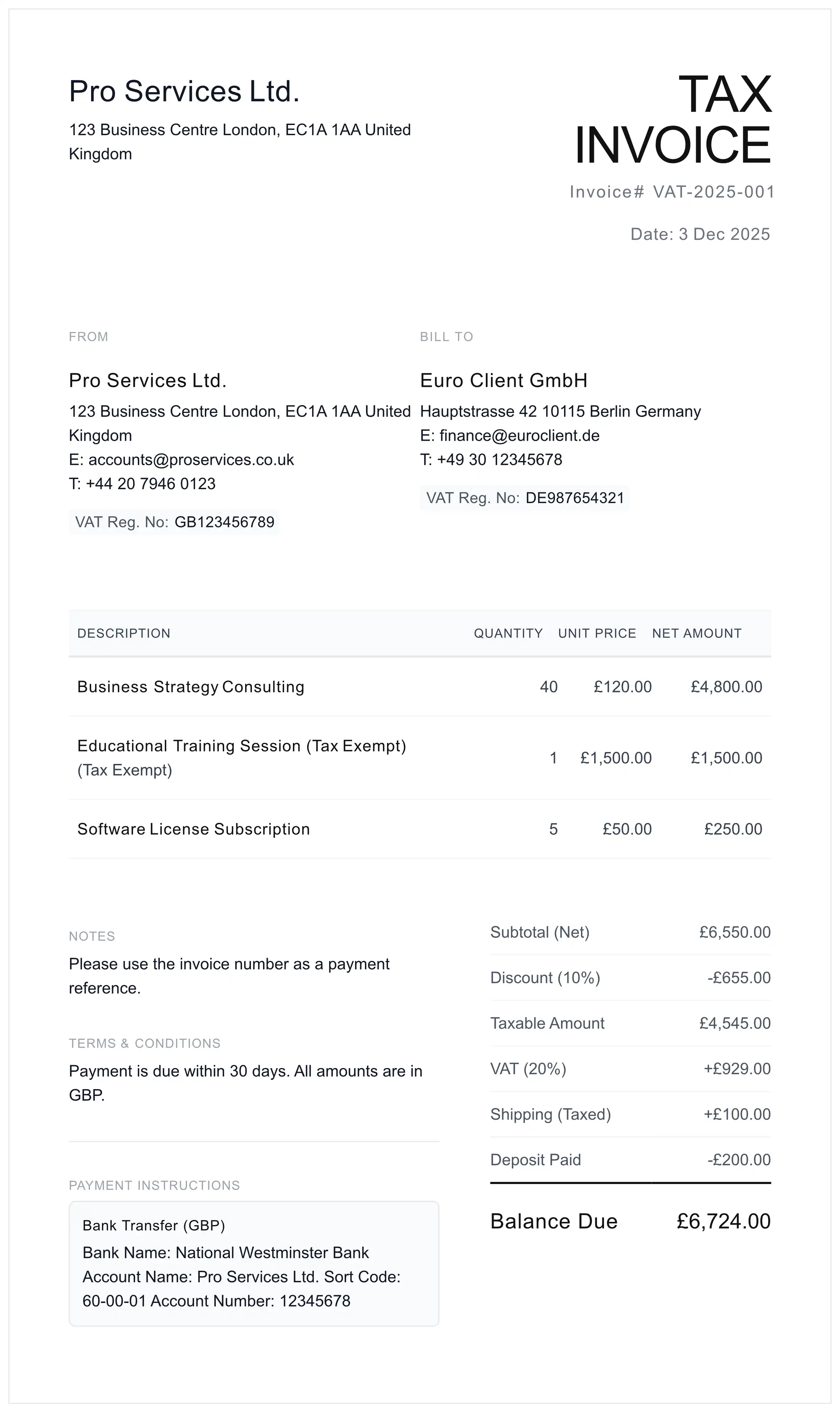
Anatomy of a Compliant Invoice
The visual structure of an invoice must facilitate rapid auditing. Below is an example generated by our system that separates tax components to meet strict accounting standards.
Country-Specific VAT Rules: UK, EU, Australia & Canada
Compliance is location-dependent. Below are the critical references for major jurisdictions. For cross-border goods shipments, also see our Commercial Invoice Guide for customs documentation requirements.
UK VAT Invoice Requirements
The UK VAT system is governed by HM Revenue & Customs (HMRC) and follows the Value Added Tax Act 1994. HMRC's invoice rules are in VAT Notice 700/21 and the VAT guide (Notice 700).
- VAT rates: 20% standard; reduced and zero rates 5% / 0% (GOV.UK / HMRC).
- Simplified invoice: allowed for supplies of £250 or less (including VAT) — see simplified invoices.
- Making Tax Digital (MTD): HMRC: “You should now keep VAT records and submit VAT Returns using compatible software.” (GOV.UK, Making Tax Digital for VAT)
- Invoice time limit: “Normally you must issue a VAT invoice within 30 days of the date you make the supply.” (700/21, section 3.1)
- Currency: you may invoice in any currency, but “For VAT purposes, amounts of money must always be expressed in sterling”: convert the total VAT at the UK market selling rate at the time of supply or, as an alternative, HMRC's published period rate of exchange (VAT Notice 700, 7.6; invoice currency guide).
- Record retention: Generally, keep all business records for VAT purposes for at least 6 years. Under the VAT One Stop Shop (OSS) scheme it is 10 years — see keeping VAT invoices.
Who you are changes what goes on the invoice
- Sole trader: GOV.UK adds “your name and any business name being used” and “an address where any legal documents can be delivered to you if you are using a business name”.
- Limited company: “If your company is a limited company, you must include the full company name as it appears on the certificate of incorporation.” Naming directors is optional, but once you name one, GOV.UK requires all of them.
Late payment from another business
- Default payment period: “Unless you agree a payment date, the customer must pay you within 30 days of getting your invoice or the goods or service.” (GOV.UK)
- Statutory interest: “8% plus the Bank of England base rate for business to business transactions”, unless your contract sets a different rate; to add it, GOV.UK says to send a new invoice (GOV.UK).
- Fixed recovery sum on top: £40 for a debt up to £999.99, £70 from £1,000 to £9,999.99 and £100 from £10,000, once per payment (GOV.UK).
Sole trader and company details: GOV.UK, Invoices: what they must include. Checked October 3, 2026.
EU VAT Invoice Requirements
EU VAT invoicing is harmonised under Council Directive 2006/112/EC. Article 226 of the VAT Directive (2006/112/EC) lists the only details Member States may require for VAT purposes on a full invoice. Which Member State's invoicing rules apply is set by Article 219a. The items are in the checklist.
- Reverse charge: where the customer pays the VAT, the invoice carries the customer's VAT identification number (Article 226(4)) and the mention “Reverse charge” (Article 226(11a)). See reverse charge; VAT numbers can be checked in VIES.
- Intra-Community supply of goods: Article 138(1) exempts goods dispatched to another Member State when the customer is a taxable person (or non-taxable legal person) identified for VAT in another Member State and has given the supplier that VAT number; the exemption can be lost if the supplier's recapitulative statement is missing or wrong (Article 138(1a)).
- ViDA: Council Directive (EU) 2025/516 (“VAT in the Digital Age”) was published on 25 March 2025 and entered into force on 14 April 2025. From 1 July 2030 structured e-invoicing becomes the default under the VAT Directive and digital reporting replaces recapitulative statements for intra-EU B2B (Directive (EU) 2025/516). The dates bind Member States, which apply them through national law.
- Words the Directive fixes: Article 226 gives the exact mention for each special case: “Reverse charge” (point 11a), “Self-billing” (10a), “Cash accounting” (7a), “Margin scheme — Travel agents” (13) and, for second-hand goods, works of art or antiques, the matching “Margin scheme — …” wording (14). An exempt sale has no set wording; there, point 11 wants the legal reference for the exemption.
- Language: Member States “may, for certain taxable persons or certain cases, require translation into their official languages” but “may, however, not impose a general requirement that invoices be translated” (Article 248a).
- Self-billing: “Invoices may be drawn up by the customer in respect of the supply to him, by a taxable person, of goods or services, where there is a prior agreement between the two parties and provided that a procedure exists for the acceptance of each invoice by the taxable person supplying the goods or services.” (Article 224). See recipient-created invoices and self-billing.
Australian GST Invoice Requirements
Australia's Goods and Services Tax (GST) is administered by the ATO (Australian Taxation Office) at 10%. The rules for tax invoices are defined under the A New Tax System (Goods and Services Tax) Act 1999.
- Tax invoice on request: “If a customer asks for a tax invoice, you must provide one within 28 days, unless it is for a sale of $82.50 (including GST) or less.”
- $1,000 or more: the tax invoice must also show the buyer's identity or ABN (see the checklist).
- Adjustment notes: “You need a valid adjustment note before you can make a decreasing adjustment, unless the adjustment is for GST of $75 or less.” (ATO, Adjustment notes)
- GST-free sales: ATO: “You don't include GST in the price if your product or service is GST-free.” On an invoice that mixes taxable and GST-free items, the invoice must clearly show which items are taxable (ATO, GST-free sales).
- E-invoicing: ATO: “Since July 2022, all Non-corporate Commonwealth Entities (NCEs) have been mandated to be able to receive Peppol eInvoices” (ATO).
- Registration: You must register for GST when your GST turnover is $75,000 or more ($150,000 for non-profit organisations), within 21 days. A business that is not registered for GST issues a regular invoice: business.gov.au says to use the word 'invoice' and not 'tax invoice'.
- Record retention: Keep most records for 5 years, generally from when you prepared or obtained the record or completed the transactions it relates to, whichever is later.
Canadian GST/HST Invoice Requirements
Canada has no single fixed GST/HST invoice format. What the invoice must show depends on its total: the Input Tax Credit Information (GST/HST) Regulations (SOR/91-45) set three tiers of information (under $100, $100 to $499.99, and $500 or more) that a GST/HST-registered customer needs before it can claim input tax credits. CRA adds that customers must be told whether GST/HST applies and whether it is included in the price or added separately, and must be shown the GST/HST rate plus either the GST/HST amount or a clear statement that the total includes GST/HST.
- Rates: Federal GST is 5% (Excise Tax Act s. 165(1)). HST replaces GST in the participating provinces: 13% Ontario, 14% Nova Scotia (since 1 April 2025), 15% New Brunswick, Newfoundland and Labrador and Prince Edward Island. British Columbia (7% PST), Manitoba (7% RST), Saskatchewan (6% PST) and Quebec (9.975% QST) charge a separate provincial sales tax (CRA rate table).
- Full field list, tiers and sources: Canada GST/HST invoice requirements.
VAT & GST Standard Rates by Country (2026)
The standard rate is what goes on an ordinary B2B or B2C invoice unless the supply qualifies for a reduced, zero or exempt treatment. Every rate below was verified against the official source linked in the same row — the national tax authority or the European Commission — so you can confirm the figure yourself before invoicing. Each row has its own anchor (for example #germany or #united-kingdom), so you can link a colleague straight to one country.
| Country | Tax | Standard rate | Reduced rates | Official source |
|---|---|---|---|---|
| Australia | GST | 10% GST is 10% of the value of a taxable supply (GST Act 1999 s 9-70). GST-free supplies (0%) are listed in Division 38: food (with exclusions such as hot food and prepared meals), health, education, child care, exports and others. Registration is required at a GST turnover of $75,000 or more (business.gov.au). | 0% GST-free (basic food, health, education, exports) | business.gov.au (Australian Government) |
| Austria | VAT | 20% USP.gv.at (last update 1 July 2026): general rate 20%; reduced rates 13%, 10% and, since 1 July 2026, 4.9% on selected basic foods such as bread, butter, eggs and milk. Menstrual hygiene products and contraceptives are VAT-exempt since 1 January 2026 (BMFWF). | 13% / 10% / 4.9% | USP.gv.at (Austrian Business Service Portal, BMF) |
| Bahrain | VAT | 10% National portal: a standard VAT rate of 10% applies from 1 January 2022. Certain goods and services are zero-rated (0%) and others are exempt. | 0% (zero-rated) and exempt on certain goods/services (see NBR) | Bahrain National Portal (bahrain.bh) / NBR |
| Belgium | VAT | 21% European Commission VAT rates table (last checked 13/07/2026): 21% standard, 6% and 12% reduced. The Belgian SPF Finances pages could not be opened for this check, so the Commission's table is cited. | 12% / 6% | European Commission: Your Europe VAT rates table |
| Bulgaria | VAT | 20% European Commission VAT rates table (last checked 13/07/2026): 20% standard, 9% reduced. | 9% | EC Your Europe (official EU portal) |
| Canada | GST/HST | 5% (federal GST) Federal GST is 5% (Excise Tax Act s. 165(1)). HST replaces GST in the participating provinces: 13% Ontario, 14% Nova Scotia (since 1 April 2025), 15% New Brunswick, Newfoundland and Labrador and Prince Edward Island. British Columbia (7% PST), Manitoba (7% RST), Saskatchewan (6% PST) and Quebec (9.975% QST) charge a separate provincial sales tax (CRA rate table). | HST 13% ON / 14% NS / 15% NB, NL, PE; 5% GST only in AB, BC, MB, QC, SK and the territories (PST/RST/QST are separate) | Canada Revenue Agency (canada.ca): GST/HST rates by province |
| Croatia | VAT | 25% Porezna uprava lists VAT rates of 0%, 5%, 13% and 25% (VAT Act, Article 38). A temporary 5% rate on natural gas, district heating and firewood, pellets, briquettes and wood chips runs until 31 March 2027 (Art. 38(4)-(5), consolidated text in force from 9 May 2026). | 13% / 5% / 0% | Porezna uprava (Croatian Tax Administration) |
| Cyprus | VAT | 19% European Commission VAT rates table (last checked 13/07/2026): 19% standard, 9% and 5% reduced, 3% super-reduced. The Cyprus Tax Department site could not be reached for this check. | 9% / 5% / 3% | EC Your Europe (VAT rates table) |
| Czech Republic | VAT | 21% Government portal: standard rate 21%, reduced rate 12%. Since 1 January 2024 supplies of books are exempt with the right to deduct (effectively 0%) under § 71i of the VAT Act (Financial Administration). | 12% / 0% | portal.gov.cz (Czech Government Portal) |
| Denmark | VAT | 25% Skattestyrelsen: 'the VAT rate is generally 25%'. Newspapers are sold at 0% (momsloven § 34(1)(18)), and exports and intra-EU supplies are also zero-rated. | 0% (e.g. newspapers; exports/intra-EU) | Skattestyrelsen (skat.dk) |
| Estonia | VAT | 24% EMTA: VAT rates are 24%, 13%, 9% and 0%. The standard rate is 24% from 1 July 2025 (previously 22%). From 1 January 2025 accommodation is taxed at 13% and press publications at 9%. | 13% / 9% / 0% | Estonian Tax and Customs Board (EMTA) |
| Finland | VAT | 25.5% Vero: general rate 25.5% since 1 September 2024 (previously 24%). The 13.5% reduced rate (14% until 31 December 2025) covers groceries, restaurants, books, pharmaceuticals, transport, accommodation and more; 10% covers newspapers and magazines. | 13.5% / 10% / 0% | Finnish Tax Administration (Vero) |
| France | VAT | 20% BOFiP: 20% normal rate, two reduced rates (10% and 5.5%) and a 2.1% particular rate. For electricity and natural-gas subscriptions, 20% replaced 5.5% for periods starting on or after 1 August 2025. | 10% / 5.5% / 2.1% | BOFiP - impots.gouv.fr (DGFiP official bulletin) |
| Germany | VAT | 19% § 12 UStG: 19% standard rate; 7% reduced rate, which covers restaurant and catering services (excluding drinks) with no end date in the current text. The European Commission VAT rates table (13/07/2026) also shows 19% / 7%. | 7% | Umsatzsteuergesetz (UStG) § 12, gesetze-im-internet.de |
| Greece | VAT | 24% AADE: regular rate 24% (since 1/6/2016), reduced 13%, super-reduced 6%. Rates cut by 30% (17% / 9% / 4%) apply on Leros, Lesvos, Kos, Samos and Chios and, from 1 January 2026, on other North Aegean, Samothrace and Dodecanese islands with up to 20,000 inhabitants (AADE circular E.2113/2025; not for tobacco products or means of transport). | 13% / 6% (islands 17/9/4) | AADE (Greek tax authority) |
| Hungary | VAT | 27% NAV guideline (last updated January 2026): general rate 27%, preferential rates 18% and 5%, and 0% for daily newspapers (published at least four times a week). | 18% / 5% / 0% | NAV (Hungarian Tax & Customs Administration) |
| India | GST | 5-40% (multi-slab) GST Council (56th meeting, PIB release): from 22 September 2025 a two-rate structure, an 18% standard rate and a 5% merit rate, plus a special 40% de-merit rate for a select few goods and services. From 1 February 2026 pan masala, tobacco (other than bidis), cigarettes and nicotine inhalation products moved to 40% and bidis to 18% (GST Council newsletter, December 2025). | 0% / 5% merit / 18% standard / 40% special de-merit | GST Council / PIB (Govt of India) |
| Ireland | VAT | 23% Revenue: standard rate 23%, reduced rate 13.5%, second reduced rate 9%, livestock rate 4.8%, plus a zero rate. From 1 July 2026 catering and restaurant supplies (excluding alcohol, soft drinks and bottled water), hot take-away food, hot tea and coffee, and hairdressing moved from 13.5% to 9%. | 13.5% / 9% / 4.8% / 0% | Revenue (Irish Tax and Customs) |
| Italy | VAT | 22% Agenzia delle Entrate: ordinary IVA rate 22%; reduced rates of 4% (e.g. food, beverages and agricultural products), 5% (e.g. certain foods) and 10% (e.g. domestic electricity and gas, medicines, building renovation work). Full lists: Table A of DPR 633/1972. | 10% / 5% / 4% | Agenzia delle Entrate: Norme generali e aliquote |
| Japan | Consumption Tax | 10% NTA: standard rate 10% (7.8% national + 2.2% local); reduced rate 8% (6.24% + 1.76%) from 1 October 2019 for food and drink other than alcoholic drinks and dining out, and for newspapers issued twice a week or more by subscription. | 8% (food and non-alcoholic drinks excluding dining out; subscription newspapers issued twice a week or more) | National Tax Agency (NTA) |
| Kuwait | VAT | No VAT No VAT in force. No official Kuwaiti government page stating the status was found; PwC Worldwide Tax Summaries (last reviewed 22 July 2026) says the GCC framework agreement is under discussion in Parliament while the draft law is being prepared by the government. | — | PwC Worldwide Tax Summaries (Kuwait) |
| Latvia | VAT | 21% VAT Law s. 41: standard rate 21%, reduced rates 12% and 5%, and 0%. A 12% rate on bread, milk, poultry meat and eggs applies from 1 July 2026 to 30 June 2027 (Transitional Provision 48); 12% also covers fresh fruit, berries and vegetables, and 5% books and press. The State Revenue Service (VID) states the 21% standard rate. | 12% / 5% / 0% | Value Added Tax Law (likumi.lv, official publication) |
| Lithuania | VAT | 21% VMI: standard rate 21%. From 1 January 2026 the 9% rate ended; accommodation, regular-route passenger transport and arts and culture admissions moved to 12%, and printed and electronic books to 5%. | 12% / 5% / 0% | Valstybine mokesciu inspekcija (VMI) |
| Luxembourg | VAT | 17% AED indirect-tax portal: four rates apply: 17% normal, 14% intermediate, 8% reduced and 3% super-reduced. | 14% / 8% / 3% | Portail de la fiscalite indirecte (pfi.public.lu, AED) |
| Malta | VAT | 18% VAT Act art. 19: standard rate 18%. The Eighth Schedule sets reduced rates of 12%, 7% and 5%. The 0% entry corresponds to supplies the Act calls 'exempt with credit'. | 12% / 7% / 5% / 0% | VAT Act (Cap. 406), legislation.mt |
| Netherlands | VAT | 21% Belastingdienst: 21% general tariff, 9% low tariff, and 0% for certain business conducted abroad from the Netherlands. From 1 January 2026 short-stay accommodation in hotels, pensions and holiday businesses is taxed at 21% instead of 9%. | 9% / 0% | Belastingdienst (Dutch Tax Administration) |
| New Zealand | GST | 15% IRD: 'GST is charged at a rate of 15%.' Long-stay commercial accommodation is taxed on 60% of its value after 4 weeks, an effective rate of 9% (IRD PUB00511). Zero-rated supplies are charged at 0% where certain requirements are met. | 9% effective (commercial accommodation over 4 weeks) / 0% (zero-rated, e.g. exports) | Inland Revenue (IRD) |
| Norway | VAT | 25% Skatteetaten (2026 rates): 25% normal rate; 15% on foodstuffs and on water and wastewater services; 12% on passenger transport, accommodation, public broadcasting and admission to cinemas, sporting events, amusement parks and activity centres. | 15% / 12% | Skatteetaten (Norwegian Tax Administration) |
| Oman | VAT | 5% Oman Tax Authority: basic rate 5% on most goods and services; zero rate (0%) on exports, essential goods (513 items) and international transport; exemptions include financial services and the rental of residential properties. | 0% (exports, 513 essential goods, international transport); exempt financial services / residential rent | Oman Tax Authority (Tax Portal) |
| Poland | VAT | 23% Ministry of Finance (page updated 15.12.2025): basic rate 23% (since 1 January 2011), reduced rates 8% and 5%, and 0% in listed cases. | 8% / 5% / 0% | podatki.gov.pl (Polish Ministry of Finance) |
| Portugal | VAT | 23% gov.pt: normal rate 23% on the mainland, 16% in the Azores and 22% in Madeira; intermediate 13% / 9% / 12%; reduced 6% / 4% / 5% (mainland rates also in Código do IVA art. 18). Rate levels are unchanged in 2026. | 13% / 6% (Azores 16/9/4; Madeira 22/12/5) | gov.pt (Portuguese Government): IVA guide |
| Qatar | VAT | No VAT No VAT in force: the General Tax Authority's laws page lists the GCC Unified VAT Agreement but no domestic VAT law (checked 25 September 2026). | — | Qatar General Tax Authority (GTA) |
| Romania | VAT | 21% ANAF: from 1 August 2025 the standard rate is 21% and a single reduced rate of 11% applies. A transitional 9% rate for qualifying homes covered purchases from 1 August 2025 to 31 July 2026 inclusive and has now ended. | 11% | ANAF (Romanian Tax Administration) |
| Saudi Arabia | VAT | 15% ZATCA: taxable persons charge VAT at 15%. Exports are zero-rated; financial services (except those charged by explicit fee), supplies of real estate by transfer of ownership and residential leases are exempt (VAT Implementing Regulations, Arts. 29-30). | 0% (exports/intl transport); exempt financial & real estate | ZATCA: Guideline on Imports and Exports under VAT (May 2026) |
| Singapore | GST | 9% MOF: GST was 3% when introduced on 1 April 1994 and rose to 8% in 2023 and 9% in 2024. IRAS: the current rate is 9%; exported goods and international services are zero-rated. | 0% (exports, qualifying international services) | Ministry of Finance (MOF) |
| Slovakia | VAT | 23% Financial Administration: since 1 January 2025 the basic rate is 23% and the reduced rates are 19% and 5%. From 1 January 2026 several foods (mainly final products with higher sugar or salt content) moved from 19% to 23%. | 19% / 5% | Financna sprava SR |
| Slovenia | VAT | 22% FURS: general rate 22%, reduced rate 9.5%, special reduced rate 5% (FURS 'Stopnje DDV', June 2026). | 9.5% / 5% | FURS (Financial Administration of Slovenia) |
| Spain | VAT | 21% Agencia Tributaria: general rate 21%; reduced rates 10% and 4%; 0% on certain transactions. A temporary 10% rate applied to certain energy supplies (electricity contracts up to 10 kW, natural gas, biomass and firewood) from 22 March to 31 May 2026 and to fuels from 22 March to 30 June 2026; the rest of 2026 is at 21% (AEAT, Tipos IVA 2026). | 10% / 4% / 0% | Agencia Tributaria |
| Sweden | VAT | 25% Skatteverket: standard rate 25%; reduced rates 12% and 6%. From 1 April 2026 food (including takeaway) is taxed at 6% instead of 12%, until 31 December 2027; food and drink consumed at a restaurant or café stays at 12%. | 12% / 6% | Skatteverket |
| Switzerland | VAT | 8.1% ESTV: normal rate 8.1%, reduced rate 2.6%, special rate 3.8% for accommodation. Parliament approved a rise to 8.5% (accommodation 4.0%, reduced rate unchanged at 2.6%) to fund the 13th AHV pension; it goes to a popular vote on 29 November 2026 and is not expected to take effect before 2028 (BSV). | 2.6% / 3.8% (accommodation) | ESTV / Swiss Federal Tax Administration (FTA) |
| United Arab Emirates | VAT | 5% Ministry of Finance: VAT was introduced on 1 January 2018 at a standard rate of 5%. Supplies of residential properties are generally exempt; exports of goods and services outside the GCC and international transport are zero-rated. E-invoicing: a pilot started on 1 July 2026 and businesses with revenue of AED 50 million or more must implement it from 1 January 2027. | 0% / exempt (some financial, residential property) | UAE Ministry of Finance |
| United Kingdom | VAT | 20% GOV.UK: standard rate 20% (from 4 January 2011, up from 17.5%); reduced rate 5% (e.g. children's car seats, home energy); zero rate 0% (e.g. most food, children's clothes). | 5% / 0% | GOV.UK / HMRC |
Last reviewed: 2026-09-25. Need the math done for you? Pick your country in our VAT & GST calculator — the same verified rates are preloaded — then issue the invoice with the VAT invoice generator.
E-Invoicing Mandates 2026: Peppol & ViDA
In a growing number of countries a PDF is no longer enough for B2B invoices: the invoice has to be a structured data file sent through a set network or platform. These milestones come from our e-invoicing mandates tracker (verified 2026-08-20), where each row quotes its official source.
| Country | System | Key dates |
|---|---|---|
| Belgium | Structured B2B e-invoicing obligation source |
|
| Poland | KSeF source |
|
| France | Généralisation de la facturation électronique entre assujettis source |
|
| Germany | Mandatory domestic B2B e-invoicing source |
|
| United Kingdom | Mandatory e-invoicing for VAT invoices from 2029 source |
|
| European Union (ViDA) | ViDA source |
|
Invoice standards: the European standard on electronic invoicing is EN 16931, and Peppol BIS Billing 3.0, the invoice and credit note specification used on the Peppol network, is “a Core Invoice Usage Specification (CIUS) of EN 16931”.
Our generator makes PDF invoices, not structured e-invoices, so in these countries use the system the tracker names for in-scope invoices.
Reverse Charge VAT: Cross-Border B2B Transactions
Under the reverse charge the customer, not the supplier, accounts for the VAT. In the EU it applies, for example, to B2B services covered by Article 44 when the supplier is not established in the customer's Member State (Article 196), and the supplier's invoice then shows the customer's VAT number (Article 226(4)) and the mention “Reverse charge” (Article 226(11a)). The reverse charge calculator quotes the EU and UK wording and works an example; in our VAT invoice generator, set the rate to 0 and tick the Reverse charge box.
India (GST): the tax invoice must state “whether the tax is payable on reverse charge basis” (CGST Rules 2017, Rule 46(p)).
For more complex cross-border scenarios involving multiple currencies, see our International Invoicing Guide or use our Multi-Currency Invoice Generator.
More VAT invoice topics
Invoices with 0% or no VAT
Zero-rated, exempt and not-registered invoices: what each must say.
Recipient-created / self-billed invoices
When the buyer issues the invoice: RCTI, self-billing and the rules by country.
Reverse charge
Self-assessed VAT, the invoice wording and a worked example.
Requirements in other countries
Canada · Germany · Switzerland
Common VAT Invoice Mistakes & Penalties
Auditors look for specific patterns to disallow input tax. Ensure you avoid these critical errors:
- Calculation on Gross: VAT is calculated on the Net amount. Calculating it on the Gross amount results in over/under payment.
- Invalid VRN: Using a fake or expired VAT number (especially for Reverse Charge) is considered tax fraud. Always validate foreign IDs.
- Currency Errors: For a UK supply invoiced in a foreign currency (e.g., a USD invoice from a UK business), the total VAT must also be shown in sterling, converted at the UK market selling rate at the time of supply or HMRC's period rate (VAT Notice 700, 7.6 and 16.4).
- Wrong Entity Billing: Invoices addressed to "The Group" instead of the specific legal entity holding the VAT registration will be rejected for deduction.
- Modification of Issued Invoices: You cannot simply "edit" an invoice once it has been sent. Correct it with a separate document that refers to the original invoice, such as a credit note (followed by a new, correct invoice where needed). Under the EU VAT Directive, "Any document or message that amends and refers specifically and unambiguously to the initial invoice shall be treated as an invoice" (Art. 219). See our Credit Memo Guide for proper procedures.
Digital Services VAT: OSS & IOSS Explained
For B2C sales of digital services (SaaS, e-books, streaming) in the EU, the "Place of Supply" is the consumer's location.
- OSS (One-Stop Shop): Allows you to report all pan-EU B2C sales in a single return, rather than registering for VAT in 27 countries.
- IOSS (Import One-Stop Shop): Used for goods imported into the EU with a value under €150. This streamlines customs clearance.
- Compliance Note: Your invoice must reflect the VAT rate of the customer's country (e.g., 21% for Spain), not your own.
How to Create a VAT Invoice: Step-by-Step
These steps follow the fields of our free VAT invoice generator; check the result against the checklist for your country.
- Enter your details and VAT number
In the VAT invoice generator, fill in your business name and address and the 'Your Tax ID / VAT Number' field. The PDF prints it after 'VAT Reg. No:'.
- Add the customer
Enter the customer's name and address, and 'Client's Tax ID / VAT Number' when their number must appear (for example on a reverse-charge invoice).
- Set the number and dates
Enter the invoice number and Date. If the time of supply (tax point) differs from the invoice date, fill in 'Supply Date / Tax Point (optional)'.
- Add the lines and mark what is taxable
List each item with quantity and net unit price. With 'Apply Tax To' set to 'Apply to Taxable Items Only' (the default), untick 'Taxable' on lines without VAT; they print '(No VAT charged)'. The generator applies one VAT rate per invoice.
- Set the rate or the reverse charge
In Totals & Adjustments enter the VAT rate. For a reverse-charge supply, set the rate to 0 and tick the 'Reverse charge' box to print 'VAT Reverse Charge applies. Customer to account for VAT.' Add any exemption reference in Notes.
- Preview, download and keep a copy
Click 'Preview & Download', check every field against the checklist, download the PDF and keep a copy for your records.
If you are shipping goods internationally and need customs-compliant documentation alongside your VAT invoice, refer to our Commercial Invoice Guide and International Invoicing Guide for HS codes, Incoterms, and country-of-origin requirements.
Frequently Asked Questions About VAT Invoices
What makes a VAT invoice valid?
It comes from a VAT-registered seller and shows every detail the tax authority lists for that kind of invoice. HMRC's list for a full UK VAT invoice is in VAT Notice 700/21, section 4.1; in the EU, Article 226 of Directive 2006/112/EC lists the details Member States may require; the ATO lists 7 details for Australian tax invoices under $1,000, plus the buyer's identity or ABN from $1,000. The checklist on this page puts the three lists side by side.
Is the supplier's VAT/GST number mandatory on an invoice?
On a VAT invoice, yes. HMRC's list (VAT Notice 700/21, section 4.1) asks for 'the name, address and VAT registration number of the supplier', and the UK simplified invoice keeps it; the EU VAT Directive requires 'the supplier's VAT identification number' (Article 226(3)). In Australia the tax invoice shows the seller's ABN.
Is a tax invoice the same as a VAT invoice?
Yes, it is the same document under a different name. HMRC's own example of a VAT invoice is headed 'A tax invoice', and the tax authorities of Australia, Singapore and Saudi Arabia call the invoice that supports a GST or VAT claim a 'tax invoice'. What makes it valid is the content, not the title.
How do I show VAT when an invoice has more than one rate?
Show, for each rate, the net (taxable) amount, the rate and the VAT: the EU VAT Directive asks for 'the taxable amount per rate or exemption', 'the VAT rate applied' and 'the VAT amount payable' (Article 226(8)-(10)), and HMRC asks for the rate of VAT for each description. In the UK, zero-rated or exempt lines must show clearly that no VAT is payable, with a separate total for their values (VAT Notice 700, 16.5). The worked example on this page shows the layout.
How does 'Reverse Charge' affect the invoice layout?
The supplier does not charge the VAT; the customer accounts for it. In the EU the invoice must then show the customer's VAT identification number (Article 226(4)) and the mention 'Reverse charge' (Article 226(11a)). The UK has its own reverse-charge wording rules; the reverse charge calculator quotes both.
Can I issue an invoice without VAT?
Yes: if you are not VAT-registered you issue an ordinary invoice with no VAT on it, and a zero-rated or exempt supply is invoiced without VAT too. What the invoice must say in each case is in our zero-rated invoice guide.
What is the difference between Zero-Rated and Exempt?
In the UK, 'VAT is not payable on zero-rated supplies', which are 'treated as taxable supplies in all other respects, including the right of the person making the supply to recover the VAT on their own business expenditure'. For exempt supplies 'no tax is payable — but, equally, the person making the supply cannot normally recover any of the VAT on their own expenses' (HMRC VAT Notice 700, paragraphs 3.5 and 3.6).
What is a simplified VAT invoice?
A shorter VAT invoice for small amounts. In the UK you may issue one when the supply is £250 or less including VAT; it shows your name, address and VAT registration number, the time of supply, a description, and for each rate the VAT-inclusive total and the VAT rate (VAT Notice 700/21, section 4.5). In the EU, Member States must allow one where the invoice amount is not higher than EUR 100 or the national equivalent (Article 220a), with the minimum content in Article 226b.
When do I need to issue a VAT invoice?
In the UK, a VAT-registered business must issue a VAT invoice whenever it supplies standard-rated or reduced-rated goods or services to another VAT-registered person, and 'Normally you must issue a VAT invoice within 30 days of the date you make the supply' (VAT Notice 700/21, section 3.1). Retailers need not issue one to unregistered customers unless asked (section 4.4). In the EU, invoices for intra-EU supplies of goods (Article 138) and for services where the customer pays the VAT under Article 196 must be issued by the 15th day of the month after the chargeable event (Article 222).
Does an invoice have to be translated?
Not as a general rule in the EU. Article 248a of the VAT Directive says: 'For control purposes, and as regards invoices in respect of supplies of goods or services supplied in their territory and invoices received by taxable persons established in their territory, Member States may, for certain taxable persons or certain cases, require translation into their official languages. Member States may, however, not impose a general requirement that invoices be translated.'
What is the 2026 requirement for E-Invoicing?
There is no single 2026 rule; each country sets its own. Our e-invoicing tracker lists, among others: Belgium from 1 January 2026 (Peppol BIS by default); Poland from 1 February 2026 for the largest taxpayers and 1 April 2026 for the rest (KSeF); France from 1 September 2026 (every company must be able to receive; large and mid-sized companies issue); Germany, where receiving has been required since 1 January 2025 and issuing follows from 1 January 2027. EU-wide, Directive (EU) 2025/516 makes e-invoicing the default from 1 July 2030. A PDF made with our generator is not a structured e-invoice.
Where can I find the current VAT or GST rate for my country?
Use the VAT & GST Rates by Country table on this page — every standard and reduced rate is verified against the national tax authority or European Commission source linked in the same row, so you can confirm the figure before putting it on an invoice.
Do all EU countries charge the same VAT rate?
No. The VAT Directive sets a floor ('The standard rate shall not be lower than 15 %', Article 97) and each member state sets its own rates, which is why standard rates in the table on this page run from 17% (Luxembourg) to 27% (Hungary). Always check the country-specific rate.
Disclaimer: This content is for educational and technical reference purposes. Tax legislation (VAT, GST, Sales Tax) is subject to frequent change. We recommend consulting with a chartered accountant or tax advisor for specific business rulings.