
Credit Memo Example, Step by Step
A fictional example, without sales tax to keep the arithmetic simple:
- The invoice. Example Supplies Inc. sends Demo Retail LLC invoice INV-2045 for $300.00. One of the lines is a wireless keyboard at $40.00.
- The problem. Demo Retail returns the keyboard, and the seller agrees a $15.00 price adjustment on another line of the same invoice.
- The credit memo. The seller issues credit memo CM-1001 against invoice INV-2045: keyboard returned $40.00, price adjustment $15.00, total credit $55.00.
- The balance. Demo Retail now owes $245.00 on INV-2045. If it had already paid the $300.00, the $55.00 would be refunded or used against its next invoice.
| Step | Document | Amount | Customer owes |
|---|---|---|---|
| Invoice issued | INV-2045 | $300.00 | $300.00 |
| Credit memo issued | CM-1001 (quotes INV-2045) | −$55.00 | $245.00 |
In the UK and many other countries the same document would be called a credit note; the numbers work the same way.
How a Credit Memo Works
- Request or discovery. The customer reports a return, damage or an overcharge, or the seller finds an error on the invoice.
- Agree the amount. The seller checks the claim and decides what to credit.
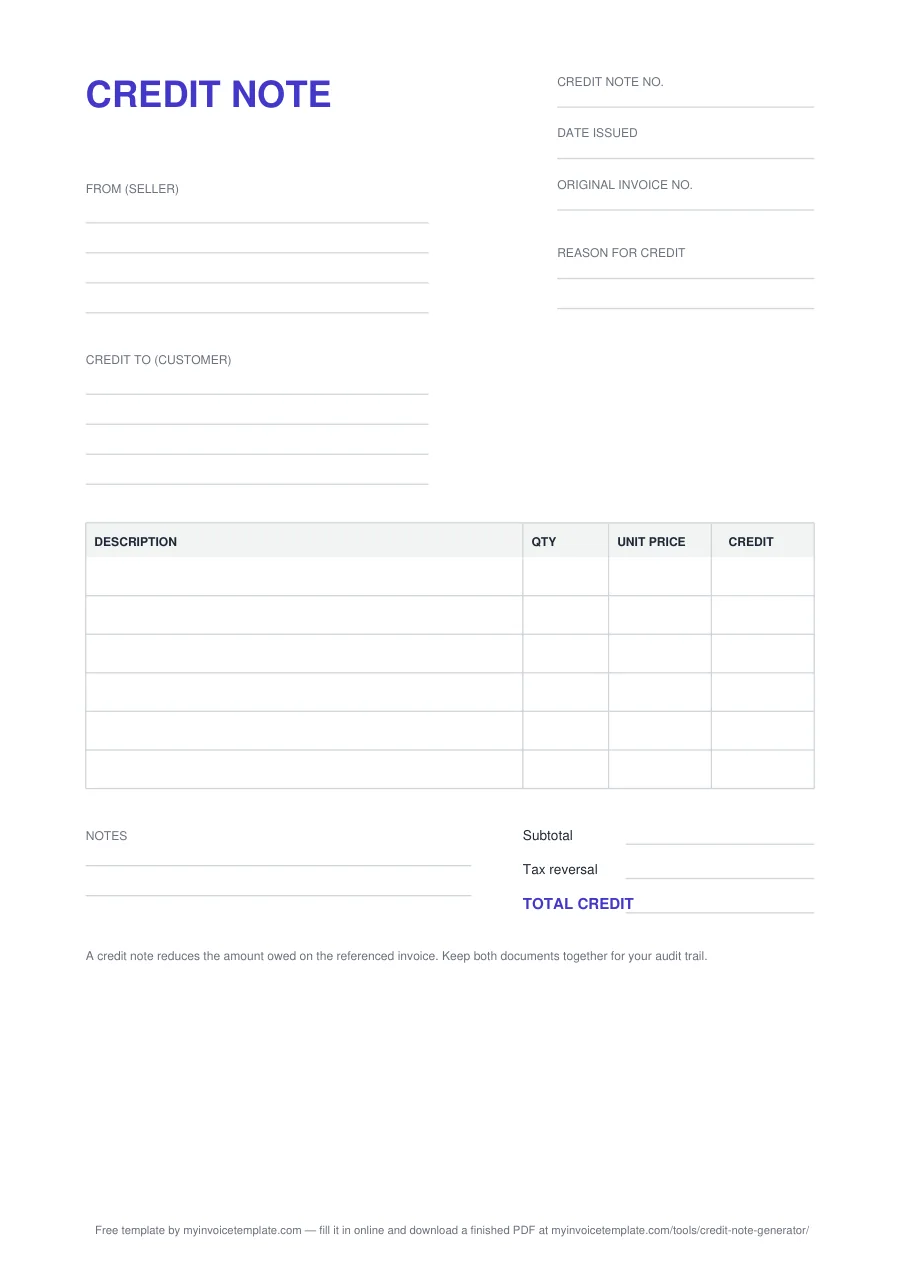
- Issue the credit memo. It gets its own number and quotes the original invoice number, the credited lines and the reason.
- Apply it. The credit reduces the open invoice; if the invoice is already paid, it is set against a future invoice or refunded. HMRC’s VAT guidance describes the credit as a claim “either to be refunded or offset against the value of future supplies” (VAT Notice 700, para 18.2.3).
Customer credit memo, or a credit memo on an invoice
Both phrases describe the same thing from the seller’s side: a credit memo issued to a customer and recorded against the invoice it names. It lowers that customer’s balance in accounts receivable until the credit is used or refunded.
When to Issue a Credit Memo (6 Common Scenarios)
A credit memo should be issued whenever you need to reduce the amount a customer owes after an invoice has been finalized. Here are the most common scenarios:
1. Billing Errors & Overcharges
You accidentally charged $1,200 instead of $1,000. Issue a credit memo for $200 to correct the overcharge.
2. Product Returns (RMA)
Customer returns defective goods. Issue a credit memo to reduce their balance and update inventory.
3. Service Level Failures
You didn't meet the SLA (99.9% uptime, but delivered 98%). Issue a credit memo for the agreed penalty.
4. Post-Invoice Discounts
Customer qualifies for early payment discount after invoice was sent. Issue credit memo for discount amount.
5. Negotiated Price Reductions
After invoicing, you agree to a lower price. Issue a credit memo for the difference.
6. Duplicate Billing Corrections
You accidentally invoiced the same item twice. Issue a full credit memo for the duplicate.
Credit Memo vs Credit Note vs Credit Invoice (and vs an Invoice)
These are naming differences, not different documents. An invoice asks for payment; a credit memo, credit note or credit invoice reduces it.
Swipe left/right to view full comparison
| Name | Where you see it | What it does |
|---|---|---|
| Credit memo (credit memorandum) | Usual US term | Reduces what the customer owes on an invoice |
| Credit note | Usual UK term; also the term HMRC’s VAT guidance and India’s GST law (CGST Act, section 34) use | The same |
| Credit invoice | Another name some businesses and software use | The same |
| Invoice | Everywhere | Asks the customer to pay |
The Cambridge Business English Dictionary lists “credit note” as the UK word, with “US credit memo” (Cambridge Dictionary).
For the fields a credit note has, see the credit note format, field by field; for a blank file headed CREDIT MEMO, see the credit memo template.
Credit Memo vs Refund vs Debit Memo: What's the Difference?
These three terms often cause confusion. Here's a clear breakdown:
Swipe left/right to view full comparison
| Feature | Credit Memo | Cash Refund | Debit Memo |
|---|---|---|---|
| Definition | Reduces customer's balance (no cash moves) | Returns cash to customer | Increases customer's balance (they owe more) |
| Cash Flow Impact | None - non-cash transaction | Cash outflow | None - non-cash transaction |
| Balance Sheet | Reduces Accounts Receivable | Reduces Cash | Increases Accounts Receivable |
| Common Use | B2B with payment terms (Net 30) | B2C or immediate settlements | Additional charges after invoice |
| Example | "We credited $200 to your account" | "We refunded $200 to your card" | "We added $50 shipping to your invoice" |
Decision Tree: Which Document Should You Use?
Q: Do you need to reduce or increase what the customer owes?
Q: Has the customer already paid the invoice?
Credit Memo in Accounting
For the seller, a credit memo lowers net sales. IRS Publication 334 says: “Credits you allow customers for returned merchandise and any other allowances you make on sales are deductions from gross sales in figuring net sales” (IRS Publication 334). It also lowers accounts receivable, or cash when the credit is refunded (OpenStax Principles of Accounting, section 6.4).
For the buyer, purchases go down: “You must deduct all returns and allowances from your total purchases during the year” (IRS Publication 334). Where VAT applies, the tax is adjusted on both sides: for UK VAT, HMRC says that unless both parties agree not to (possible only when the customer can reclaim all the VAT), “you should both adjust the original VAT charge” (VAT Notice 700, para 18.2.1).
How to Write a Credit Memo (Step-by-Step)
These steps use the free Credit Note Generator. Its Document Title is free text, so the PDF heading can read CREDIT MEMO; the other printed labels stay “Credit Note No.”, “Credit To” and “TOTAL CREDIT”, and amounts print as positive figures. For a blank file headed CREDIT MEMO, use the credit memo template.
 1 2 3 4
 Set the heading, number and date
Open the Credit Note Generator and type CREDIT MEMO into Document Title (free text). In Credit Note # enter the next number in your own credit memo series, kept separate from your invoice numbers (for example CM-1001), and set the Date.
Name the original invoice
In Original Invoice Reference type the line to print under the title, for example 'Credit applied against invoice INV-2045'.
List the credited lines and any tax
Add one line per credited item with its quantity and price, as positive numbers. The tax row starts as 'Tax' at 0: enter your own tax name and the rate the original invoice charged, or leave it at 0.
Give the reason and send it
Write the reason in Notes (printed as 'Reason / Notes'), download the PDF, send it to the customer and keep a copy with the original invoice.
Ready to write your credit memo? For corporate billing workflows, also see our corporate invoice generator.
Open the Credit Note GeneratorCommon Credit Memo Mistakes to Avoid
Deleting the Original Invoice
Problem: The record of what was billed, and why it changed, disappears. This applies to all invoice types, including commercial invoices.
Solution: Always issue a credit memo instead of deleting.
Wrong Numbering Sequence
Problem: Using invoice numbers for credit memos causes confusion.
Solution: Use separate sequence (CN-2026-001, CN-2026-002). Our invoice numbering guide covers numbering formats and the official rules.
Missing Original Invoice Reference
Problem: Auditors can't trace the correction.
Solution: Always include "Credit against Invoice #INV-XXX".
Tax Calculation Errors
Problem: Crediting wrong tax amount causes VAT/GST issues.
Solution: Calculate tax reversal on the credited line items only.
For Accountants: Sources and Details
Expand below for the official texts this guide relies on. Each one is quoted and linked.
🇬🇧 UK VAT: what a valid credit note must show
HMRC VAT Notice 700, paragraph 18.2.3: “To be valid for VAT purposes a credit note must: reflect a genuine mistake or overcharge or an agreed reduction in the value of the supply, and be issued within 14 days of the refund payment being made to the customer”. The same paragraph lists the details it must show, including the identifying number and date of issue, the supplier’s VAT registration number, the rate and amount of VAT credited, and the number and date of the original VAT invoice.
Source: HMRC VAT Notice 700, section 18 (page last updated 25 June 2026; checked 25 September 2026). Template: UK VAT credit note.
📊 IAS 10: Events after the reporting period
A credit memo issued after the year-end, but before the accounts are approved, raises the question IAS 10 answers. Its paragraph 3 reads:
Paragraph 8: “An entity shall adjust the amounts recognised in its financial statements to reflect adjusting events after the reporting period.” Source: IAS 10 as adopted in the EU, Commission Regulation (EU) 2023/1803.
⏱️ Time limits for correcting tax (UK VAT, US income tax)
| Where | What it covers | The official text |
|---|---|---|
| United Kingdom (HMRC) | Correcting VAT errors | “The time limit for error corrections is 4 years from the: end of the prescribed accounting period in which the error occurred for under-declared and over-declared output tax and over-claimed input tax” (VAT Notice 700/45, para 4.7) |
| United States (IRS) | Claiming a federal income tax credit or refund | “generally the later of these 2 dates: 3 years from the date you filed your federal income tax return, or 2 years from the date you paid the tax” (IRS, Time you can claim a credit or refund) |
Checked 25 September 2026. These are general tax-correction limits, not rules about credit memos themselves.
Frequently Asked Questions
What is a credit memo in simple terms?
A credit memo is a document that reduces the amount a customer owes to a seller. It's issued when an invoice needs to be corrected - for example, if you overcharged a customer, they returned goods, or you agreed to a discount after sending the invoice.
Can I delete an invoice instead of issuing a credit memo?
Correct it with a credit memo instead. The credit memo names the original invoice and records the reduction and the reason, so the invoice, the correction and why it was made all stay on record. In EU VAT law, any document that amends and refers specifically and unambiguously to the initial invoice is treated as an invoice (Directive 2006/112/EC, Art. 219).
What's the difference between a credit memo and a refund?
A credit memo reduces what the customer owes; no money moves because of it. A refund pays money back. If the customer has already paid, the credit on the memo is either refunded as a separate payment or set against future invoices; HMRC's VAT guidance describes a credit note as a claim 'either to be refunded or offset against the value of future supplies' (VAT Notice 700, para 18.2.3).
What information should a credit memo contain?
Our credit memo and credit note templates carry a title that says what the document is, its own number, the issue date, the seller and the customer, the number of the original invoice, the reason, the credited lines with amounts, any tax credited and the total credit. For UK VAT, HMRC VAT Notice 700 para 18.2.3 gives the full list, including the supplier's VAT registration number and the rate and amount of VAT credited.
How do I record a credit memo in accounting?
The seller reduces sales (through a sales returns and allowances account) and reduces accounts receivable, or cash if the credit is refunded (OpenStax Principles of Accounting, section 6.4). The buyer reduces purchases: IRS Publication 334 says 'You must deduct all returns and allowances from your total purchases during the year.' Where VAT applies, both sides normally adjust the VAT too; for UK VAT, HMRC VAT Notice 700 para 18.2.1 lets them skip it only when the customer can reclaim all the VAT and both agree. Our credit memo journal entry guide shows the entries for the seller and the buyer.
Is a credit memo the same as a credit note?
Yes, they are the same document under different names. 'Credit memo' is the usual US term and 'credit note' the usual UK term: the Cambridge Business English Dictionary lists 'credit note' with 'US credit memo'. Both reduce the amount a customer owes.
When should I issue a credit memo vs. a new invoice?
Issue a credit memo to correct an existing invoice (errors, returns, discounts). Issue a new invoice only for completely new transactions or when the original invoice hasn't been finalized yet.
How does a credit memo affect revenue?
It lowers net sales. IRS Publication 334 says: 'Credits you allow customers for returned merchandise and any other allowances you make on sales are deductions from gross sales in figuring net sales.'
Legal & Financial Disclaimer
Reference Only: This document is a technical reference for informational purposes, maintained by MyInvoiceTemplate.com. It summarizes the sources linked above and does not replace the advice of a certified tax professional in your specific jurisdiction. Accounting regulations are subject to change. Please consult your internal finance controller or external auditor before applying significant General Ledger adjustments.