
Free Non-GST Invoice Template — for Sellers Not Registered for GST or VAT
Download the non-GST invoice template
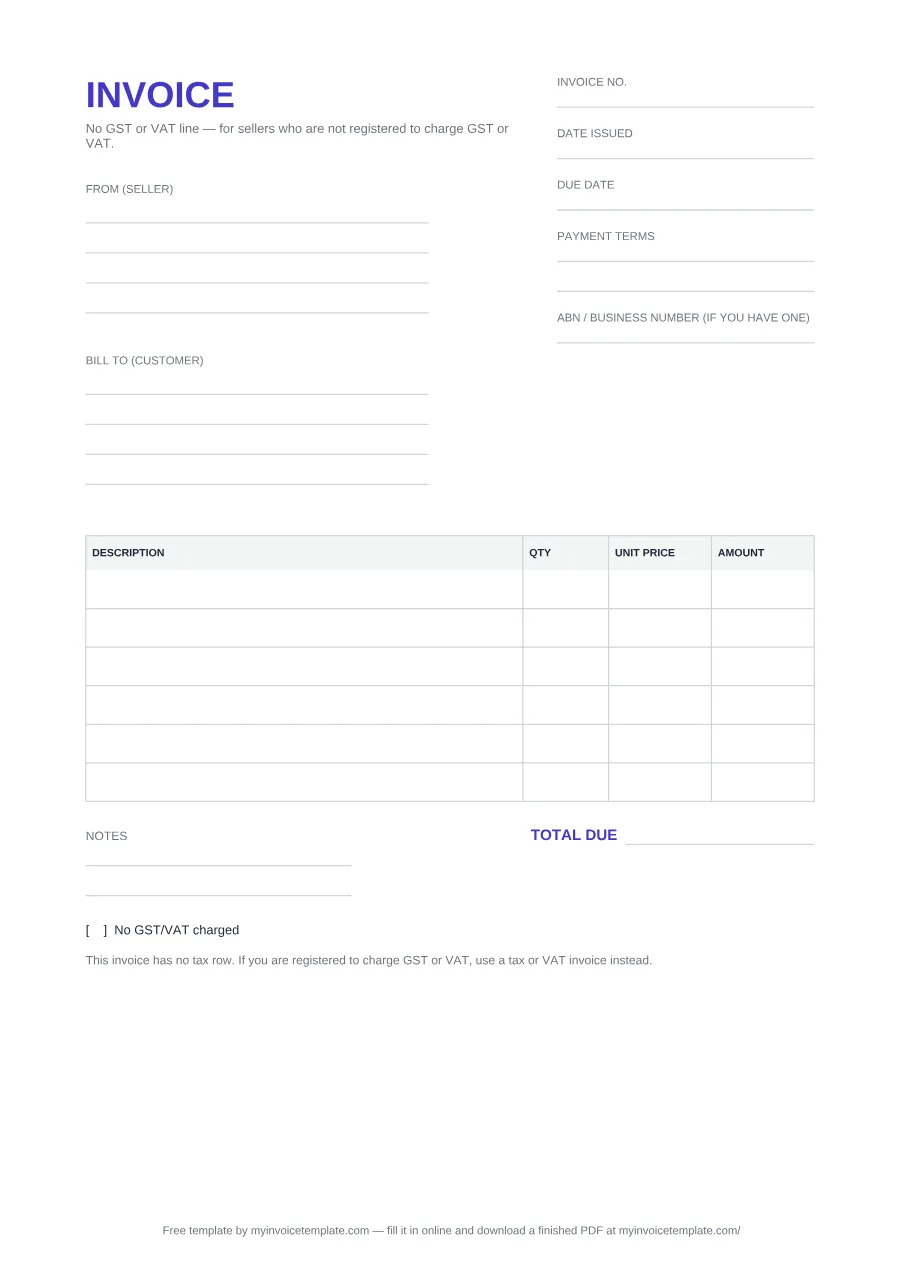
What's inside the non-GST invoice template
| Field | What to write |
|---|---|
| INVOICE (title) | The heading is the plain word "INVOICE", not "tax invoice" or "VAT invoice". Under it the PDF and Word files print: "No GST or VAT line — for sellers who are not registered to charge GST or VAT." |
| Invoice no. | Your own number for this invoice, unique within your series. |
| Date issued | The date you send the invoice. |
| Due date | The date you expect to be paid. |
| Payment terms | When and how the customer should pay, for example the number of days and your bank details. |
| ABN / business number (if you have one) | In Australia, your ABN. Elsewhere, any business or company number you trade under. Leave it blank if you have none. It is not a GST or VAT number, because an unregistered seller does not have one. |
| From (seller) | Your name or business name, address and contact details: four lines in the PDF and Word files, three in Excel. |
| Bill to (customer) | The name and address of the person or business you are billing: four lines in the PDF and Word files, three in Excel. |
| DESCRIPTION / QTY / UNIT PRICE / AMOUNT | One row per item or service. AMOUNT is QTY × UNIT PRICE. There are six rows in the PDF, seven in Word and ten in Excel. |
| Notes | Two lines for anything else, such as the date you supplied the work (PDF and Word only; the Excel file has no Notes block). |
| TOTAL DUE | The sum of the AMOUNT column. There is no Subtotal line and no Tax line: the total is what the customer pays. |
| [ ] No GST/VAT charged | An optional tick line. Tick it if you want the invoice to say so; leave it empty if you do not. |
| Bottom line | A printed reminder: "This invoice has no tax row. If you are registered to charge GST or VAT, use a tax or VAT invoice instead." |
Non-GST invoice vs tax invoice
| Country | Not registered | Registered | Source |
|---|---|---|---|
| Australia | A "regular invoice". business.gov.au: "businesses that aren’t registered for GST use invoices that don’t show any tax", headed "the word ‘invoice’ – you must not use ‘tax invoice’". | A tax invoice when "a taxable sale is more than $82.50 (including GST)" or "a customer asks for one (regardless of the amount) – you have 28 days to give it to them". | business.gov.au, How to invoice |
| United Kingdom | An invoice without VAT. GOV.UK: "Only VAT-registered businesses can issue VAT invoices." | A VAT invoice. VAT Notice 700, para 16.2.1: "Whenever you supply standard-rated or reduced-rated goods or services to another VAT-registered person, you must give that person a VAT invoice." | GOV.UK, Keeping VAT records; VAT Notice 700 |
| India | No GST on the bill. CGST Act s. 32(1): "A person who is not a registered person shall not collect in respect of any supply of goods or services or both any amount by way of tax under this Act." | A tax invoice (CGST Act s. 31; its details are in CGST Rule 46), or a bill of supply for exempt supplies or tax paid under section 10 (s. 31(3)(c) and Rule 49). | CBIC tax information portal, CGST Act ss. 31–32 |
About this page
Free to download. No signup and no email address needed.
Files generated on from one template configuration, so the three files match the field list below. The Word and Excel files were test-opened in Microsoft Word and Microsoft Excel. Each file carries one plain-text line crediting this site; in the Word and Excel files you can delete it.
The form is headed INVOICE on A4 and has no Tax or VAT line in its totals. These are its fields and what to write in each:
In the Excel file
Type into the outlined cells. AMOUNT is calculated for each row as QTY × UNIT PRICE, and TOTAL DUE is the sum of the ten rows. The sheet has no tax-rate cell, so no tax can be added by mistake.
Whether you are registered decides which document you issue. An unregistered seller must not call the document a tax invoice or add GST or VAT to it:
This template is a general business document, not legal, accounting or tax advice. GST and VAT rules change and depend on your circumstances. Check the current rules with your tax authority or a qualified adviser before you rely on them.
Who should use it
Use this template if you sell goods or services but are not registered for GST or VAT. The rules below are quoted from official sources in Australia, India, the United Kingdom and Germany.
Australia
business.gov.au sorts invoices into two types: tax invoices, which "GST-registered businesses must use", and regular invoices, where "businesses that aren’t registered for GST use invoices that don’t show any tax". It adds: "There’s no law that sets out what to put in a regular invoice." The common-practice list that follows starts with "the word ‘invoice’ – you must not use ‘tax invoice’" and includes your business name, your ABN, a unique invoice number, the date, your contact details, a description with quantity and price, when and how you want to be paid, and the buyer's name. This template has a place for each of them.
- Your ABN. The ATO says that "If the supplier does not provide an ABN and the total payment for goods and services is more than $75 (excluding GST) you generally withhold the top rate of tax from the payment". The ATO also lists some payments that are exempt from this. Quoting your ABN on the invoice gives the payer the number they need.
- The GST threshold. The ATO says you must register for GST when your business has "a GST turnover (gross income from all businesses minus GST) of $75,000 or more", or $150,000 or more for non-profit organisations. If you provide taxi or limousine travel for passengers, including ride-sourcing, you must register "regardless of your GST turnover". Once you are registered, use a tax invoice instead of this template.
India
CGST Act section 32(1): "A person who is not a registered person shall not collect in respect of any supply of goods or services or both any amount by way of tax under this Act." An unregistered seller's bill therefore carries no GST, which is what this template prints.
A bill of supply is a different document. Under section 31(3)(c) it is issued by "a registered person supplying exempted goods or services or both or paying tax under the provisions of section 10", instead of a tax invoice. CGST Rule 49 lists its details, including the supplier's GSTIN, a consecutive serial number of up to sixteen characters that is unique for a financial year, the HSN code, and a signature or digital signature. This template is not laid out as a bill of supply: it has no GSTIN, HSN or signature line.
United Kingdom and the EU
GOV.UK: "Only VAT-registered businesses can issue VAT invoices." Even after applying to register, "You cannot include VAT on your invoices until you get your VAT registration number". GOV.UK's list of what an invoice must include has "VAT amount if applicable" and also "the date the goods or service were provided (supply date)". This template has no separate supply-date field, so write that date in the description or the Notes. EU countries set their own rules for small businesses that charge no VAT. In Germany, for example, § 34a UStDV requires such an invoice to state that the small-business exemption under § 19 UStG applies, and to show your Steuernummer or a VAT or small-business ID number (the "business number" line fits it). For VAT-registered businesses that make zero-rated or exempt sales, in the UK or the EU, read the zero-rated invoice guide.
Registered, but selling GST-free or zero-rated items?
Then this template is the wrong one. A registered business keeps issuing tax or VAT invoices and shows the untaxed items on them:
- Australia (ATO): "A tax invoice that includes taxable and non-taxable items, must clearly show which items are taxable. Items are non-taxable if they are GST-free or input-taxed."
- United Kingdom (VAT Notice 700, para 16.5): on a VAT invoice that includes zero-rated or exempt supplies, "you must make sure that those items show clearly that there’s no VAT payable and you must show a separate total for their values."
Use the VAT invoice template or the VAT invoice generator instead. For the difference between zero-rated, exempt and not registered, see the zero-rated invoice guide.
Sources
Every rule on this page is quoted from these official pages, checked on September 25, 2026:
- business.gov.au: How to invoice (invoice types, regular invoices, tax invoices)
- ATO: Registering for GST (last updated 14 September 2026)
- ATO: Withholding if ABN is not provided (last updated 11 June 2025)
- ATO: Tax invoices (last updated 18 September 2026)
- GOV.UK: Charge, reclaim and record VAT — Keeping VAT records
- GOV.UK: Register for VAT
- GOV.UK: Invoices — what they must include
- HMRC: VAT guide (VAT Notice 700), paras 3.5, 16.2.1 and 16.5 (last updated 25 June 2026)
- Germany: § 34a UStDV, Rechnungen von Kleinunternehmern (gesetze-im-internet.de)
- CBIC: CGST Act 2017, section 32
- CBIC: CGST Act 2017, section 31
- CBIC: CGST Rules 2017, rule 49 (bill of supply)