
Free Estimate Generator
Create a professional job estimate with labor and material line items and a validity date, then download it as a PDF. 100% free, no signup required.
- Estimate the job with labor + materials and a "Valid Until" date.
- Send the PDF and get written approval (changes = change order).
- Invoice the same items once the work is done.
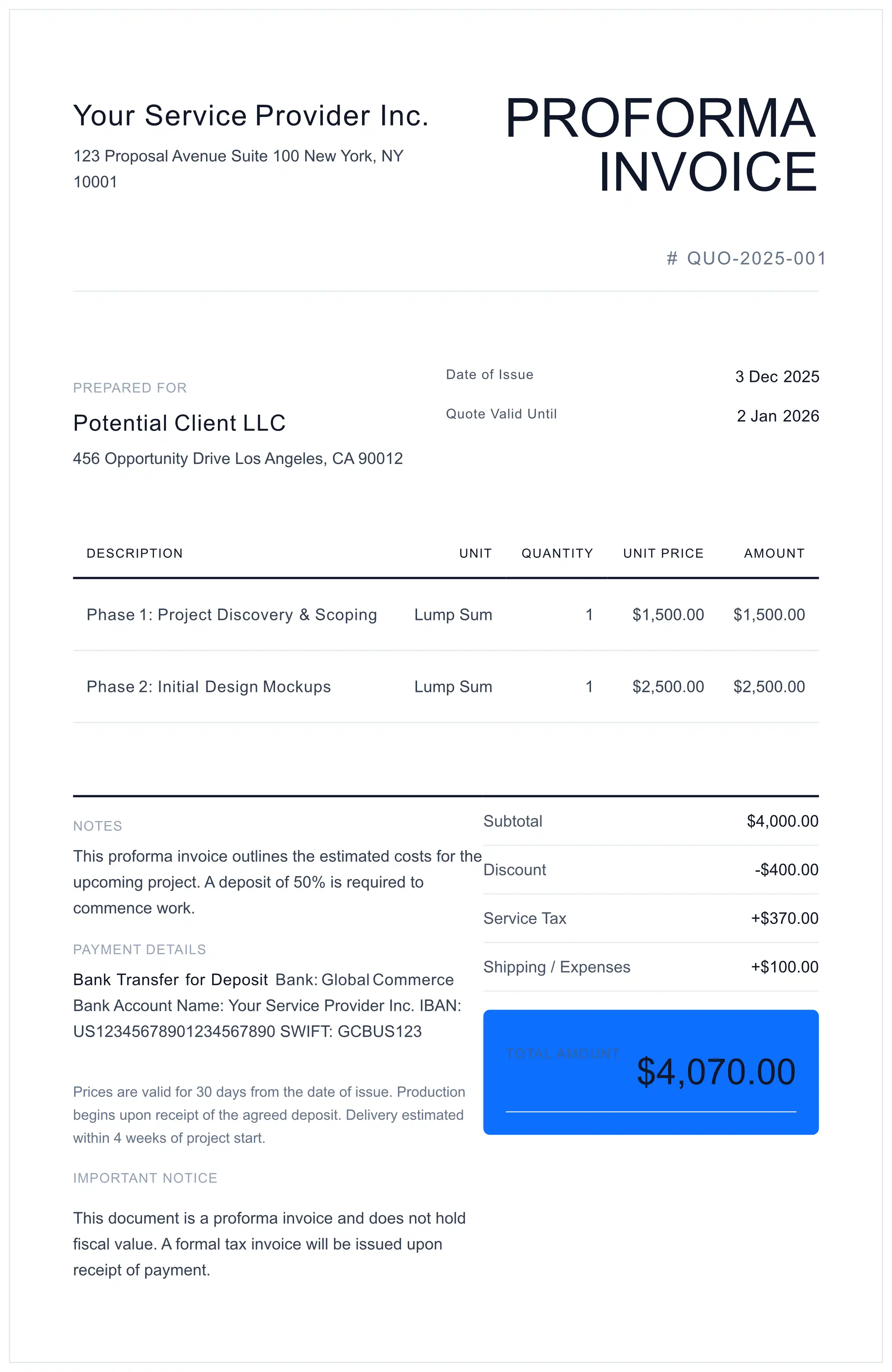
Prefer a blank estimate (quote) template? Download it as PDF, Word (DOCX), or Excel (XLSX) with working formulas — free, no signup, no email. Or fill it in online on this page and download a finished, calculated PDF.
What the estimate editor above includes
- Estimate number (EST-prefixed), client details and a 30-day validity date you can adjust
- Labor and material line items with automatic totals, on a layout clearly labeled ESTIMATE
- Live preview and free PDF download
Free to use — no signup, no account. Unmetered for normal use, with an anti-abuse cap of 20 generated PDFs per device per day. Each PDF carries a one-line credit for this site, on by default — one free checkbox in the settings turns it off. Your draft autosaves in your own browser, and when you download, its content is sent over an encrypted HTTPS connection to our server, which renders the PDF.
What is a Job Estimate?
An estimate is your good-faith approximation of what a job will cost, sent before the work begins.
Unlike an invoice, an estimate does not request payment — and unlike a firm quote, it is an approximation: the final bill can move if the scope does. In US trades (contractors, repair shops, landscapers, handymen) the estimate is the standard first document. Done right, it protects both sides:
- For the client: an itemized picture of labor and materials before committing
- For you: a documented, dated approximation — with a validity date, so old prices can't be claimed months later
- For the job: the reference every change order and the final invoice point back to
Once the client approves — ideally in writing — you do the work, record any changes as change orders, and issue a formal invoice for the same items. Need a firm, binding price instead? Use our quotation generator; for the writing craft itself, see how to write a quote.
How to Create a Job Estimate
Six steps to an estimate your client can approve on the spot.
- 1 Enter Your Business Details
Add your business name, address, and contact information — and upload your logo for a professional look.
- 2 Add the Prospective Client
Enter the client's company name and address exactly as they should appear on the offer.
- 3 Set the Validity Date
Choose how long the estimated prices stand (commonly 30 days — shorter when material prices are moving).
- 4 List Labor and Materials
Separate labor lines (hours × rate) from material lines. Itemized estimates get approved faster and disputed less.
- 5 State the Estimate Terms
Say plainly that the figure is an estimate, how scope changes are handled (written change orders), and how the client approves.
- 6 Download Your PDF
Generate and download the estimate instantly. No signup, nothing to pay.
Estimate vs Quotation vs Invoice
Three documents, three levels of commitment. Pick the one that matches yours.
| Feature | Estimate | Quotation | Invoice |
|---|---|---|---|
| When it's sent | Before the scope is final | When the scope is defined | After delivery |
| Purpose | Good-faith approximation | Firm price offer | Request for payment |
| Final price? | Can move with scope (change orders) | Fixed within the validity window | Yes — payment due |
| Typical user | US trades & repairs (contractor, auto, landscaping) | Services & B2B offers | Everyone |
| Right tool | This page | Quotation Generator | Invoice Generator |
Where a proforma invoice fits between a quotation and an invoice: proforma invoice vs invoice vs quotation (and estimate).
5 Common Estimate Mistakes
Avoid these errors to win the job and protect your margin when scope moves.
An open-ended estimate can be approved months later at outdated material prices. Always set "Valid Until".
"Job — $X" invites disputes. Separate labor from materials and spell out what counts as an extra.
Say up front that scope changes are priced in writing before the work happens — that one line prevents the end-of-job fight.
Say clearly whether prices include or exclude tax. Surprises at invoice time damage trust.
Numbered estimates (EST-2026-001) are easier to reference in change orders, invoices, and bookkeeping.
Estimate FAQ
What is the difference between an estimate, a quote, and a bid?
An estimate is a good-faith approximation of what a job will cost — the final invoice can differ if the scope changes. A quote (quotation) is a firm price offer for a defined scope, usually binding once accepted within its validity window. A bid is a formal offer in a competitive tender, common in construction and government work. This tool produces a clearly labeled estimate; if you need a firm offer, use our quotation generator.
Is an estimate legally binding?
Generally no — an estimate is an approximation, not a fixed price, and the final invoice may differ if the work changes. But the label alone does not decide it: if the document reads like a firm offer and the client accepts it, it can be treated as one, and some jurisdictions expect the final bill to stay reasonably close to a written estimate. Say clearly on the document that prices are estimates subject to scope, and confirm changes in writing.
What should a job estimate include?
Your business details, the client's details, an estimate number, the issue date, a validity date, itemized labor and materials with quantities and prices, any tax treatment, the estimated total, and a line stating that the figure is an estimate and how changes to scope will be handled.
How do I handle changes after the client approves the estimate?
Put it in writing before doing the extra work: a short change order stating what changed, the price impact, and the client's approval. Change orders referenced back to the estimate number keep the final invoice defensible and avoid the classic end-of-job dispute.
How long should an estimate stay valid?
Common validity periods are 14, 30, or 60 days. Material prices move, so trades often keep estimates shorter. This tool defaults to 30 days, and you can set the validity date to anything you like.
How do I turn an approved estimate into an invoice?
Once the client approves, deliver the work and recreate the same line items in any of our invoice generators, adding a due date and your payment terms. Reference the estimate number on the invoice so both documents tie together in your records.
Is this estimate generator really free?
Yes — no account, no email address, nothing to pay. It is free and unmetered for normal use; an anti-abuse cap of 20 PDFs per device per day (200 per IP) applies, well above ordinary use, and the blank template downloads on this page are not metered. A one-line "Created free with myinvoicetemplate.com" credit is switched on by default and one free checkbox in the settings turns it off. Your draft is stored in your own browser on this device, so download and keep the PDF you need.
Ready to Send Your Estimate?
100% free. No signup. Download your professional estimate PDF instantly.
Create Free Estimate