
Quick answer
HMRC (the UK tax authority) describes the pro-forma invoice like this: it “details the goods or services which will be supplied if payment is made” and “provides the document against which payment is invited” (VATREC9010). The Cambridge Dictionary gives two everyday senses: an invoice “asking for payment before goods or services are supplied”, and one “sent to a possible customer to give an example of prices charged” (Cambridge Dictionary).
- Quotation or estimate: an offer of a price. It does not ask for payment.
- Proforma invoice: looks like an invoice and invites payment (or approval of an exact amount) before the supply. It is not the tax invoice: in the UK, “You cannot reclaim VAT using … a pro-forma invoice” (GOV.UK).
- Invoice (final or tax invoice): “The primary function of an invoice is to provide formal confirmation of a specified supply of goods or services” (VATREC9010). Where VAT applies, this is the VAT invoice the buyer reclaims VAT with.
- Receipt: confirms a payment you have received. See invoice vs receipt.
Is a proforma legally binding? This page does not answer yes or no, because it depends on the wording, the buyer’s acceptance and the law that applies. For international sales of goods, see Is a proforma invoice legally binding?, which quotes the CISG’s offer and acceptance articles.
Quotation, proforma, invoice and advance-payment invoice side by side
Each tax cell says which jurisdiction it covers. “Ours” means the default in our own generators.
| Question | Quotation / estimate | Proforma invoice | Invoice (final / tax invoice) | Retainer or deposit invoice |
|---|---|---|---|---|
| Purpose | Offers a price for goods or work. Ours prints that it is “not an invoice or a request for payment”. | Sets out what will be supplied if payment is made, and is “the document against which payment is invited” (UK, VATREC9010). | “Formal confirmation of a specified supply of goods or services” (UK, VATREC9010). | An invoice for an advance payment before the supply. EU: an invoice is required for a “payment on account” in the cases listed in Art. 220(1)(4)-(5). |
| When issued | Before the customer decides. Ours carries a “Quote Valid Until” date, 30 days after the issue date by default. | Before the supply: “Unless payment is received, the goods or services will not be supplied” (UK, VATREC9010). | For a supply made. After a paid proforma, UK: “The tax point will follow the normal rules” (VATREC9020). | For an advance, before the work or goods are delivered. |
| Asks for payment? | No. | It can invite payment in advance (UK, VATREC9010). It is not a bill for a supply already made. | Yes, for the supply it records. | Yes, for the advance amount. |
| VAT / tax document? | No. It is not an invoice. | No. UK: it “has no place in the books of account” and should “preferably be endorsed ‘This is not a VAT invoice’” (VATREC9010). | Yes, when a VAT-registered business issues it with the required details. UK: “Only VAT-registered businesses can issue VAT invoices” (GOV.UK). EU: contents in Art. 226. | Yes, when issued as a VAT invoice. UK: a payment or VAT invoice before the supply creates a tax point for that amount (Notice 700, 14.2.2). EU: VAT is chargeable “on receipt of the payment” (Art. 65). |
| Can the buyer reclaim VAT with it? | No. UK: input tax must be “supported by a valid VAT invoice” (VATREC9020). | No. UK: “You cannot reclaim VAT using … a pro-forma invoice” (GOV.UK). | Yes, if it is a valid VAT invoice (UK, VATREC9020). EU: deduction requires holding an invoice drawn up under the Directive’s rules (Art. 178(a)). | The normal invoice rules apply, as in the previous column. |
| Numbering | Ours: QUO-<year>-001 (quotation) or EST-<year>-001 (estimate). | Ours: QUO-<year>-001, in a field labelled “Quote / Proforma #”. | EU: “a sequential number, based on one or more series, which uniquely identifies the invoice” (Art. 226(2)). Ours starts at INV-001. | Part of your invoice sequence (EU: Art. 226 applies to invoices issued under Art. 220). |
| What comes next | On acceptance, the work or delivery and an invoice, or a proforma first if you want payment up front. | UK: once paid or supplied, “a full VAT invoice must be issued within 30 days” (VATREC9020). | Payment, then a receipt if the customer wants proof of payment. | The final invoice for the balance. Our consulting, contractor and freelance invoice generators have a “Deposit Paid” line that changes the total to “Balance Due”. |
Proforma invoice vs invoice (final or tax invoice)
The short version: a proforma describes a sale that has not happened yet; the invoice records the sale. Only the invoice counts for VAT.
United Kingdom: what HMRC says
“You cannot reclaim VAT using an invalid invoice, a pro-forma invoice, a statement or a delivery note.”
GOV.UK, Keeping VAT records
“A pro-forma invoice, in normal circumstances, cannot be considered to be an accounting document and has no place in the books of account of the trader either issuing or receiving it. Pro-forma invoices should always be clearly described as such and should preferably be endorsed ‘This is not a VAT invoice’.”
HMRC VAT Traders' Records Manual, VATREC9010
“Pro-forma or similar invoices are not, therefore, acceptable evidence. … If the issuer of a pro-forma invoice subsequently receives payment and/or makes a supply, a full VAT invoice must be issued within 30 days. The tax point will follow the normal rules.”
HMRC VATREC9020
HMRC defines pro-formas as commercial documents “that contain some or all of the information normally contained on an invoice, but which do not fulfil that primary function” (VATREC9010). So a proforma can show the VAT you expect to charge, but it is not the document the VAT is reclaimed on.
European Union: what counts as an invoice
The EU VAT Directive (2006/112/EC, consolidated text of 14 April 2025) does not mention pro forma invoices at all. What it sets out is when an invoice must be issued and what it must contain, and that is what the buyer needs:
- Deduction needs an invoice. To deduct VAT on goods or services, the buyer “must hold an invoice drawn up in accordance with Sections 3 to 6 of Chapter 3 of Title XI” (Art. 178(a)).
- Advance payments need an invoice too. An invoice must be issued for “any payment on account made to him before one of the supplies of goods referred to in points (1) and (2) was carried out” and for “any payment on account made to him by another taxable person or non-taxable legal person before the provision of services was completed” (Art. 220(1)(4)-(5)).
- VAT on advances. “Where a payment is to be made on account before the goods or services are supplied, VAT shall become chargeable on receipt of the payment and on the amount received” (Art. 65).
- Invoice content. Art. 226 lists the details required on those invoices, starting with “(1) the date of issue; (2) a sequential number, based on one or more series, which uniquely identifies the invoice”.
Member States apply the Directive through national law, so check your own country’s VAT rules as well. Text quoted from EUR-Lex.
United States
The US has no national VAT. The Congressional Research Service puts it this way: “Most countries have VATs; the United States is an exception. Individual states within the United States generally impose a consumption tax in the form of a retail sales tax” (CRS, IF13037). For sales tax, follow the rules of the state concerned. US customs law does use the term: for some imports, if no invoice is available, “a pro forma (or substitute) invoice, as provided for in § 141.85, shall be filed” (19 CFR 141.83(d)). That is a customs question for goods crossing a border, covered in proforma vs commercial invoice.
India (GST)
We found no CBIC statement about proforma invoices, so we do not state a GST rule for them. The CGST Act provides for a tax invoice for the supply (section 31) and, “on receipt of advance payment”, “a receipt voucher or any other document, containing such particulars as may be prescribed, evidencing receipt of such payment” (section 31(3)(d), CBIC).
Comparing with a commercial invoice instead? A commercial invoice is the invoice for goods sold and shipped internationally. See commercial invoice vs invoice and proforma vs commercial invoice.
Proforma vs quotation and estimate
Both come before the sale. A quote or estimate offers a price so the customer can decide; a proforma is laid out like the invoice and is sent when you want payment, or sign-off on an exact amount, before you deliver.
- A quote is usually enough when the customer is still choosing, or when you will invoice after delivery on normal terms.
- Buyers ask for a proforma when they must pay before delivery and need an invoice-style document to approve or pay against: HMRC notes pro-formas are “frequently used to offer goods or services to customers who are: not known to the supplier, or of doubtful creditworthiness” (VATREC9010).
- Estimate vs quotation: our quotation and estimate generators use the same layout and print the same notice. The estimate has the title ESTIMATE and numbers starting at EST-<year>-001.
What our documents actually print
| Document | Where it prints | Exact wording |
|---|---|---|
| Proforma invoice generator (PDF) | Under the heading “Important Notice”, below the notes and terms | “This document is a proforma invoice and does not hold fiscal value. A formal tax invoice will be issued upon receipt of payment.” |
| Quotation and estimate generators (PDF) | Under the heading “Important Notice”, below the notes and terms | “This document is a quotation (estimate), not an invoice or a request for payment. Prices are valid until the date shown above; a formal invoice will be issued upon acceptance.” |
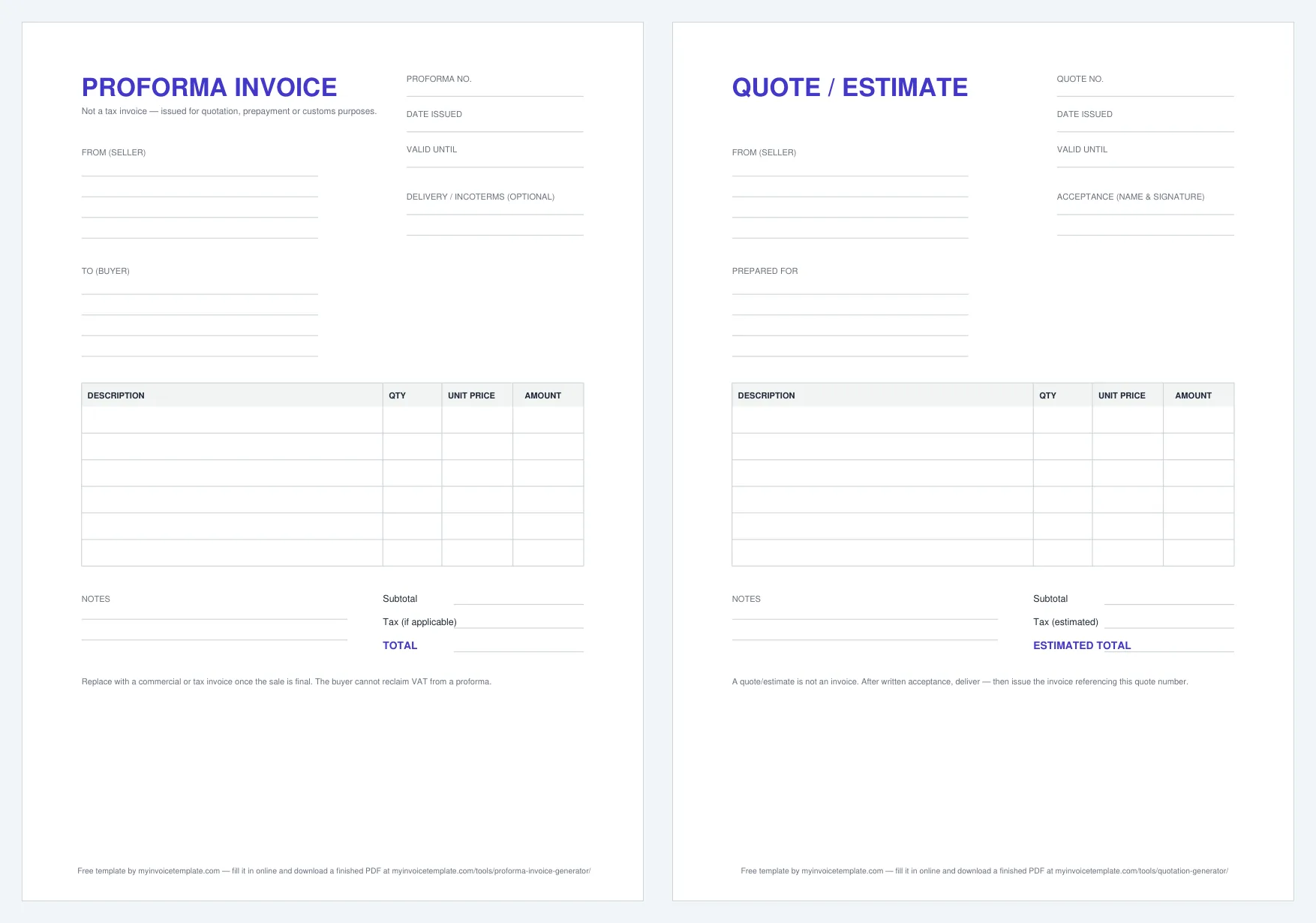
| Proforma invoice template (blank file) | Under the title | “Not a tax invoice — issued for quotation, prepayment or customs purposes.” |
| Quote / estimate template (blank file) | Below the totals | “A quote/estimate is not an invoice. After written acceptance, deliver — then issue the invoice referencing this quote number.” |
Proforma vs retainer or deposit invoice
A proforma asks for money without being an invoice. A retainer or deposit invoice is an invoice for an advance payment, so the invoice rules apply to it from the start.
- UK: if you receive a payment or issue a VAT invoice before the basic tax point, “the tax point for the amount you invoice or receive is the date you issue the invoice or receive the payment, whichever happens first” (VAT Notice 700, 14.2.2). HMRC adds: “Most deposits serve primarily as advance payments and will create tax points under paragraph 14.2.2(a) when you receive them” (14.2.3). A paid pro-forma is followed by “a full VAT invoice … within 30 days” (VATREC9020).
- EU: VAT on a payment on account becomes chargeable “on receipt of the payment and on the amount received” (Art. 65), and an invoice is required for the payment on account (Art. 220(1)(4)-(5)).
Which to send: use a proforma when you want payment before you commit to the supply and will issue the invoice once paid. Use an invoice for the deposit when you want the advance on your books as an invoiced amount. Retainer terms themselves (what the retainer covers and how it is drawn down) belong in your contract; see consulting billing best practices.
We have no separate retainer tool. For a deposit invoice, use the invoice generator. For the final bill, the consulting, contractor and freelance invoice generators have a “Deposit Paid” line; when it is above zero, the PDF shows the remaining amount as “Balance Due”.
Your customer paid the proforma: what to issue next
- Issue the invoice. UK: “a full VAT invoice must be issued within 30 days” of receiving payment or making the supply, and “The tax point will follow the normal rules” (VATREC9020). EU: an invoice is due for the payment on account (Art. 220(1)(4)-(5)); national law sets the deadline. US: there is no VAT invoice to issue; businesses normally send the final invoice for the order, marked as paid or showing the payment received.
- Give it its own invoice number. Use your invoice sequence, not the proforma number, and quote the proforma number as a reference if you like.
- Send a receipt if the customer asks for proof of payment. Use the receipt generator.
In our generators: the proforma and invoice generators keep separate drafts in your browser on this device, and no button turns a proforma into an invoice. To bill a paid proforma, open the invoice generator and enter the details again. Download and keep each PDF you need.
Which document should you send?
- The customer is still deciding and wants a price→ Quotation or estimate
- You want payment, or approval of an exact amount, before you supply→ Proforma invoice
- You have supplied the goods or services, or the proforma has been paid→ Invoice
- You want a deposit or retainer invoiced as an invoice→ Invoice for the advance
- You have been paid and the customer wants proof→ Receipt
- The goods are being shipped abroad→ Proforma vs commercial invoice
For every invoice type in one place, see types of invoices.
Frequently asked questions
What is the difference between a proforma invoice and a final invoice?
A proforma comes before the sale and describes what will be supplied if the buyer pays or accepts; HMRC calls it the document “against which payment is invited” (VATREC9010). The final invoice is issued for the supply itself, and it is the document the tax rules work from. In the UK a pro-forma invoice cannot be used to reclaim VAT, and once the issuer receives payment or makes the supply, “a full VAT invoice must be issued within 30 days” (VATREC9020). The final invoice is a new document with its own invoice number; it can quote the proforma number as a reference.
What is the difference between an estimate and a proforma invoice?
An estimate (like a quotation) offers a price for the work so the customer can decide. It does not ask for money: the estimate and quotation PDFs from our generators print “not an invoice or a request for payment”. A proforma is laid out like an invoice and is normally sent when the buyer should pay, or approve an exact amount, before you deliver. HMRC describes it as the document “against which payment is invited” and says the goods or services “will not be supplied” unless payment is received (VATREC9010). Neither one is a tax invoice.
What is the difference between a quotation and a proforma invoice?
A quotation is your offer of a price, valid until a date you set, and the customer accepts it or not. A proforma sets out the same kind of detail in invoice form and is used to invite payment in advance (HMRC VATREC9010), for example with a new customer. In practice a quote often comes first; the proforma follows when the customer agrees and you want payment before you supply. Whether either document binds anyone depends on its wording, the buyer’s acceptance and the law that applies.
Retainer invoice vs proforma invoice: which should I send?
Send a proforma when you want the customer to pay before anything is supplied and you do not want to issue an invoice yet. A retainer or deposit invoice is an invoice for an advance payment, so the invoice rules apply to it. In the EU an invoice is required for a “payment on account” in the cases listed in Directive 2006/112/EC, Art. 220(1)(4)-(5), and VAT becomes chargeable when the payment is received (Art. 65). In the UK, receiving a payment or issuing a VAT invoice before the supply creates a tax point for that amount (VAT Notice 700, 14.2.2), and HMRC says most deposits are advance payments (14.2.3). A proforma does not replace that invoice: in the UK, once a proforma is paid, a full VAT invoice must be issued within 30 days (VATREC9020).
Is a proforma invoice a tax invoice? Can it show VAT or GST?
In the UK, no. GOV.UK says: “You cannot reclaim VAT using an invalid invoice, a pro-forma invoice, a statement or a delivery note.” HMRC describes pro-formas as documents that “contain some or all of the information normally contained on an invoice” but do not confirm a supply, and says they should “preferably be endorsed ‘This is not a VAT invoice’” (VATREC9010). So a proforma can show the VAT you expect to charge, but the buyer reclaims VAT only with the VAT invoice issued later (VATREC9020). In the EU, deduction requires holding an invoice drawn up under the Directive’s invoicing rules (Art. 178(a)). For India’s GST, we found no CBIC statement on proforma invoices, so we do not state one; the CGST Act provides for a tax invoice (s. 31) and, for an advance payment, a receipt voucher or other document evidencing the payment (s. 31(3)(d)).
Can I turn a proforma into the final invoice in your generator?
Not automatically. The proforma and invoice generators keep separate drafts in your browser, and no button turns a proforma into an invoice. When the customer has paid or you have delivered, open the invoice generator, enter the details again, give the invoice its own invoice number and, if you like, quote the proforma number in the notes.
Sources
All retrieved on September 25, 2026.
- HMRC, VAT Traders' Records Manual, VATREC9010: Pro-forma invoices: Introduction
- HMRC, VATREC9020: Can a pro-forma invoice be used to account for VAT?
- GOV.UK, Charge, reclaim and record VAT: Keeping VAT records
- HMRC, VAT guide (VAT Notice 700), paragraphs 14.2.2 and 14.2.3
- Council Directive 2006/112/EC, consolidated text of 14.04.2025 (EUR-Lex): Articles 65, 178, 220 and 226
- Congressional Research Service, Value-Added Taxes (VATs) and Tariffs, IF13037 (June 18, 2025)
- eCFR, 19 CFR 141.83 (Title 19 up to date as of September 23, 2026)
- CBIC, CGST Act 2017, section 31
- Cambridge Dictionary, “pro forma invoice”
General information, not tax or legal advice. Rules differ by country and change; check with your tax authority or an adviser for your situation.