
UK Credit Note Template with VAT Fields
Download the UK credit note template
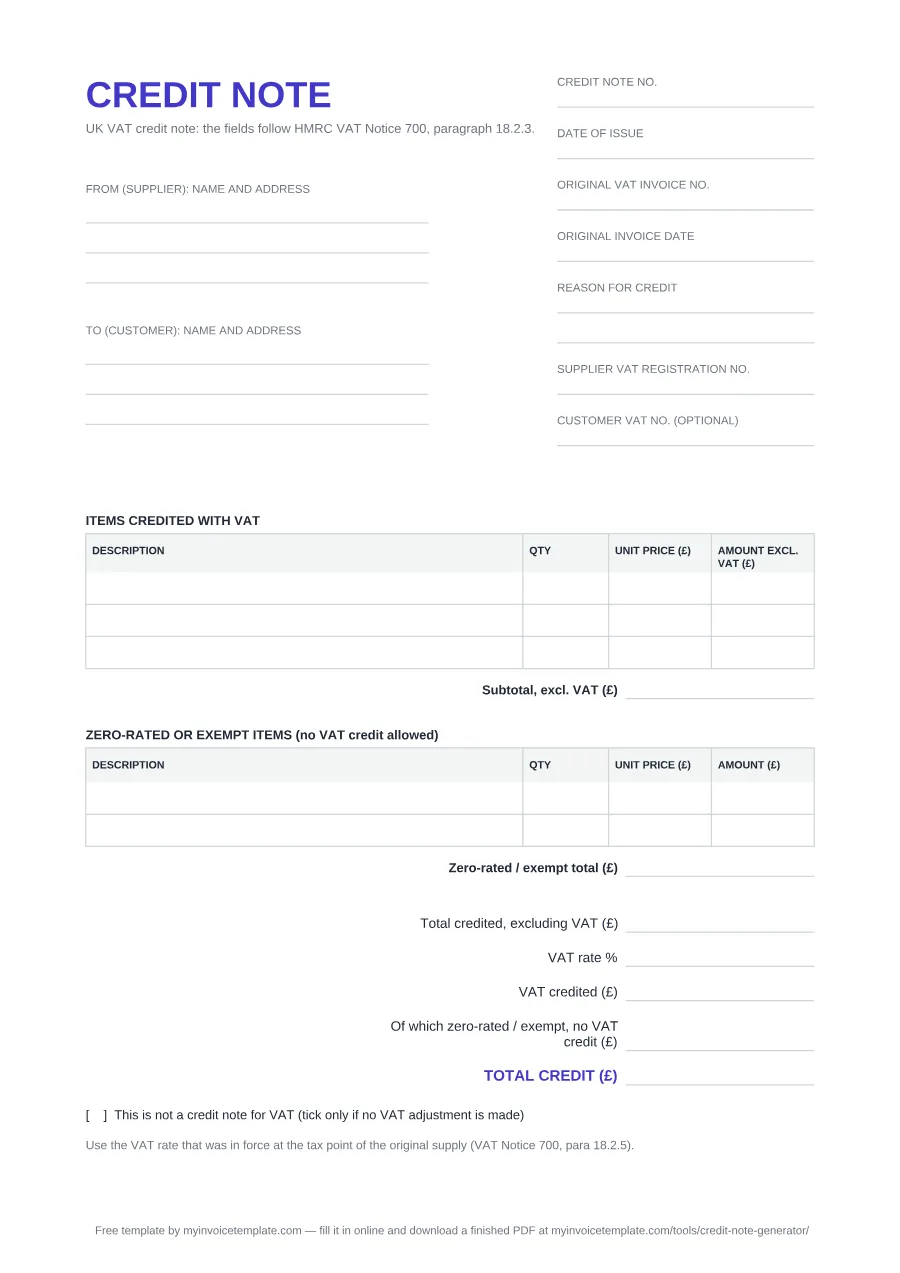
How this template covers each HMRC item
| HMRC item (18.2.3) | Field in this template |
|---|---|
| the identifying number and date of issue | Credit note no. + Date of issue |
| the name, address and registration number of the supplier | From (supplier): name and address + Supplier VAT registration no. |
| the name and address of the customer | To (customer): name and address |
| a description which identifies the goods or services for which credit is being claimed or allowed | DESCRIPTION column (both item blocks) |
| the quantity and amount for each description | QTY, UNIT PRICE (£) and AMOUNT columns |
| the total amount credited, excluding VAT | Total credited, excluding VAT (£) |
| the rate and amount of VAT credited (expressed in sterling) | VAT rate % + VAT credited (£) |
| the number and date of the original VAT invoice or invoices relating to the supply | Original VAT invoice no. + Original invoice date |
| ‘This is not a credit note for VAT’ (only when no VAT adjustment is made) | Tick line near the bottom |
Cancelling a whole invoice or crediting part of it
| Whole invoice cancelled | Part credit | |
|---|---|---|
| Typical reason | Order cancelled or all goods returned | One item returned, or a price cut agreed after delivery |
| Lines on the credit note | Every line of the original invoice | Only the line or part being credited |
| Total credited, excluding VAT | £500.00 | £50.00 |
| VAT credited at 20% | £100.00 | £10.00 |
| Total credit | £600.00 | £60.00 |
| Left to pay on the original invoice | Nothing: the invoice is fully credited | The invoice total less £60.00 |
About this page
Free, no signup. The PDF and Word files are A4. Each file carries one small line pointing to our online generator; you can delete it in the Word and Excel files.
Files generated on from one template configuration, so the files match the field list on this page. The Word and Excel files were opened and checked in Microsoft Word and Excel.
Three more parts of the layout come from HMRC's text or are clearly optional:
- Zero-rated or exempt items block, with its own total and the words "no VAT credit allowed". HMRC, paragraph 18.2.4: "Credits for zero-rated or exempt supplies included in a credit or debit note must be totalled separately and the note must show clearly that no VAT credit has been allowed for them."
- Customer VAT no. (optional). Not on the 18.2.3 list; there if you want to show it.
- Reason for credit. Not a listed detail, but paragraph 18.2.6 says "The accounts or supporting documents must make clear the nature of the adjustment and the reason for it."
What the Excel version calculates
Each line amount is quantity × unit price. Subtotal, excl. VAT sums the VAT block and Zero-rated / exempt total sums the second block. Total credited, excluding VAT adds the two. VAT credited is the VAT-block subtotal times the rate you type into the VAT rate cell (rounded to the penny), so zero-rated and exempt lines never attract VAT. TOTAL CREDIT is the total excluding VAT plus the VAT credited. The rate cell starts at 0.
UK credit note sample (filled in, £)
The same layout completed for a return of one standard-rated item and one zero-rated item. The names, numbers and the VAT registration number are made up.
| Description | Qty | Unit price (£) | Amount (£) |
|---|---|---|---|
| Items credited with VAT | |||
| Office chair (returned) | 1 | £120.00 | £120.00 |
| Zero-rated or exempt items (no VAT credit allowed) | |||
| Children's clothing (returned) | 2 | £8.00 | £16.00 |
| Total credited, excluding VAT | £136.00 | ||
| VAT rate | 20% | ||
| VAT credited | £24.00 | ||
| Of which zero-rated / exempt, no VAT credit | £16.00 | ||
| TOTAL CREDIT | £160.00 | ||
The 20% is the UK standard rate from our verified VAT rate data (GOV.UK / HMRC, gov.uk/vat-rates). The children's clothing line sits in the zero-rated block because GOV.UK gives "most food and children’s clothes" as its examples of zero-rated goods. On a real credit note, use the rate on the original invoice:
"The rate of VAT to be used for a credit or debit note is the one which was in force at the time of the tax point of the original supply."
The same layout covers both. What changes is which lines you copy from the original invoice and how much of each you credit. Figures below are placeholders worked out at the 20% standard rate; use the rate on your own invoice.
What the customer gets from the credit note
A credit note is not money back by itself. Under paragraph 18.2.3 it has to stand for a real claim by the customer, which you settle in one of two ways: you refund the amount, or the customer takes it off what they pay you for later supplies. If the original invoice has not been paid yet, the customer simply pays the invoice total minus the credit. Either way, keep the credit note with the invoice it refers to; the original invoice number and date are on it for that reason.
Not in the UK, or not charging VAT? The credit note template uses international wording on A4, and the credit memo template uses US wording on US Letter.
This template is a general-purpose business document, not tax advice. The HMRC text above was checked against VAT Notice 700 on 2026-09-25; confirm against the current version, or with an adviser, before you rely on it.
What HMRC says a valid VAT credit note must show
Paragraph 18.2.3 of HMRC's VAT guide, in full:
18.2.3 Valid credit notes
To be valid for VAT purposes a credit note must:
- reflect a genuine mistake or overcharge or an agreed reduction in the value of the supply, and be issued within 14 days of the refund payment being made to the customer
- give value to the customer, that is, represent a genuine entitlement (or claim) on the part of the customer for the amount overcharged either to be refunded or offset against the value of future supplies
- show clearly all the following details:
- the identifying number and date of issue
- the name, address and registration number of the supplier
- the name and address of the customer
- a description which identifies the goods or services for which credit is being claimed or allowed
- the quantity and amount for each description
- the total amount credited, excluding VAT
- the rate and amount of VAT credited (expressed in sterling)
- the number and date of the original VAT invoice or invoices relating to the supply — if you cannot do this (for example, because returned goods cannot be identified with a particular invoice), you must be able to satisfy HMRC by other means that you accounted for VAT on the original supply
If credit notes are issued without a VAT adjustment, they should state ‘This is not a credit note for VAT’.
Even if you and your customer decides not to adjust the VAT on credit notes which pass between you, you will still need to adjust your records of outputs and inputs in order to complete your VAT Return.
Two of these are conditions rather than fields: the credit must reflect a genuine mistake, overcharge or agreed reduction and give value to the customer, and HMRC sets the 14-day point quoted above. The template cannot meet those for you; the details list is what it lays out.
When HMRC lets you skip the VAT adjustment or the credit note
Both parties agree not to adjust (18.2.1)
"When you allow a credit or contingent discount to a customer who can reclaim all the tax on your supply as input tax, you do not have to adjust the original VAT charge provided both you and your customer agree not to do so. Otherwise, you should both adjust the original VAT charge. You should issue a credit note to your customer and keep a copy."
If you use this, tick the template's "This is not a credit note for VAT" line, as paragraph 18.2.3 asks, and leave the VAT rate and VAT credited empty.
Prompt payment discounts (18.2.2)
"If the discount is taken up within the specified time you may adjust the consideration and amount of VAT accounted for by issuing a credit note. If you choose not to use a credit note, the original invoice must have the following information:
- the discount terms (which must include, but need not be limited to, the time by which the discounted price must be paid)
- a statement that the customer can only recover as input tax the VAT paid to the supplier
HMRC recommends businesses use the following wording on the invoice: ‘A discount of X% of the full price applies if payment is made within Y days of the invoice date. No credit note will be issued. Following payment you must ensure you have only recovered the VAT actually paid’.
In the absence of a credit note, the original invoice, together with other records which show the consideration received, such as a bank statement, provide the evidence necessary to support the VAT adjustment."
Credit notes and debit notes under UK VAT
A debit note does the opposite job: it records an increase in the price. HMRC gives it its own list (18.2.4) and one accounting rule covers both documents (18.2.6).
18.2.4 Valid debit notes "To be valid for VAT purposes a debit note must:
- reflect a genuine mistake or undercharge or an agreed increase in the value of the supply, and be issued within 14 days of the increase being agreed between the supplier and the customer
- show clearly all of the following details, the: identifying number and date of issue; name, address and registration number of the supplier; name and address of the customer; identifying number and date of issue of the VAT invoice or invoices relating to the supply for which there is an increase in price; a description sufficient to identify the goods or services supplied to which the increase in price applies; the amount of the increase in price, excluding VAT; the rate and the amount of VAT debited (expressed in sterling)
Credits for zero-rated or exempt supplies included in a credit or debit note must be totalled separately and the note must show clearly that no VAT credit has been allowed for them."
18.2.6 Accounting for credit or debit notes you issue or receive "When you issue a credit note or receive a debit note, you must adjust:
- the records of the taxable supplies you have made
- your output tax
The accounts or supporting documents must make clear the nature of the adjustment and the reason for it.
If you have charged or claimed an incorrect amount of VAT and have already declared it on your VAT Return, the remainder of this section does not apply. This is because you can only correct an error in your declaration by adopting the appropriate method of error correction detailed in section 4 of How to correct VAT errors and make adjustments or claims (VAT Notice 700/45).
Where the adjustment is not in respect of an error in the amount of VAT declared on a VAT Return, you should make any VAT adjustment arising from the issue or receipt of a credit or debit note in the VAT account in the accounting period in which the increase in price or decrease in price occurs. For decreases in price this will be the accounting period where the refunded amount is paid to the customer. For increases in price this will be when the supplier and customer reach agreement over the increased value of the supply."
For a blank debit note, see the debit note template or the debit note generator. For the bookkeeping entries on both sides of a credit, including the VAT lines, see credit memo journal entries.