
Types of Invoices, With an Example of Each
13 kinds of invoice, what each one is for, who issues it and when. Where we have a blank file, you can see it; where a rule comes from tax or customs law, it is quoted from the official source (EU, UK, Singapore, New Zealand and US).
Quick answer: the 13 types at a glance
| Type | Who issues it | When | Asks for payment? | Blank file | Online maker |
|---|---|---|---|---|---|
| Standard (sales) invoice | Seller | When or after you supply goods or services | Yes | Blank invoice | Invoice generator |
| Tax / VAT / GST invoice | Seller registered for VAT or GST | For taxable sales, when the tax rules require one | Yes | VAT invoice | VAT invoice generator |
| Proforma invoice | Seller | Before the sale: for prepayment, approval or customs | Invites payment in advance; not a tax invoice | Proforma invoice | Proforma generator |
| Commercial invoice | Exporter (seller or shipper) | With goods shipped across a border | Records the sale for customs | Commercial invoice | Commercial invoice generator |
| Credit note | Seller | After an invoice, to reduce or cancel it | No: it lowers the amount owed | Credit note | Credit note generator |
| Debit note | Seller (or a buyer claiming a credit) | After an invoice, to add to the amount | Yes, for the extra amount | Debit note | Debit note generator |
| Self-billing invoice | The customer, by prior agreement | When the buyer raises the invoice for what it buys | Records what the buyer will pay | None | No maker |
| Interim (progress) invoice | Seller | During a long job, for work done so far | Yes | Contractor invoice | Contractor invoice generator |
| Final invoice | Seller | At the end of a job, for the balance | Yes | Blank invoice | Invoice generator |
| Recurring invoice | Seller | Every period for the same charge | Yes | Web development (recurring block) | No maker |
| Past-due (overdue) invoice | Seller | After the due date passes unpaid | Yes: a reminder of what is still owed | None | No maker |
| Timesheet invoice | Seller (freelancer, contractor or agency) | For hours recorded on timesheets | Yes | Recruitment (contract staffing) | No maker |
| E-invoice (structured) | Seller, through e-invoicing software or a network | Where a mandate or the customer requires it | Yes | None | No maker |
Quotes, purchase orders and receipts are not invoices; they are covered further down.
1. Standard (sales) invoice
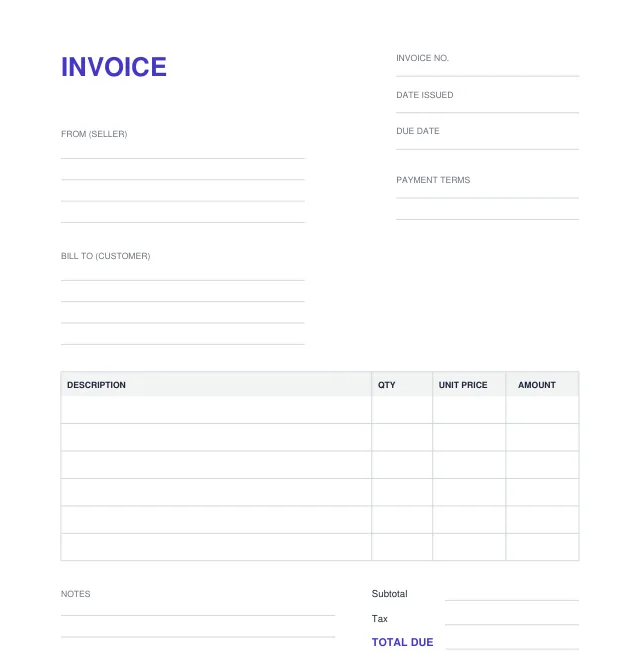
The ordinary invoice: the seller tells the buyer what was supplied, when, at what price, and when payment is due. It carries an invoice number, the date, both parties’ details, the items with quantities and prices, and the total. Most of the other types on this page are a standard invoice with something added or changed.
Blank file: blank invoice template (PDF, Word, Excel) · Online: free invoice generator · How to fill it in: how to create an invoice
2. Tax invoice / VAT invoice / GST invoice (full and simplified)
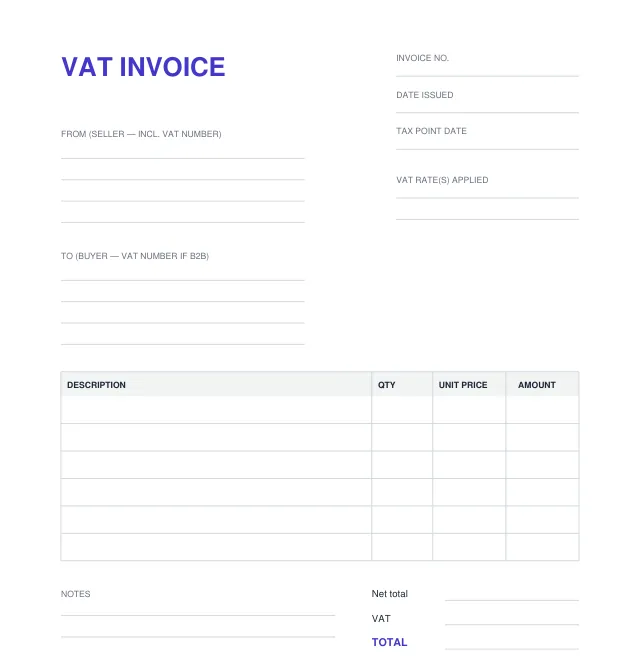
A tax (VAT) invoice is defined by the details it must carry: in the EU, Article 226 of Directive 2006/112/EC lists them (date, sequential number, VAT numbers, VAT rate and amount, and more), and in the UK HMRC lists them in VAT Notice 700/21 para 4.1. It is issued by a seller registered for VAT or GST, and it is the document the buyer’s tax claim relies on.
Blank file: VAT invoice template · Online: VAT invoice generator · Not registered? non-GST invoice template
Full and simplified tax invoices
- EU: Member States must allow a simplified invoice "where the amount of the invoice is not higher than EUR 100 or the equivalent in national currency" (Directive 2006/112/EC, Art. 220a(1)(a)). It needs at least the date of issue, the supplier’s identification, the type of goods or services, and "the VAT amount payable or the information needed to calculate it" (Art. 226b).
- UK: for a supply of "£250 or less (including VAT)" a simplified VAT invoice is enough; above £250 you must issue "either a full VAT invoice or a modified VAT invoice, showing VAT inclusive rather than VAT exclusive values" (VAT Notice 700/21, paras 4.4 and 4.5). HMRC also lists cases where you do not always have to issue a VAT invoice to a registered person, such as an invoice "only for exempt or zero-rated sales within the UK" (para 4.6).
- Singapore: "A tax invoice must be issued when your customer is GST registered", in general "within 30 days from the time of supply". You may issue a simplified tax invoice instead "if the total amount payable for your supply (including GST) does not exceed $1,000" (IRAS, Invoicing customers).
- New Zealand: "New laws, which took effect on 1 April 2023, replaced the requirement to use tax invoices with a more general requirement to provide and keep certain records known as taxable supply information", and you "do not need to change the wording of the GST documents your business uses" (IRD). Taxable supply information must be provided to GST-registered buyers within 28 days of a request for supplies over $200 (IRD, how it works).
Country-by-country details are in the VAT and GST invoicing guide; for zero-rated and exempt sales see the zero-rated invoice guide.
3. Proforma invoice
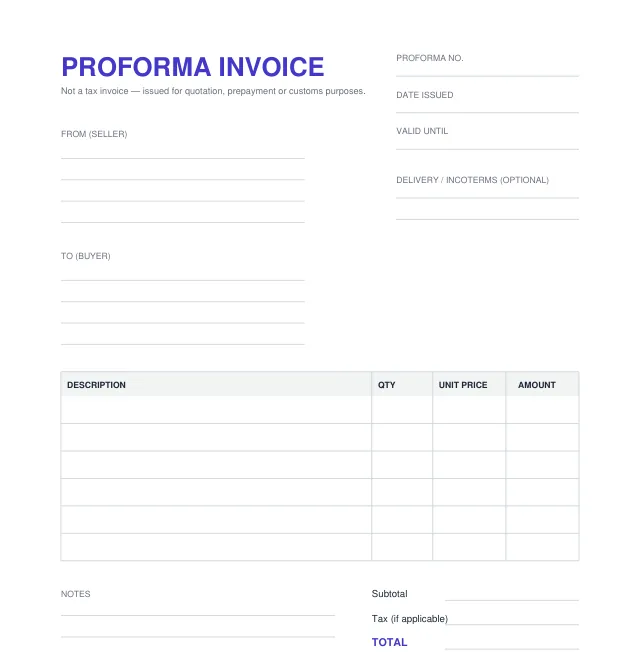
A proforma is sent before the sale, laid out like an invoice, so the buyer can pay in advance, approve an exact amount or arrange an import. It is not the tax invoice. HMRC says that pro-forma invoices "cannot be used as evidence to reclaim input tax, even if they show all the details required for a VAT invoice", and that they should be "clearly marked ‘this is not a VAT invoice’" (VAT Notice 700, para 17.3). Once the sale goes ahead, you issue the real invoice.
More: what is a proforma invoice · proforma invoice vs invoice · Blank file: proforma template · Online: proforma generator
4. Commercial invoice
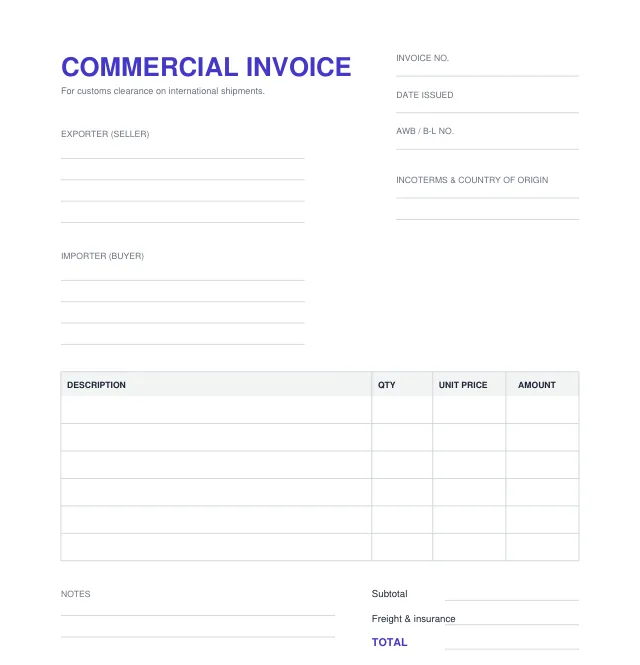
The invoice that travels with goods shipped across a border, so customs can see what is being imported, by whom and for how much. For US imports, 19 CFR 141.86(a) says: "Each invoice of imported merchandise, must set forth the following information", starting with the port of entry, the time, place and parties of the sale, "A detailed description of the merchandise", the quantities and the purchase price of each item (eCFR).
More: commercial invoice guide · commercial invoice vs invoice · Blank file: commercial invoice template · Online: commercial invoice generator
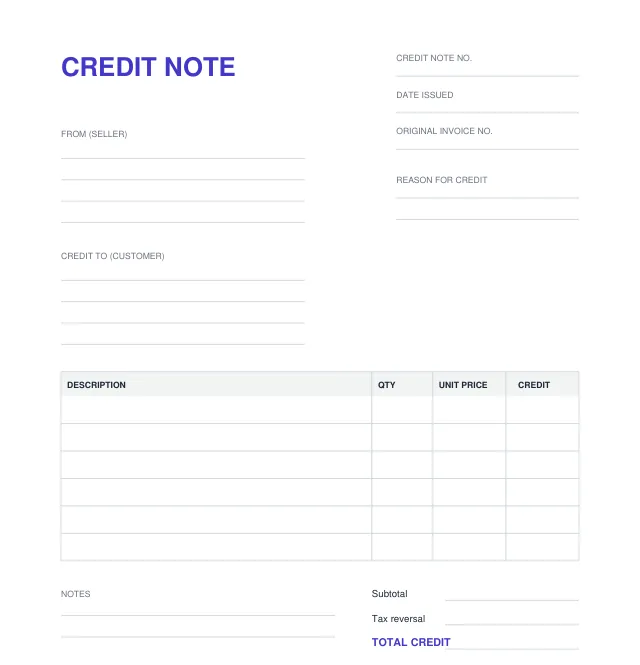
5. Credit note (credit memo)
Issued by the seller after an invoice, to reduce or cancel it: goods returned, a price error, a discount agreed later. It refers to the original invoice. EU VAT law treats it as an invoice: "Any document or message that amends and refers specifically and unambiguously to the initial invoice shall be treated as an invoice" (Directive 2006/112/EC, Art. 219). In New Zealand, credit and debit notes are now called "supply correction information" (IRD). In the US the same document is also called a credit memo.
More: guide to credit memos · Blank files: credit note template, credit memo template · Online: credit note generator
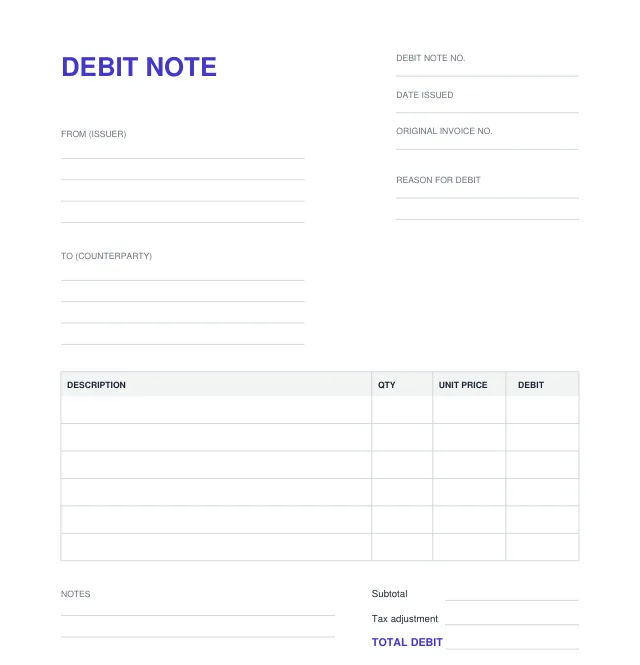
6. Debit note
The mirror of a credit note: raised after an invoice has gone out, to increase the amount owed on it, for example after an undercharge or agreed extra costs. Some buyers also use a debit note to record a credit they are owed by a supplier. Singapore’s IRAS limits the first use: "You should only issue a debit note to request for payment for transactions where no GST is charged (e.g. internal billings within the same company), or to suppliers from whom credit is due"; for other standard-rated supplies to GST-registered customers you issue a tax invoice (IRAS).
Blank file: debit note template · Online: debit note generator
7. Self-billing invoice
Here the customer draws up the invoice for what it buys, and the supplier accepts it. The EU VAT Directive allows this "where there is a prior agreement between the two parties and provided that a procedure exists for the acceptance of each invoice by the taxable person supplying the goods or services" (Art. 224), and the invoice carries "the mention ‘Self-billing’" (Art. 226(10a), EUR-Lex). In the UK, "VAT self-billed invoices must include the reference ‘self billing’" (VAT Notice 700, para 17.4.1).
No example file and no maker here: a self-billing invoice is drawn up by the buyer, not by the supplier. For the rules in New Zealand, Australia, the UK and the EU, see buyer-created (recipient-created) tax invoices.
8. Interim (progress) invoice
On a long job, an interim or progress invoice bills part of the contract before the whole job is finished: a completed stage, or the work done in a period. Each one should name the contract or project and the stage it covers, so the customer can match it to what was agreed.
No dedicated progress-billing maker. Bill one stage at a time with the contractor invoice template, or online with the contractor invoice generator, which has a Payment Schedule / Milestones field; the invoicing guide for contractors covers the kinds of contractor invoices.
9. Final invoice
The last invoice on a job, for the balance still owed. It can list the total contract amount, what was already invoiced or paid (interim invoices, deposits) and the amount now due. The term is also used for the real invoice issued after a proforma; see proforma invoice vs invoice.
Blank file: blank invoice template · Online: free invoice generator
10. Recurring invoice
The same charge billed at regular intervals, such as a monthly retainer, a subscription or hosting. Each period gets its own invoice with its own number and date, even when the amount does not change.
No recurring maker: our generators make one invoice at a time and do not schedule or send invoices. The web development invoice template has a separate block for monthly charges.
11. Past-due (overdue) invoice
An invoice that was not paid by its due date. A past-due notice re-sends it, or a statement of it, marked overdue, with the original invoice number, the due date and the amount still outstanding. Whether you can add a late fee or interest depends on your agreement and the law where you trade.
No past-due maker. The late fee calculator works out interest by US state, and the demand letter generator drafts a payment demand.
12. Timesheet invoice
Bills time recorded on timesheets, which the client may need to approve first: one line per person per period, hours × rate. Staffing agencies, contractors and freelancers billing by the hour use it.
No dedicated maker. The recruitment invoice template has a contract-staffing section for approved timesheets, and the freelance invoice template bills hours × rate. In the free invoice generator, enter the hours as the quantity.
13. E-invoice (structured electronic invoice)
An e-invoice in the sense of today’s mandates is a structured data file that the buyer’s software can read automatically, not a picture of an invoice. The EU VAT Directive currently defines an electronic invoice as one "issued and received in any electronic format" (Art. 217), which an emailed PDF meets. Directive (EU) 2025/516 replaces that definition, with effect from 1 July 2030, with one that requires a "structured electronic format which allows for its automated and electronic processing" (EUR-Lex).
Our PDFs are not structured e-invoices. The generators and templates on this site produce PDF, Word and Excel files. To see which countries require structured e-invoices, and from when, see the e-invoicing mandates tracker.
Documents that are not invoices
- Quote or estimate: offers a price before any work, so the customer can decide; it does not ask for payment. See how to write a quote, the quotation template and the estimate generator.
- Purchase order: issued by the buyer to order goods or services. Our template calls it a "Buyer-issued order to a vendor — an offer to purchase, not an invoice". See the purchase order template and the purchase order generator.
- Receipt: proof that a payment was received, issued after the invoice is paid. See invoice vs receipt, the receipt template and the receipt generator.
For the difference between a proforma and a commercial invoice, see proforma vs commercial invoice.
Templates by trade
These are layouts for particular lines of work, not separate invoice types: each one is a standard invoice with the fields that trade needs.
How to choose the right type
- You supplied goods or services and want to be paid: a standard invoice, or a tax/VAT invoice if you are registered and the sale is taxable.
- You want payment or approval before you supply: a proforma invoice (or a quote, if you are only offering a price).
- You are shipping goods across a border: a commercial invoice for customs.
- An invoice you sent was too high, or goods came back: a credit note. Too low: a debit note or a new invoice.
- Your customer raises the invoices for you, by agreement: self-billing.
- A long job is billed in stages: interim invoices, then a final invoice.
- The same charge every period: a recurring invoice each period.
- An invoice is unpaid after its due date: a past-due notice.
- You bill hours from approved timesheets: a timesheet invoice.
- A mandate or your customer requires a structured format: an e-invoice, sent through e-invoicing software.
- You have been paid: a receipt.
Frequently asked questions
How many types of invoices are there?
There is no official list. This guide covers 13 kinds you are likely to meet: the standard sales invoice, the tax or VAT invoice (full and simplified), the proforma, the commercial invoice, credit and debit notes, the self-billing invoice, interim and final invoices, recurring and past-due invoices, the timesheet invoice and the structured e-invoice. Quotes, purchase orders and receipts are related documents but not invoices.
What is the difference between an invoice and a tax invoice?
A tax (VAT) invoice is defined by the details it must carry: in the EU, Article 226 of Directive 2006/112/EC lists them (date, sequential number, VAT numbers, VAT rate and amount, and more), and in the UK HMRC lists them in VAT Notice 700/21 para 4.1. An ordinary sales invoice asks for payment but does not have to meet those rules; a tax invoice is issued by a registered seller where the tax rules require one.
What is a simplified invoice?
A shorter tax invoice allowed for small amounts. EU: Member States must allow one "where the amount of the invoice is not higher than EUR 100 or the equivalent in national currency" (Directive 2006/112/EC, Art. 220a). UK: for a supply of "£250 or less (including VAT)" (VAT Notice 700/21, paras 4.4 and 4.5). Singapore: "if the total amount payable for your supply (including GST) does not exceed $1,000" (IRAS).
Is a proforma invoice a real invoice?
It looks like one but it is not the tax invoice. HMRC says that pro-forma invoices "cannot be used as evidence to reclaim input tax, even if they show all the details required for a VAT invoice" and should be "clearly marked ‘this is not a VAT invoice’" (VAT Notice 700, para 17.3).
Is a credit note a type of invoice?
In EU VAT law it counts as one: "Any document or message that amends and refers specifically and unambiguously to the initial invoice shall be treated as an invoice" (Directive 2006/112/EC, Art. 219). In New Zealand, credit and debit notes are now called "supply correction information" (IRD).
Can the customer create the invoice?
Yes, under a self-billing arrangement. The EU VAT Directive allows it "where there is a prior agreement between the two parties and provided that a procedure exists for the acceptance of each invoice" (Art. 224), and such an invoice carries the mention "Self-billing" (Art. 226(10a)). In the UK, "VAT self-billed invoices must include the reference ‘self billing’" (VAT Notice 700, para 17.4.1).
Is a PDF invoice an e-invoice?
Not in the sense that e-invoicing mandates use. Today the EU VAT Directive defines an electronic invoice as one "issued and received in any electronic format" (Art. 217), which a PDF sent by email meets. Directive (EU) 2025/516 replaces that definition, with effect from 1 July 2030, with one that requires a "structured electronic format which allows for its automated and electronic processing". A PDF is not a structured format. Our generators and templates produce PDF, Word and Excel files, not structured e-invoices.
Which of these can I make for free on this site?
Blank templates and online makers exist for the standard invoice, the VAT invoice, the proforma, the commercial invoice, the credit note and the debit note, and blank templates for several trades. There is no dedicated maker for self-billing, interim, recurring, past-due, timesheet or structured e-invoices. The online generators are free and unmetered for normal use; an anti-abuse cap of 20 PDFs per device per day (200 per IP) applies, well above ordinary use, and blank template file downloads are not metered. A one-line "Created free with myinvoicetemplate.com" credit is switched on by default and one free checkbox in the settings turns it off. Your draft is stored in your own browser on this device, so download and keep the PDF you need.
Sources
Every legal rule on this page is quoted from these official sources, checked on September 25, 2026:
- HMRC: VAT guide (VAT Notice 700), paras 17.3 (pro-forma invoices) and 17.4.1 (self-billing); last updated 25 June 2026
- HMRC: Record keeping for VAT (VAT Notice 700/21), paras 4.1, 4.4, 4.5 and 4.6; last updated 18 March 2024
- Council Directive 2006/112/EC (EUR-Lex consolidated text of 14.04.2025), Articles 217, 219, 220a, 224, 226 and 226b
- Council Directive (EU) 2025/516, Article 5(4): the new Article 217, with effect from 1 July 2030
- Inland Revenue (NZ): Taxable supply information for GST and How taxable supply information for GST works
- IRAS (Singapore): Invoicing customers; last updated 29 July 2026
- 19 CFR 141.86, Contents of invoices and general requirements (eCFR)
The example images are the top of page 1 of our own blank templates, rendered for this page. This guide is general information, not legal or tax advice.